Socio Today
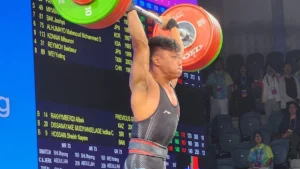
Indonesian weightlifting sensation Rahmat Erwin Abdullah has once again etched his name into the annals of sporting history by capturing the gold medal at the 2026 Asian Games. Competing in the fiercely contested men’s 75-kilogram division on Saturday, September 26, 2026, Abdullah delivered a masterclass in tactical execution and raw power, successfully completing all of his lifting attempts across both the snatch and clean and jerk categories. This triumph not only solidifies his status as one of the preeminent pound-for-pound weightlifters in the world today, but it also marks a successful defense of the continental title he originally claimed during the previous edition of the Games.
The victory serves as a monumental morale boost for the Indonesian contingent, providing the nation with its second gold medal of the ongoing multi-sport quadrennial extravaganza in Aichi-Nagoya, Japan. Abdullah’s flawless performance on the platform demonstrated his exceptional composure under pressure, tactical brilliance from his coaching staff, and an unyielding commitment to physical conditioning that has become the hallmark of his illustrious career.
A Masterclass on the Platform: The Chronology of Triumph
The competition in the men’s 75kg category was expected to be a grueling battle of attrition, featuring some of the strongest athletes from across the Asian continent. However, Rahmat Erwin Abdullah approached the competition with an air of absolute authority from the moment he stepped onto the platform.
The event commenced with the snatch discipline, where the Indonesian lifter immediately set a high standard. In his first attempt, Abdullah confidently hoisted 155 kilograms, establishing an early psychological advantage over his rivals. Refusing to rest on his laurels, he returned to the platform for his second attempt, successfully negotiating 158 kilograms. Not content with merely leading, Abdullah closed out his snatch rotation by masterfully locking out 160 kilograms, a feat that placed him in an optimal position heading into his favored discipline, the clean and jerk.
With the conclusion of the snatch, the focus shifted to the clean and jerk, where Abdullah has historically broken world records and dominated international fields. Despite holding a formidable advantage, the Indonesian camp maintained a conservative yet effective strategy. Abdullah bypassed lower weights to conserve energy and target specific tactical advantages, stepping up for his first clean and jerk attempt at a staggering 201 kilograms—a weight that many competitors use as their maximum limit. He executed the lift with textbook precision.
With victory all but secured, Abdullah opted for 206 kilograms on his final attempt. Demonstrating extraordinary core stability and leg drive, he successfully hoisted the immense barbell overhead, completing a clean sweep of his designated lifts and finishing the competition with a combined total of 365 kilograms. This flawless series of lifts underscored not only his physical superiority but also his mental fortitude, having executed every single technical demand placed upon him by his coaches throughout the afternoon.
Fierce Rivalry and the Podium Standings
While Abdullah claimed the top step of the podium, the battle for the remaining medals was a tense affair that highlighted the immense depth of Asian weightlifting. Securing the silver medal was Thailand’s formidable lifter, Weeraphon Wichuma, who pushed the Indonesian champion throughout the session. Wichuma put together a stellar performance, compiling a total of 365 kilograms—mirroring Abdullah’s final tally in terms of overall weight class competitiveness, though tie-breaker metrics and body weight specifications ultimately defined the final standings. Wichuma’s silver-winning effort was built upon a 160kg snatch and a brilliant 205kg clean and jerk, proving that the Thai athlete is operating at the absolute peak of his athletic powers.
Meanwhile, the bronze medal was fiercely contested and ultimately claimed by North Korea’s Chong Song Ri. The North Korean lifter showcased his explosive strength early in the competition by launching an impressive 162kg snatch, which briefly gave him the psychological upper hand in the opening half of the event. However, a comparatively conservative 195kg clean and jerk brought his overall total to 357 kilograms. While it was not enough to surpass Abdullah or Wichuma, Chong’s performance was more than sufficient to secure a hard-earned spot on the podium, rounding out a truly world-class medal ceremony that featured some of the heaviest lifting ever recorded in this weight division at the continental level.
Contextualizing the Legacy: From Hangzhou to Aichi-Nagoya
To fully appreciate the magnitude of Rahmat Erwin Abdullah’s latest triumph, one must look back at his remarkable trajectory over the preceding years. At the previous Asian Games held in Hangzhou, China, in 2023, Abdullah competed in the men’s 73kg division and delivered a performance that similarly electrified the sporting world.
During that campaign, Abdullah served as a vital anchor for the Indonesian contingent, securing the nation’s fifth gold medal of the Games. In Hangzhou, he totaled 359 kilograms, a remarkable sum composed of a 158kg snatch and a 201kg clean and jerk. His ability to transition across weight categories—navigating international regulatory adjustments and physical conditioning protocols to move up to the 75kg class for the 2026 edition—speaks volumes about his adaptability and the meticulous scientific approach employed by his support staff, led by his father and former national coach, Erwin Abdullah.
Defending a continental title in weightlifting is notoriously difficult due to the constant emergence of young talent and the shifting geopolitical landscape of the sport in Asia, where nations like China, North Korea, Thailand, and Kazakhstan constantly push the boundaries of human strength. By successfully defending his crown across different weight classes in consecutive editions of the Asian Games, Abdullah has cemented his status as a generational talent, matching the consistency required of true sporting dynasties.
Strategic Implications and the Broader Impact for Indonesian Sport
Beyond individual accolades, Rahmat Erwin Abdullah’s gold medal carries profound strategic and psychological implications for the Indonesian contingent at the 2026 Asian Games. Multi-sport events of this scale often hinge on momentum; early victories by established stars tend to alleviate pressure across other disciplines, inspiring younger athletes and validation for national training programs.
The gold won by Abdullah is only Indonesia’s second of the current campaign, making its timing critically important. As the nation seeks to establish a respectable standing on the final medal table amidst fierce competition from regional powerhouses, weightlifting continues to prove its status as Indonesia’s most reliable medal factory on the international stage. Historically, sports like badminton, weightlifting, and pencak silat have borne the heaviest burdens of expectation, and Abdullah’s victory reaffirms that the nation’s elite training systems are capable of producing world-class champions who can peak at the exact moment required.
Furthermore, Abdullah’s success is expected to provide a substantial grassroots boost to weightlifting within the archipelago. In a country traditionally obsessed with badminton and football, weightlifters like Abdullah and Olympic champion Eko Yuli Irawan have steadily carved out a new appreciation for strength sports among the youth. The narrative of dedication, familial support, and relentless perseverance embodied by Abdullah serves as a powerful blueprint for aspiring athletes training in regional gymnasiums across Indonesia.
Official Responses and Analytical Perspectives
While formal post-match press conferences often yield standard diplomatic responses, sports analysts and officials within the Indonesian Weightlifting Association (PABSI) were quick to praise the athlete’s strategic brilliance. Observers noted that the decision to forgo high-risk initial weights in favor of a calculated, step-by-step progression demonstrated a level of maturity that separates elite champions from merely talented lifters.
"Rahmat is not just lifting weights; he is managing a complex mathematical and physiological equation in real-time," noted one senior sports analyst following the event. "His ability to adjust his mindset between the snatch—which requires immense technical fluidity—and the clean and jerk—which demands brute explosive power and ironclad psychological stability—is what makes him virtually untouchable on his best day."
Coaching staff members emphasized that the victory was the culmination of years of uninterrupted preparation, factoring in altitude training, nutritional optimization, and rigorous injury prevention protocols. Given the physical toll that elite-level weightlifting takes on joints, tendons, and the nervous system, maintaining peak form from the 2023 Asian Games through various world championships and straight into the 2026 Asian Games is a testament to both the athlete’s resilience and the sophisticated sports science backing him.
Looking Ahead: The Road Beyond Aichi-Nagoya
As the celebrations in the Indonesian camp commence, attention will inevitably shift toward the horizon. The global weightlifting calendar is relentless, with upcoming World Championships and the looming qualification cycle for future international showcases serving as the next logical milestones for Abdullah.
At a relatively young age, Rahmat Erwin Abdullah still possesses the physical prime years ahead of him. His capacity to continuously refine his technique and push past personal bests suggests that his ceiling has not yet been reached. Whether he chooses to remain in the 75kg division or explore further strategic shifts in weight classes, his opponents are now acutely aware that beating Abdullah requires perfection.
For now, the national anthem of Indonesia rings proudly through the arena in Aichi-Nagoya, celebrating a golden chapter written in chalk, sweat, and steel. Rahmat Erwin Abdullah stands once more at the summit of Asian weightlifting—a champion of unwavering resolve, a defender of continental supremacy, and a enduring source of national pride.