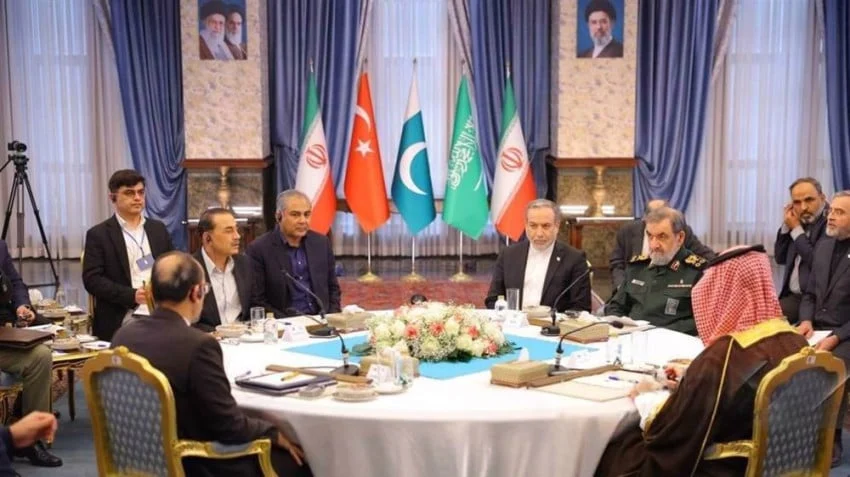
The geopolitical architecture of the Middle East is undergoing a profound and rapid transformation, underscored by a high-stakes diplomatic and security summit in the Iranian capital. Senior military and intelligence chiefs from Saudi Arabia, Pakistan, and Turkey convened in Teheran for pivotal talks with high-ranking Iranian security officials. This diplomatic outreach coincides with intensifying international efforts to de-escalate persistent military and political tensions between Iran and the United States, while simultaneously redefining how regional heavyweights manage collective security.
The delegation arriving in Teheran represents a powerful axis of nations. Saudi Arabia, Pakistan, and Turkey are the foundational pillars of the Mecca Defense Alliance—a collective security architecture initially forged amid deep regional instability and persistent anxieties regarding Iran’s regional posture and its network of allied non-state actors. Yet, in a striking departure from historical antagonism, these three nations have pivoted toward direct, institutionalized dialogue with Teheran. This diplomatic engagement persists even as the alliance faces severe structural tests, most notably the ongoing security threat posed by Yemen’s Houthi movement—a key member of Iran’s self-described "Axis of Resistance"—whose cross-border drone and missile campaigns have historically targeted Saudi infrastructure.
The high-level delegation visiting Teheran on Monday featured formidable figures in regional defense and intelligence: Saudi Arabia’s Defense Minister Prince Khalid bin Salman, Pakistan’s Chief of Army Staff General Asim Munir, and Ibrahim Kalin, the head of Turkey’s National Intelligence Organization (MIT). According to official statements from both Saudi and Iranian government sources, the delegation held extensive closed-door consultations with Mohsen Rezaei, the influential secretary of Iran’s Supreme National Security Council. This convergence of military might and intelligence oversight in the heart of Iran signals a strategic reassessment among Middle Eastern capitals, moving away from purely adversarial containment toward pragmatic diplomatic engagement and risk mitigation.
Chronology and Background of the Shift
To fully grasp the magnitude of the meetings in Teheran, one must examine the rapid evolution of diplomatic and military milestones that have shaped the region over recent years. The historical framework of Middle Eastern security has long been defined by external interventions, primarily led by the United States and its Western allies, juxtaposed with intense regional polarization between Iran and Sunni-majority Arab states.
The turning point toward regional self-reliance began accelerating in March 2023, when Saudi Arabia and Iran stunned international observers by agreeing to restore diplomatic ties under a Chinese-brokered accord in Beijing. This monumental rapprochement broke a seven-year diplomatic freeze triggered by the 2016 storming of the Saudi embassy in Teheran. Following the resumption of diplomatic ties, economic and security channels slowly opened, paving the way for more direct high-level military dialogues.
Concurrently, geopolitical anxieties over regional flashpoints—including the protracted civil war in Yemen, the proliferation of advanced drone technology, and the broader fallout from the Gaza conflict—prompted Sunni-majority powers to consolidate their own defensive capabilities. This culminated in August 2026 with the formal signing of the Mecca Defense Alliance.
The Mecca Defense Alliance: Structure and Ambitions
The Mecca Defense Alliance was engineered to address a perceived vacuum in regional deterrence. Under the terms of the mutual defense pact signed in August 2026, the signatories established a binding cooperative framework: an armed attack against any single member state is legally and strategically classified as an attack against all three, obligating the remaining members to render immediate political, logistical, or military assistance.
This alliance brings together a unique and formidable combination of strategic assets:
- Saudi Arabia: Contributing vast financial resources, unparalleled diplomatic leverage, and immense influence over global energy markets and supply chains.
- Pakistan: Providing robust conventional military power, extensive counter-terrorism experience, and established nuclear deterrence capabilities.
- Turkey: Bringing a technologically advanced defense manufacturing sector—particularly renowned for its combat drone technology—alongside its formidable standing as a major NATO military power.
Despite the explicit anxieties surrounding Iran’s regional ambitions that initially catalyzed the formation of the alliance, Turkish and Pakistani diplomats have consistently maintained that the pact is not designed as an offensive mechanism directed against Teheran or any other specific sovereign state. Instead, proponents of the agreement frame it as a stabilizing deterrent meant to insulate the broader region from external shocks and asymmetric threats. However, the decision by the alliance’s core architects to travel collectively to Teheran just months after formalizing their pact demonstrates a sophisticated dual-track strategy: maintaining a collective deterrent shield while simultaneously pursuing comprehensive bilateral engagement with Iran to prevent miscalculation and active conflict.
The Vision for Endogenous Security
Addressing the media during his weekly press briefing in Teheran, Iranian Foreign Ministry Spokesperson Esmaeil Baghaei offered a cautiously optimistic assessment of the high-level security talks. Baghaei characterized the meetings as a foundational step toward the establishment of an inclusive, cooperative regional security mechanism.
Central to Iran’s foreign policy narrative during these discussions has been the longstanding concept of "endogenous security"—a security framework that relies primarily on the capabilities, cooperation, and indigenous interests of the nations situated directly within the Persian Gulf and broader Middle East, rather than relying on external security guarantees from Western superpowers like the United States.
From Teheran’s perspective, an endogenous security model effectively neutralizes the justification for long-term Western military footprints in the region. By engaging key members of the Mecca Defense Alliance directly, Iran aims to convince its neighbors that regional stability is best achieved through cooperative diplomacy and mutual non-interference, rather than through competitive military alignments that could inadvertently draw foreign adversaries into local disputes.
Official Responses and Regional Reactions
While official readouts from the delegations of Saudi Arabia, Pakistan, and Turkey have remained measured, political analysts note that the talks reflect a shared pragmatic realization. For Riyadh, maintaining a stable relationship with Teheran is essential for the uninterrupted realization of Saudi Vision 2030, an ambitious economic diversification program that requires a stable, conflict-free regional environment to attract foreign direct investment and secure critical energy corridors.
Pakistan views regional stability through the lens of internal economic recovery and border security. Islamabad has consistently sought to balance its historic, deep-rooted strategic partnership with Riyadh while avoiding any scenario that could import sectarian tensions or destabilize its western border with Iran.
Turkey, acting under the strategic doctrine of its intelligence chief Ibrahim Kalin, continues to pursue an independent foreign policy that prioritizes mediation, trade, and regional influence. Ankara has frequently positioned itself as a bridge between Middle Eastern states and Western powers, utilizing its unique status as a NATO member to facilitate backchannel communications and de-escalate ongoing flashpoints.
Broader Implications and Future Outlook
The evolving dialogue between Teheran and the architects of the Mecca Defense Alliance carries profound implications for the global geopolitical landscape.
First, it signals a distinct trend toward "strategic autonomy" among major Middle Eastern powers. Decades of protracted conflicts—ranging from the post-2003 Iraq war to the Syrian civil war and the devastating humanitarian crises in Yemen—have exhausted regional economies and underscored the limits of military solutions. Leaders in Riyadh, Islamabad, Ankara, and Teheran increasingly recognize that protracted regional instability directly threatens their respective national security and economic development.
Second, the engagement complicates traditional Western alliance structures. As Middle Eastern states diversify their diplomatic and security portfolios, Washington and its European allies must adapt to a multipolar regional environment where traditional client states are increasingly willing to negotiate directly with long-standing adversaries on matters of war, peace, and regional architecture.
Finally, while the path toward a fully integrated, cooperative security architecture in the Middle East remains fraught with historical distrust, sectarian divides, and competing regional ambitions, the talks in Teheran mark a significant psychological and diplomatic shift. By moving the discourse from battlefield deterrence in Mecca to face-to-face diplomacy in Teheran, these regional powers are actively rewriting the rules of engagement, striving to ensure that the future of the Middle East is shaped by its own capitals rather than dictated by outside powers.