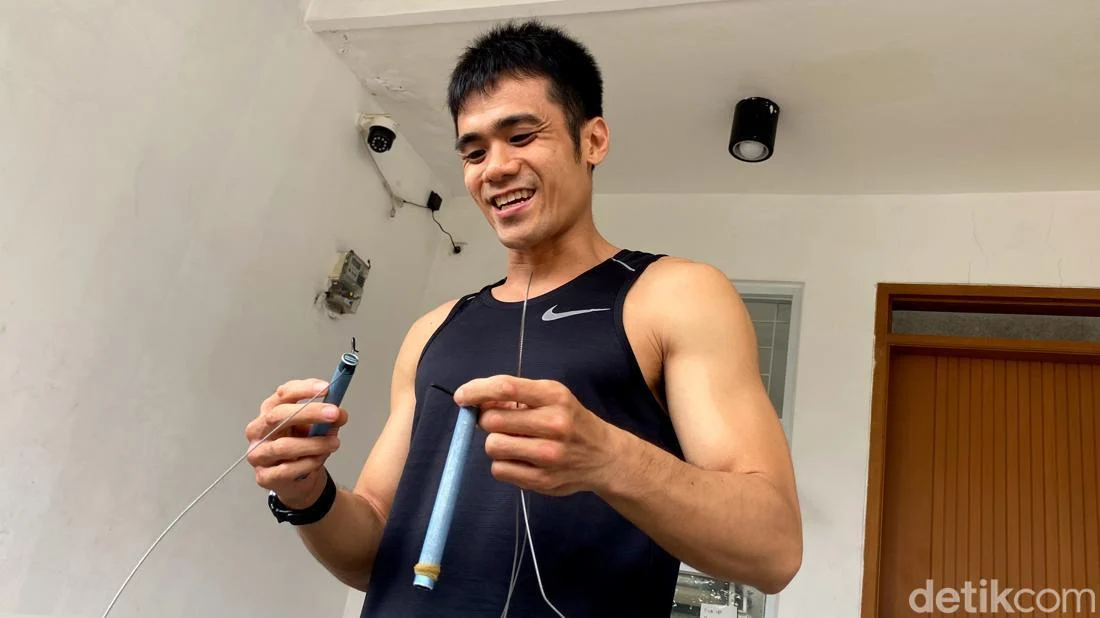
The boundaries of unconventional sports achievements continue to be pushed in unexpected ways, most recently by an Indonesian athlete who turned a casual community dare into a globally recognized milestone. Tidji Prahyudi Nurdjono, a fitness enthusiast hailing from Bandung, West Java, has officially etched his name into the record books by shattering a world jump rope record using an improbable piece of footwear: traditional flip-flops, commonly known in Indonesia as sandal jepit. What began as a lighthearted exchange of videos among peers has blossomed into an extraordinary testament to dedication, resilience, and the relentless pursuit of physical excellence.
This remarkable feat not only highlights the growing popularity of jump rope—internationally recognized as a high-intensity athletic discipline—but also underscores how localized fitness communities can serve as breeding grounds for world-class talent. As global interest in functional fitness, home-based workouts, and creative athletic challenges reaches an all-time high, Tidji’s journey offers a compelling narrative of how ordinary routines can yield extraordinary outcomes through sustained discipline.
The Chronology of a Record-Breaking Feat
The path to global recognition rarely follows a straight line, and for Tidji, the journey began within the digital spaces shared by jump rope enthusiasts. Members of local and regional jump rope communities frequently exchange training clips, instructional tips, and playful challenges to motivate one another. In this instance, fellow community members circulated footage showcasing various jump rope milestones, effectively laying down a gauntlet.
Rather than dismissing the feat as an unattainable stunt, Tidji viewed it as an opportunity to test his agility and coordination under unconventional conditions. Skipping rope inherently requires precise timing, cardiovascular endurance, and spatial awareness; introducing footwear devoid of ankle support, structural cushioning, and secure fastening systems drastically increases the difficulty.
Without prior experience skipping in flip-flops, Tidji stepped up to the challenge. The execution yielded astonishing results: he successfully registered an impressive 249 completed rotations within a strict 60-second timeframe. This performance decisively surpassed the existing benchmark, earning him global validation and cementing his status as an innovator within the sport.
From Aesthetic Ambitions to Lifelong Discipline
Tidji’s relationship with jump rope extends far beyond a singular record-breaking moment, rooted in a nearly nine-year commitment to personal transformation. His journey commenced in late 2017, driven by motivations familiar to millions worldwide: the desire to achieve a healthier lifestyle, implement a practical cardiovascular regimen, and sculpt a physique reminiscent of martial arts icon Bruce Lee.
Reflecting on his early days in the sport during an interview on a national morning program, Tidji noted, "So I started the hobby around late 2017. I wanted to pursue jump rope because I wanted a cool body, I wanted a six-pack, I wanted a body like Bruce Lee. But as I continued, it turned out to be a long-term commitment."
What started as a superficial goal evolved into a profound athletic passion. Over the course of nearly a decade, Tidji integrated jump rope into the core of his daily existence, discovering unique advantages that suited both his physical needs and his personality.
The Introvert’s Ultimate Cardio Solution
For many fitness enthusiasts, maintaining a consistent routine is frequently hindered by external factors—gym memberships, commuting times, equipment availability, and adverse weather conditions. For Tidji, who identifies as an introvert, jump rope presented a seamless solution to these logistical hurdles.
"In my opinion, jump rope is superior to other forms of cardio," Tidji explained. "Because for me as an introvert, I don’t need to leave the house. If the air quality isn’t good, or if it’s raining, I can still jump rope. I can still maintain my consistency without depending on the weather."
This independence from external infrastructure has allowed Tidji to maintain an unyielding training cadence. Urban populations increasingly face challenges related to high air pollution levels, limited green spaces, and congested fitness facilities. By relying on a piece of equipment as portable as a jump rope—which requires minimal floor space and virtually no setup time—athletes can bypass these barriers entirely. The discipline offers a democratic form of fitness, accessible to individuals regardless of socioeconomic status, geographic location, or access to commercial gym facilities.
Evolution of Training Methodology: From Volume to Intensity
As Tidji’s proficiency in jump rope matured, so too did his training philosophy. Rather than adhering to rigid, repetitive volume counts that often lead to early burnout or joint fatigue, he adopted a time-based approach designed for sustainable progression.
"I count it more toward time," Tidji shared, detailing his foundational training phase. "So when I first started, I didn’t jump rope a lot. It was more toward 15 minutes of jumping, getting whatever I could. If I got tired, I would rest, drink water, and jump again."
This measured introduction allowed his cardiovascular system, connective tissues, and musculature to adapt organically to the high-impact nature of skipping. As his stamina and physiological resilience increased, Tidji transitioned his regimen toward High Intensity Interval Training (HIIT), a scientifically proven method for maximizing caloric expenditure and cardiovascular conditioning in minimal time frames.
His current protocol reflects a streamlined, highly efficient application of HIIT principles: "30 seconds of jumping, 10 seconds of rest, repeated 12 times, sometimes 24 times. It’s as simple as that." This structured interval training elevates the heart rate rapidly, induces the excess post-exercise oxygen consumption (EPOC) effect—commonly known as the afterburn effect—and delivers significant physiological adaptations without requiring hours of daily exertion.
Broader Implications for the Jump Rope Community and Fitness Culture
Tidji Prahyudi Nurdjono’s achievement resonates on multiple levels within the broader landscape of modern health and fitness. First, it elevates the status of jump rope from a mere children’s playground game or boxing warm-up tool into a sophisticated, highly technical sport capable of extreme athletic expression. International jump rope federations have increasingly pushed for formal recognition, citing the discipline’s demands on coordination, footwork, speed, and endurance.
Second, the viral nature of community-driven challenges illustrates the transformative power of digital connectivity in sports. Regional athletes in Southeast Asia are increasingly participating in global ecosystems, utilizing social media platforms and online communities to benchmark their skills against international standards. This cross-pollination of ideas fosters a competitive yet supportive environment where unexpected talents from local neighborhoods can emerge onto the global stage.
Finally, Tidji’s milestone serves as a practical reminder of the efficacy of minimalist training. In an era dominated by expensive fitness technology, complex gym equipment, and elaborate wellness regimens, his success underscores that foundational human movements—combined with relentless consistency, intelligent programming, and a willingness to embrace unconventional challenges—remain the most potent tools for achieving peak physical condition. As Tidji continues his athletic journey in Bandung, his story stands as an inspiring blueprint for fitness enthusiasts across the globe, proving that greatness often begins with a simple step, or in his case, a single flip-flop-clad jump.