Socio Today
The intersection of elite athletic competition and corporate social responsibility reached a new milestone as the Maybank Marathon 2026 in Partnership with Visa successfully concluded its latest edition in Bali on August 23, 2026. Beyond the traditional pursuit of personal bests and podium finishes, this year’s event cemented its reputation as a pioneer in sustainable sports management by aggressively scaling up its environmental and social initiatives. By seamlessly integrating participants into the core of its sustainability mission, PT Bank Maybank Indonesia Tbk (Maybank Indonesia) has redefined what a major international sporting event can achieve for local communities and the planet.
At the heart of this year’s expanded framework were two prominent initiatives: the Maybank Marathon Run for Charity (MMRFC) and the innovative Jejak Hijau Runner movement. These programs not only galvanized thousands of runners but also produced quantifiable milestones that underscore the bank’s long-term commitment to responsible stewardship. Through strategic collaborations with environmental bodies, charitable foundations, and local community leaders, the 2026 marathon demonstrated that large-scale sporting events can serve as powerful catalysts for systemic ecological and social change.
Record-Breaking Philanthropy Through the Maybank Marathon Run for Charity
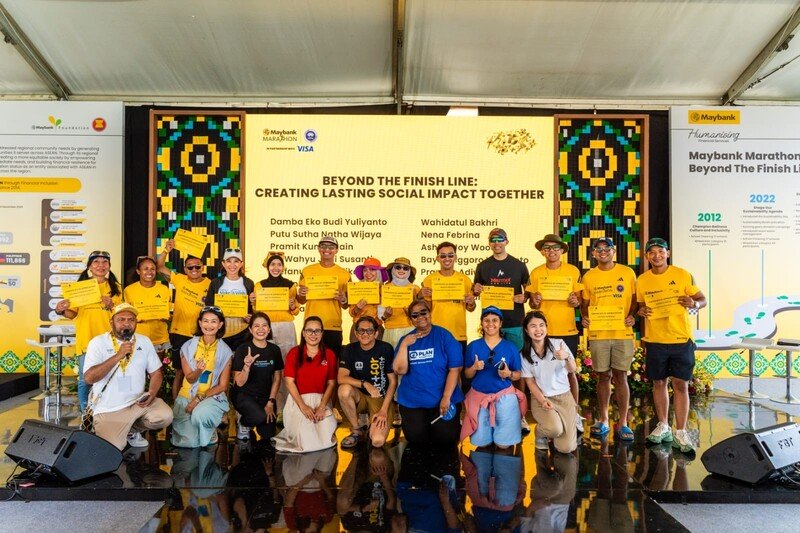
The philanthropic pillar of the event, the Maybank Marathon Run for Charity (MMRFC) 2026, delivered unprecedented results, reflecting a growing appetite among athletes to leverage their endurance for a greater cause. A dedicated collective of 35 inspirational runner-advocates partnered with six distinct sustainability organizations to spearhead fundraising campaigns that resonated deeply with the running community and the public alike.
Through these concerted efforts, the MMRFC 2026 successfully amassed a staggering total of Rp933,711,005 in donations. This figure represents a remarkable 29 percent year-on-year increase compared to the funds raised during the previous iteration of the marathon. The entirety of the collected capital is slated for direct distribution to beneficiaries carefully vetted by the six sustainability partners, ensuring that the financial impact reaches grassroots projects addressing critical socio-economic needs.
President Director of Maybank Indonesia, Steffano Ridwan, emphasized that the phenomenal success of the charity run is a testament to the event’s broader philosophical evolution. According to Ridwan, the marathon was deliberately architected to transcend the boundaries of a standard athletic competition, serving instead as a dynamic platform where the passion for running converges with genuine empathy for society and the environment.
"Maybank Marathon we built not only as a sports event, but also as a platform that brings together the spirit of running with a concern for society and the environment," Steffano stated. He further noted that the MMRFC embodies the bank’s overarching corporate ethos, "Humanising Financial Services," which serves as the foundational compass guiding all institutional initiatives and community-facing programs.
Pioneering Eco-Conscious Running with the Jejak Hijau Runner Movement
While the philanthropic numbers grabbed headlines, the environmental front witnessed equally groundbreaking innovations, spearheaded by the Jejak Hijau Runner initiative. Designed to mitigate the ecological footprint of race day while actively cleaning the course, this program deployed specialized pacers assigned to the full marathon category, specifically guiding groups targeting finish times of sub-6 hours 30 minutes and sub-7 hours.
These designated pacers carried a dual responsibility. In addition to their traditional athletic duty of helping participants maintain a steady cadence to safely beat the official cut-off time, these pacers acted as mobile environmental ambassadors. Throughout the winding Bali course, the Jejak Hijau Runners actively collected litter and discarded waste encountered along the route.
This hands-on ecological cleanup forms a vital component of the broader Jejak Hijau Maybank Marathon movement, which seeks to actively engage participants, spectators, and the entire logistical ecosystem in curbing the environmental degradation traditionally associated with mass-participation sporting events.
Head of Sustainability at Maybank Indonesia, Maria Trifanny Fransiska, underscored the indispensable role that runners play in fostering a more environmentally accountable sporting culture. "Through the Jejak Hijau Runner, we want to show that every runner can take part in the sustainability journey of the Maybank Marathon," Maria explained. She added that the program fulfills a dual purpose: guiding athletes to the finish line while simultaneously broadcasting an urgent, practical message regarding environmental conservation during the grueling race journey.
The Roadmap to 2030: Decoding Carbon Baselines and Operational Reductions
The introduction of the Jejak Hijau Runner is far from a standalone stunt; it represents a calculated tactical move within Maybank Indonesia’s comprehensive roadmap toward achieving a net-zero carbon footprint for the event by 2030—a target officially designated as the Maybank Marathon Netral Karbon 2030.
This ambitious 2030 target is anchored in rigorous scientific measurement and data-driven accountability rather than mere corporate idealism. Following the 2025 installment of the marathon, Maybank Indonesia commissioned a comprehensive carbon footprint audit. The resulting data revealed that the Maybank Marathon 2025 generated a total emission volume of 4,336 tCO₂e (tonnes of carbon dioxide equivalent)—a standardized metric used to aggregate diverse greenhouse gas emissions into a unified carbon dioxide equivalent scale.
A granular analysis of the 2025 audit data yielded critical insights for future planning. The findings revealed that participant-related activities, particularly long-distance transportation and local accommodation logistics, constituted the single largest source of carbon emissions associated with the event. Armed with this empirical baseline, the organizing committee formulated the comprehensive "Jejak Hijau Roadmap," establishing a strategic trajectory for systematic decarbonization over subsequent years.
For the 2026 edition, this roadmap translated into aggressive operational overhauls. Maybank Indonesia implemented sweeping optimizations across race logistics, including the large-scale deployment of electric vehicles (EVs) for official transit, enhanced scheduling and routing for participant shuttle services, and rigorous localized resource and waste management protocols designed to divert garbage from local landfills.
Extending Impact to Local Communities Through the Desa Sanding Bebas Emisi Program
True to its holistic approach to sustainability, Maybank Indonesia recognized that the ecological footprint of a marathon extends far beyond the physical boundaries of the race weekend. Consequently, the bank’s sustainability framework deliberately bridges urban athletic participants with rural host communities.
In collaboration with World Resources Institute (WRI) Indonesia, Maybank Indonesia continued its flagship community-focused environmental initiative: the Desa Sanding Bebas Emisi (Emission-Free Sanding Village) program. This strategic partnership is engineered to foster the development of a low-emission rural economy through comprehensive community-led greenhouse gas emissions mapping and localized organic waste management systems.
By integrating the local populace into the environmental equation, the initiative elevates the Maybank Marathon from a transient weekend event into a continuous, year-round engine for ecological education and sustainable rural development. The community-based organic waste management systems established under this program empower villagers to convert agricultural and household refuse into valuable compost, thereby closing the loop on local resource consumption.
Championing Social Inclusivity via the Piduh Charity Café
While environmental stewardship and philanthropic fundraising formed the bedrock of the 2026 event, Maybank Indonesia ensured that the crucial dimension of social inclusivity was prominently represented. Demonstrating a commitment to marginalized segments of society, the bank extended targeted support to the Piduh Charity Café, operating in close synergy with the Yayasan Widya Guna foundation.
The Piduh Charity Café has been strategically positioned as an inclusive empowerment hub and professional skills-training center tailored specifically for children and young adults with special needs. By equipping these individuals with vocational hospitality and culinary skills, the initiative fosters long-term economic self-sufficiency and social integration. The inclusion of this project rounds out the marathon’s multifaceted sustainability framework, perfectly balancing environmental conservation with tangible social equity and community empowerment.
Collaborative Imperative on the Road to 2030
The convergence of record-shattering charitable donations, innovative on-course ecological cleanups, data-driven carbon accounting, rural emission-reduction initiatives, and vocational inclusivity programs paints a clear picture of Maybank Indonesia’s strategic vision. The Maybank Marathon 2026 in Partnership with Visa has successfully established a new benchmark for how corporate entities can utilize major sporting spectacles as comprehensive platforms for sustainable development.
Reflecting on the magnitude of the undertaking and the path that lies ahead, Maria Trifanny Fransiska emphasized that achieving the ultimate corporate and environmental goal requires an unwavering commitment to multi-stakeholder collaboration. The transformation of a major international sporting event into a net-zero carbon platform cannot be achieved in isolation.
"The journey toward the Maybank Marathon Netral Karbon 2030 cannot be done alone. Collaboration and participation are key so that every implementation can produce measurable progress while leaving a broader positive impact on society and the environment," Maria concluded.
With the successful execution of the 2026 event, Maybank Indonesia has proven that athletic excellence, environmental consciousness, and social responsibility are not mutually exclusive pursuits, but rather mutually reinforcing pillars capable of driving profound, lasting change across Indonesia and beyond.