Socio Today
The landscape of institutional and higher-education heritage tourism in Indonesia has welcomed a sophisticated addition with the inauguration of the Institut Teknologi Bandung (ITB) Museum. Situated on the fourth floor of the Sasana Budaya Ganesha (Sabuga) building in West Java, the museum officially opened its doors to the public following a grand inauguration ceremony on July 3, 2026, officiated by Indonesia’s Minister of Culture, Fadli Zon. The establishment of this cutting-edge cultural and educational repository marks a significant milestone in how historic academic institutions preserve their legacy, seamlessly bridging the gap between physical archival preservation and modern interactive digital technologies.
The museum joins a select group of premier university-backed heritage spaces in Indonesia, complementing established institutions such as the IPB Future Museum and Gallery at IPB University, the UGM Museum at Universitas Gadjah Mada, and the National Museum of Education at Universitas Pendidikan Indonesia (UPI). However, the ITB Museum distinguishes itself through a heavily curated spatial design that borrows heavily from international museum standards, prioritizing immersive storytelling, touchless digital interfaces, and spatial audio-visual installations over static display cases.
A Century in the Making: The Chronology and Development of Museum ITB
The conceptualization of the ITB Museum is the culmination of nearly a decade of strategic planning. The project was initially envisioned by a dedicated core group of 11 founders back in 2017, who recognized the urgent need to systematically archive and showcase the rich historical trajectory of Indonesia’s premier technical university. The physical realization of the museum gained official momentum in August 2025, coinciding with the 105th anniversary of ITB’s intellectual predecessor, the Technische Hoogeschool te Bandoeng, which was originally established during the Dutch colonial era in 1920.
The realization of this ambitious architectural and curatorial project was significantly accelerated by substantial philanthropic support. In November 2025, ITB formalized partnerships regarding major renovation donations with the Purnomo Yusgiantoro Center—a strategic energy and policy research think tank founded in 2016 by former Minister of Energy and Mineral Resources Purnomo Yusgiantoro—and prominent industrialist Dato Dr. Low Tuck Kwong. Dato Dr. Low Tuck Kwong, a Singapore-born naturalized Indonesian citizen recognized as one of the nation’s foremost business leaders and former top-ranking individual on Forbes’ Indonesian billionaires list, emerged as a principal benefactor.
A silver plaque prominently displayed in the museum’s grand foyer honors the extensive network of donors whose contributions made the facility possible. Alongside Dato Low Tuck Kwong and the Purnomo Yusgiantoro Center, the honor roll features notable corporate leaders, alumni, and public figures including Nurhayati Subakat of Paragon Corp, Yani Panigoro of Medco Energy, industrialist T.P. Rachmat, former cabinet minister and current political figure Pramono Anung, prominent sculptor Nyoman Nuarta, and Maritime Affairs and Fisheries Minister Sakti Wahyu Trenggono, among others. This unprecedented convergence of academic, corporate, and governmental backing underscores the cultural significance attached to preserving ITB’s institutional heritage.
Navigating the Four Curatorial Zones of ITB Museum

Spanning a vast layout on Sabuga’s fourth floor, the museum is methodically structured into four distinct thematic zones. Each zone guides visitors through a chronological and thematic evolution, ensuring an educational experience that appeals equally to casual visitors, academic researchers, and nostalgic alumni.
The journey begins at the Roots of ITB History zone. Protected behind secure glass panels, this initial section chronicles the chronological evolution of the campus from its colonial founding as Technische Hoogeschool te Bandoeng in 1920 through various historical epochs up to the official inauguration of the ITB Jakarta campus on August 1, 2024. Visitors encounter authentic academic ledgers, rare documents, and historical photographs. Interactive touchscreens allow users to digitally browse through a collection of 337 photographs capturing the historic March 2, 1959 campus inauguration, which was graced by Indonesia’s founding fathers, President Sukarno and Vice President Mohammad Hatta.
A prominent blue narrative panel outlines the leadership lineage of ITB, detailing the terms of successive board chairs, academic senate leaders, and rectors. The exhibits meticulously highlight the institution’s historical mandate: producing top-tier engineers to serve colonial-era infrastructure development plans amidst the global economic crises following World War I. Furthermore, the zone highlights ITB’s monumental contributions to space science, particularly its management of the Bosscha Observatory through the Faculty of Mathematics and Natural Sciences since 1951.
The historical panels do not shy away from the complex socio-political shifts of the mid-20th century. The exhibits trace the campus’s various nomenclature changes, including its operation as Bandung Kogyo Daigaku during the Japanese military occupation, its post-independence transition to the Bandung Technical School (Sekolah Tinggi Teknik Bandung), and its temporary reversion under Dutch control as the Faculty of Engineering under the De Nood Universiteit, which later folded into the Universiteit van Indonesie. The transitional era culminated in 1948 when full administrative control was transferred to Indonesian authorities under the University of Indonesia umbrella. An accompanying acoustic station allows visitors to listen to authentic archival audio recordings of President Sukarno critically addressing how colonial technical education was engineered primarily to serve Dutch imperial interests rather than indigenous advancement.

Bridging Research Excellence and Natural Heritage in Zone Two
Transitioning into the second zone, titled The Footprints of Enlightenment in Research and Education, visitors encounter some of the museum’s most technologically advanced interactive exhibits. This zone serves as a tribute to ITB’s scientific breakthroughs and its symbiotic relationship with the Indonesian ecosystem.
A striking digital projection wall immediately captures attention, featuring animated visualizations of prehistoric fauna—such as elephants, wild boars, tapirs, and horned deer—interspersed with representations of early hunters and giant mammoth tusk replicas. These animations are contextualized by high-definition digital renderings of zoomorphic cave paintings found across archaeological sites in Sangkulirang and Liang Tewet in East Kalimantan, tying academic research directly to Indonesia’s ancient anthropological heritage.
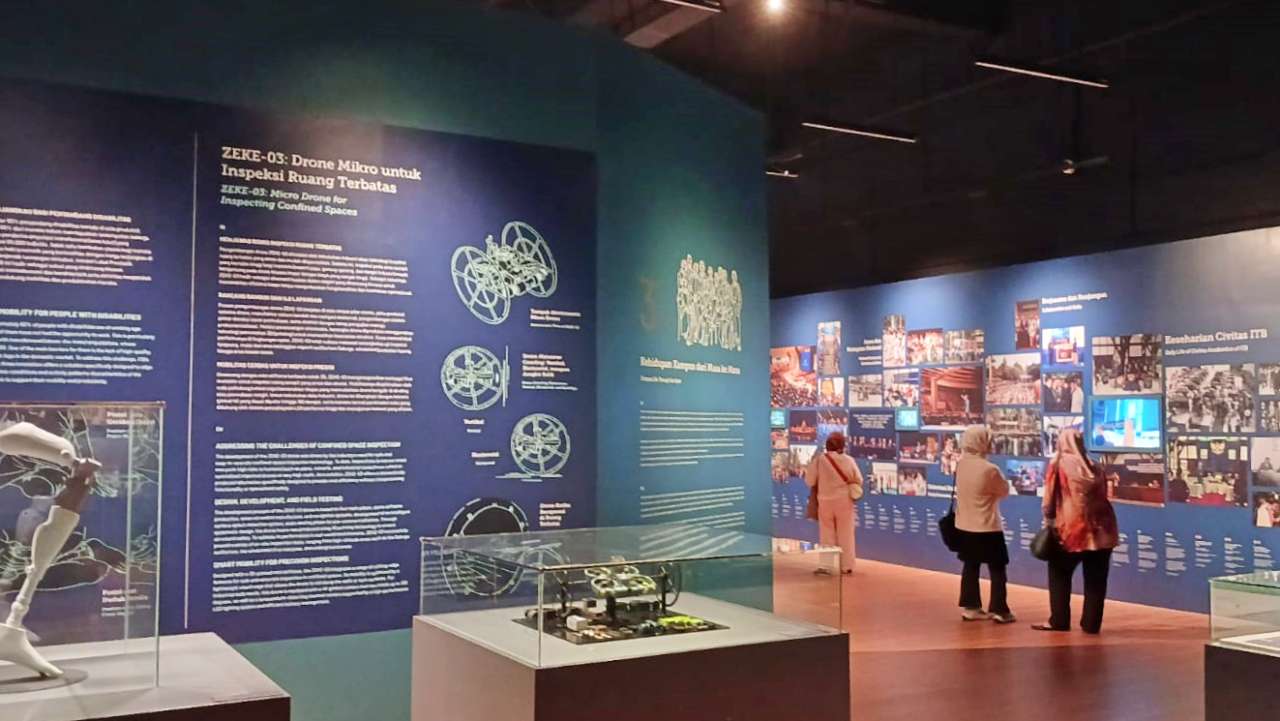
Further along the gallery, a large archival display cabinet houses tangible relics of scientific inquiry, accompanied by dual touchscreen interfaces that provide detailed metadata for items such as historical stationary steam engine models, antique analytical balances, and Tridacna fossils. Crucially, the museum highlights contemporary applied research designed to address societal challenges. Highlighted innovations include Varuna, a mobile water purification installation engineered to provide clean drinking water during emergency disaster relief operations; a multi-axis prosthetic knee joint capable of mimicking complex human leg mechanics; and ZEKE-03, a micro-drone specifically designed for navigating and inspecting confined industrial spaces.

For younger visitors, an interactive “Learning from Nature” station offers an engaging gamified experience. A massive digital wall projects a lush forest ecosystem populated by tigers, birds, and pangolins. By utilizing front-facing touch terminals, children can input custom data, select animal avatars, and solve digital puzzles to introduce their own customized animal animations into the projection ecosystem.
Nostalgia and Student Activism: Exploring Campus Life
The third zone shifts its focus toward Campus Life Across the Eras, functioning as an emotional anchor for ITB alumni. This section preserves the socio-cultural fabric of student life, capturing the spirited atmosphere of intellectual discourse, extracurricular endeavors, and political movements that shaped generations of scholars.
Among the standout artifacts are physical relics of student resistance and democratization movements, including historic headbands bearing inscriptions such as “Solidaritas ’95” (Solidarity ’95), “Deklarasi KM-ITB” (KM-ITB Declaration), and “Reformasi untuk Rakyat” (Reform for the People). Another section pays homage to the campus’s media and broadcasting history, displaying vintage television sets and studio cameras utilized by students and faculty within media laboratories and control rooms.

A dedicated corner within this zone celebrates the legacy of specific academic departments, most notably Chemical Engineering. This sub-exhibit highlights the discipline’s profound developmental contributions to the nation, featuring biographical tributes to foundational figures in Indonesian chemical engineering alongside a scale miniature of Plant Unit 5, the largest production facility operated by Pupuk Kaltim.
The Future Vision and Immersive Cinematic Experience
The final leg of the exhibition narrative, the Future Inspiration zone, employs large-format touchscreen kiosks to spotlight distinguished alumni, visionary researchers, and modern pioneers associated with ITB. Visitors can access comprehensive profiles, intellectual philosophies, and documented contributions of figures who have shaped modern Indonesian science, engineering, and public policy.
The tour concludes within the 360-degree Theater Dome—an intimate, cinema-style auditorium designed to deliver a fully immersive audiovisual wrap-up. Seated in comfortable tiered chairs, visitors are enveloped by panoramic overhead projections that synthesize the historical trajectory of the campus, the biographical struggles of pioneering scientists, and the ongoing frontiers of institutional research.

Accessibility and Operational Impact
By offering tiered ticketing structures—priced at IDR 50,000 for the general public and a subsidized IDR 20,000 for ITB students and alumni—the museum ensures broad socio-economic accessibility. Curatorial experts note that the integration of tactile archives with cutting-edge digital infrastructure prevents the exhibition space from falling into the trap of academic obsolescence, creating a dynamic learning environment that redefines how national universities present their institutional heritage to the public.