As the landing gear of the aircraft touched down at Mutiara SIS Al-Jufri Airport on a Monday morning in late September 2026, the haunting memories of the catastrophic 2018 earthquake and tsunami in Central Sulawesi immediately rushed back. Exactly eight years prior, on September 28, 2018, a powerful 7.4-magnitude earthquake violently ruptured the Pasigala region—encompassing Palu, Sigi, and Donggala. Triggered by the relentless movement of the Palu-Koro Fault, one of Indonesia’s most active and formidable geological fault lines, the disaster left an indelible scar on the nation.
The ensuing catastrophe stands as one of the deadliest seismic events in modern Indonesian history, following the devastating Yogyakarta earthquake of 2006 and the Lombok earthquakes of 2018. The violent shaking spawned towering tsunamis reaching heights of five to seven meters and precipitated massive soil liquefaction, most notably in the neighborhoods of Petobo and Perumnas Balaroa in Palu. This liquefaction phenomenon caused catastrophic ground displacement, where entire residential blocks and community lands sank several meters into churning black slurry.
Now, eight years later, while psychological trauma still lingers among survivors, daily life has pressed forward. A profound shift has taken root across Pasigala and its surrounding districts—one defined by an urgent collective consciousness toward adaptation, disaster mitigation, and community resilience. Crucially, this resilience draws heavily upon indigenous knowledge systems and traditional practices that have long guided local communities in interpreting and harmonizing with their natural environment.
Bridging Research and Practice: The BICARA Sulawesi Tengah Initiative
These hard-earned lessons regarding seismic activity, soil liquefaction, and long-term ecological recovery served as the foundation for the BICARA Sulawesi Tengah program held on September 29–30, 2026. Representing the travel and cultural journalism platform TelusuRI, contributors Rifqy Faiza Rahman and Deta Widyananda participated as speakers and field observers. The event was organized through a strategic collaboration between the Lingkar Temu Kabupaten Lestari (LTKL) and Comms Lab, carrying the overarching theme "Reading Sigi: Resource Management, Knowledge, Economy, and Resilience."
Although the event’s title explicitly highlights Sigi, the discussions resonated deeply across other regions grappling with the threats of active fault lines, such as the Sausu and Palolo faults. Beyond functioning as an academic and community forum, BICARA Sulawesi Tengah was designed to strengthen the collaborative roles of academics, journalists, content creators, and civil society organizations. The goal is to cultivate robust public narratives centered on restorative economic practices, framing the intricate nexus among climate change, water security, energy transition, and food sovereignty. These insights are subsequently translated into accessible media formats that actively encourage disaster preparedness and sustainable regional development.
Shifting Paradigms: The Debate Over Restorative Economic Development
The core of the public seminar took place on Tuesday, September 29, 2026, at the Faculty of Forestry Auditorium at Tadulako University in Palu. Despite tight schedules, robust dialogues flourished, bridging academic research, policy frameworks, field realities, and the compounding challenges of climate change and regional economic models.
The opening session featured three prominent speakers: Fiorentina Refani, Director of Socio-Bioeconomy at the Center of Economic and Law Studies (CELIOS); Yusuf Priambodo, author of Reset Indonesia and expedition leader for Indonesia Baru; and Neni Muhidin, a writer, researcher, and founder of the Nemu Buku literacy collective. Each speaker presented critical findings grounded in localized research across Sulawesi and the broader archipelago.
Yusuf Priambodo opened the discussion by sharing visual documentation from the Indonesia Baru Expedition, highlighting the severe socio-ecological consequences of extractive industries, particularly large-scale palm oil plantations and nickel mining. Documenting vulnerable regions such as Raja Ampat, Halmahera, and Morowali in Central Sulawesi, Yusuf emphasized how unchecked industrial extraction has severely marginalized indigenous communities. Local populations face acute water crises, toxic arsenic pollution, and the systematic loss of ancestral lands handed down through generations. Consequently, he argued, transitioning toward a restorative economic paradigm rooted in biodiversity, biotechnology, local food systems, and indigenous wisdom is no longer optional, but an absolute necessity.
Adding macroeconomic context, Fiorentina Refani presented CELIOS’s latest research regarding the economic trajectory of Sulawesi, with a specific focus on Central Sulawesi. Although the province recorded the nation’s third-highest economic growth rate at 8.32% in the first quarter of 2026, its underlying economic structure reveals a dangerous paradox. Traditional agricultural sectors are being rapidly outpaced by extractive industries, primarily nickel mining and downstream processing. To quantify this environmental degradation, CELIOS assigned the region an alarming ecological damage score of 4.5 out of 5, signaling the heavy toll of resource exploitation on local ecosystems.

Concluding the first panel, Neni Muhidin shared insights from an ongoing toponymy study titled "Reading the Landscape through Names, Memories, and Community Knowledge," conducted across the Pasigala region. The research decodes historical land nomenclature categorized by human history, cultural habits, topographical features, and disaster histories. Significantly, local disaster knowledge is often cryptically embedded within regional toponyms. A prime example is Toro Village in the Kulawi Subdistrict of Sigi Regency. Situated adjacent to the Lore Lindu National Park, Toro Village continues to preserve ancestral wisdom through traditional rituals and communal food storage systems known as gampiri.
Despite utilizing differing investigative methodologies, all speakers arrived at a unified conclusion: viable alternatives to extractivism exist. Societies can forge developmental paths that honor ecological limits and safeguard the welfare of future generations. CELIOS has outlined a nine-sector framework for a restorative economy—including regenerative agriculture, sustainable forestry, artisanal fisheries, home industries, and green tourism. Complementing this, Yusuf highlighted the potential of sustainable ecotourism to protect forest cover, biodiversity, and indigenous cultural heritage, while Neni underscored place-based toponyms as vital mental maps for disaster resilience.
Multi-Stakeholder Synergy: The Sigi Hijau Framework
The second seminar session shifted focus to governance and applied policy, featuring Afit Lamakarate, Head of the Food Crops, Horticulture, and Agriculture Office of Sigi Regency, alongside Nedya Sinintha Maulaning, Chair of Gampiri Interaksi Lestari. Both leaders detailed collaborative efforts to institutionalize restorative economics in Sigi.
The 2018 earthquake and tsunami catalyzed a regional realization that post-disaster recovery cannot be achieved through isolated efforts. By forging partnerships between local government bodies, youth collectives like Gampiri Interaksi Lestari—which functions as a local business incubator—and diverse community stakeholders, the region established the Sigi Hijau Multi-Stakeholder Collaboration (KMP Sigi Hijau). Backed by formal regional regulations, the Sigi Hijau vision provides the legal and operational framework for sustainable development, seamlessly integrating traditional ecological knowledge with modern regenerative agriculture.
Digital Storytelling and Data Translation
Translating complex research into engaging public narratives formed the core of a subsequent workshop session titled "Data-Driven Storytelling Through Short-Form Video," co-facilitated by TelusuRI and Nur Amri Firmansyah, a local filmmaker and anthropology student at Tadulako University.

Drawing from its editorial experience, TelusuRI outlined strategies for packaging data-heavy investigations into concise visual formats tailored for digital audiences, particularly demographics aged 18 to 35. Showcasing video outputs from their Arah Singgah expedition spanning from Sumatra to Papua, TelusuRI demonstrated how grassroots stories of restorative economic practices can be successfully popularized. Key takeaways from the workshop included isolating unique narrative angles from dense datasets, demystifying academic terminology for general audiences, structuring compelling story arcs to maximize emotional impact, and optimizing video duration for social media algorithms.
Meanwhile, Nur Amri emphasized the importance of ethnographic immersion in gathering authentic grassroots data. Utilizing anthropological research methods, he outlined a production workflow that begins with deep community listening before translating field realities into resonant visual narratives.
Field Realities: Coffee Farming and Agroforestry in Sigi
The second day of the program transitioned from the academic halls of Palu to the rugged terrain of Sigi Regency. On September 30, 2026, a delegation comprising representatives from LTKL, Comms Lab, speakers, and journalists embarked on a field visit to Dombu Village and the Gampiri Communal Space.
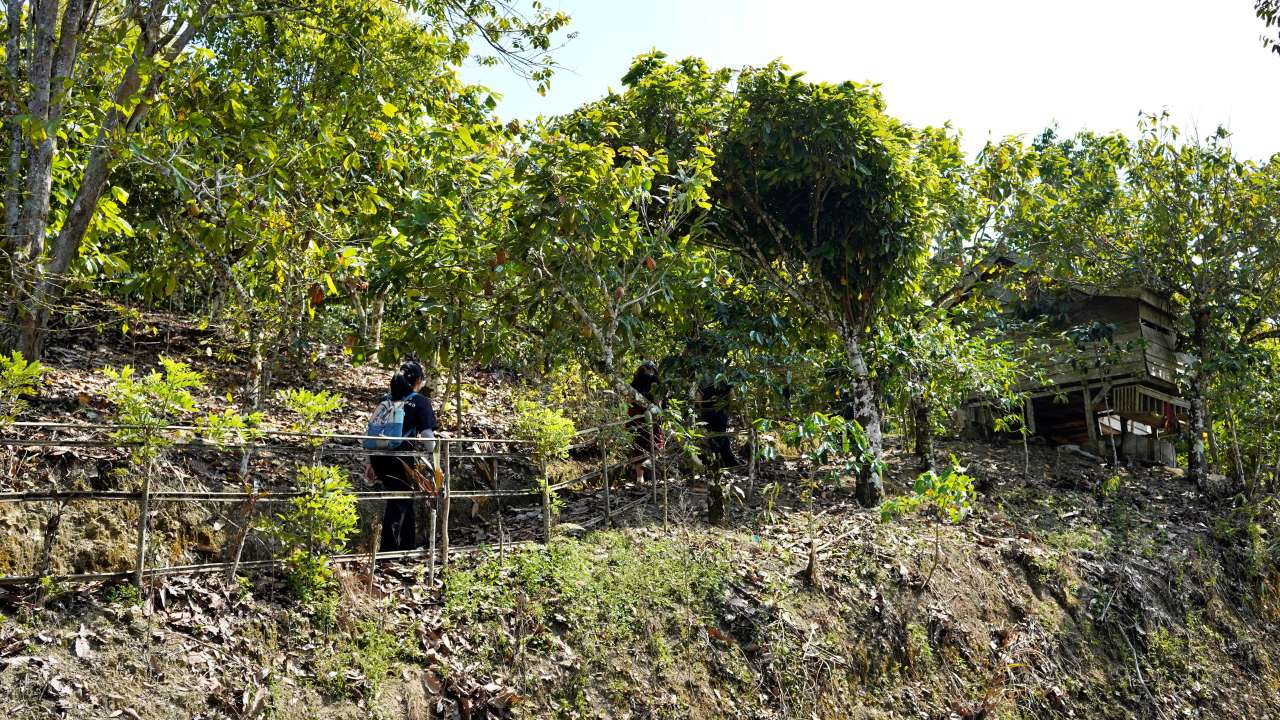
Located in the Marawola Barat Subdistrict, Dombu Village sits roughly an hour’s drive from Palu along winding mountain roads characterized by steep inclines. The delegation visited Welim Pela and his wife, Jelvin Likunono, local farmers specializing in robusta and arabica coffee, cacao, and diverse agroforestry crops under the mentorship of Gampiri Interaksi Lestari. Situated along steep hillside slopes with gradients reaching up to 30 degrees, their three-hectare farm displayed the harsh effects of an extended dry season, with surrounding hillsides bathed in dry, ochre tones.
To mitigate climate vulnerabilities and market volatility, Welim and Jelvin practice multi-crop agroforestry, integrating coffee and cacao with durian, cloves, and citrus trees. This diversified cropping strategy ensures that farmers are not financially beholden to a single commodity, stabilizing household income across annual harvest cycles. To secure reliable market access and improve commodity value, these farmers partner with Gampiri Interaksi Lestari, receiving continuous training in sustainable cultivation techniques, post-harvest processing, and quality control.

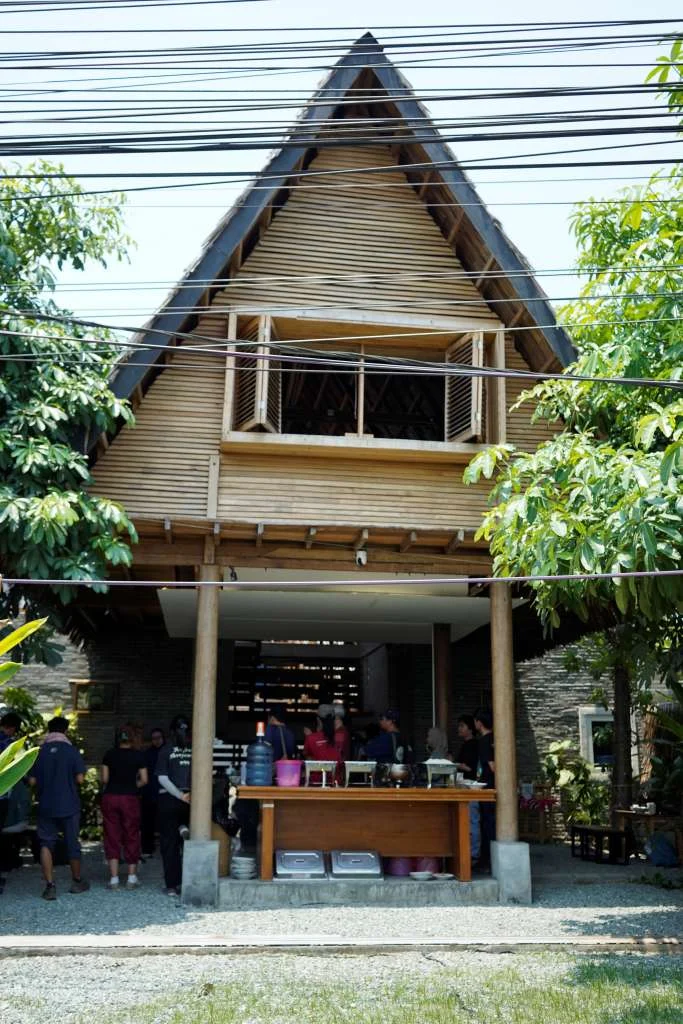
The field itinerary concluded at the Gampiri Communal Space, situated strategically on the border of Sigi Regency and Palu City. Designed architecturally to mirror the traditional gampiri—a communal rice granary unique to the Kaili indigenous people of Sigi—the facility houses administrative offices, production units, workshop spaces, and specialized processing facilities for coffee, cacao, and vanilla. By bridging upstream indigenous producers with downstream consumer markets, the facility stands as a tangible monument to community-led resilience, ensuring that local knowledge, ecological stewardship, and sustainable enterprise continue to thrive in post-disaster Central Sulawesi.