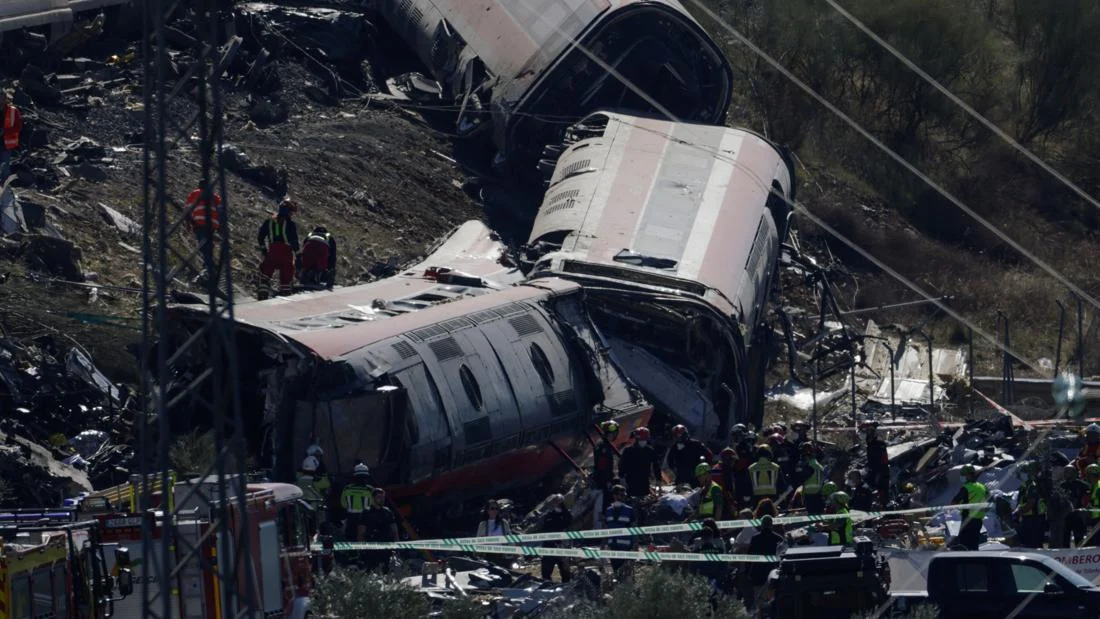
The transportation infrastructure of Spain was plunged into profound grief and disbelief following one of the deadliest railway disasters in modern European history. A catastrophic high-speed train collision along the vital Madrid-Seville corridor resulted in the tragic loss of 68 lives and left more than 100 individuals injured. As rescue operations concluded and investigators descended upon the crash site near Urda in the province of Toledo, preliminary findings have pointed toward a horrifying convergence of automated system failures and highly questionable human intervention from operational controllers.
The incident, which occurred on Wednesday, October 28, 2026, has not only exposed critical vulnerabilities in Spain’s advanced rail network but has also triggered an immediate, high-level governmental response. With Prime Minister Pedro Sanchez declaring a three-day national mourning period, the international community is closely watching how Spanish authorities handle the fallout from an accident that has shattered public trust in a sector long heralded for its technological precision and safety standards.
Chronology of a Disaster: The Madrid-Seville Tragedy
The sequence of events leading up to the disaster began early Wednesday morning on what is traditionally one of Spain’s busiest and most economically vital rail arteries. The Madrid-Seville line holds historical significance as the nation’s very first high-speed rail corridor, operational since the early 1990s and utilized by millions of passengers annually.
At approximately 08:30 local time, normal operations along the route were abruptly interrupted by a significant technical anomaly. According to reports from the Spanish Ministry of Transport, a sudden computer system failure struck the signaling and traffic management network, prompting an automated safety response that safely brought six high-speed trains to a halt across the affected sector. Among the immobilized vehicles were two specific services: a high-speed train operated by the national railway company Renfe, and another operated by the private rail enterprise Iryo. Both trains had departed from Madrid and were heading southward toward Seville.
Under standard safety protocols, automated halts initiated by system failures require manual overrides, strict verification, and direct authorization from central traffic controllers before any movement can resume. However, initial investigations suggest that a critical breakdown in communication and operational judgment occurred within the control center. Rather than maintaining a cautious standstill until the signaling integrity could be fully verified, the operator on duty issued a directive that investigators have described as inexplicable.
The controversial instruction granted the stalled trains permission to resume their journeys without any speed restrictions or adequate spacing assurances. Consequently, the moving Renfe high-speed train accelerated along the tracks, unaware that the Iryo service directly ahead of it was either completely stationary or moving at a significantly reduced speed due to the lingering effects of the initial system glitch.
The collision occurred near kilometer 118 in the vicinity of Urda at a devastating velocity estimated at 200 kilometers per hour. The sheer kinetic energy involved in a high-speed impact of this magnitude left little room for survival in the affected carriages. Emergency services, including paramedics, firefighters, and civil guard units, rushed to the scene to find scenes of absolute devastation, with twisted metal and debris scattered across the tracks.
Evolving Casualty Figures and Rescue Operations
Initial reports released by regional authorities in the immediate aftermath of the crash estimated a lower death toll of approximately 10 individuals. However, as emergency response teams systematically cut through the wreckage and accessed the heavily damaged carriages, the grim reality of the disaster became apparent.
By Friday, October 30, 2026, the official death toll had climbed sharply to 68 fatalities. In addition to those who lost their lives, more than 100 passengers sustained injuries ranging from moderate to critical. Local hospitals in Toledo and surrounding regions were placed on maximum alert, mobilizing trauma teams and issuing blood donation appeals to cope with the sudden influx of casualties. Forensic specialists and disaster victim identification teams were deployed to the site to manage the recovery process with dignity and precision, while psychological support units were established to assist the traumatized survivors and grieving families.
Government Response and Accountability
The severity of the incident prompted an immediate and uncompromising response from the highest levels of the Spanish government. Prime Minister Pedro Sanchez traveled directly to the disaster zone in Urda to inspect the wreckage, consult with emergency coordinators, and address the press.
During his address, Prime Minister Sanchez did not mince words regarding the gravity of the situation. He vowed that the state would conduct a comprehensive, transparent, and independent investigation to unearth every detail behind the catastrophe. Sanchez emphasized that if negligence, procedural breaches, or systemic human error are proven to be the root causes, those responsible will face strict legal consequences.
"We will investigate this accident to the absolute end. If there was negligence, it will be brought to light," Sanchez stated firmly. He highlighted the unacceptability of a nation of Spain’s technological standing enduring two catastrophic high-speed rail accidents within a single year. The Prime Minister explicitly linked the current disaster to a previous fatal incident that occurred in January 2026 at Adamuz in Cordoba, which claimed 46 lives. While acknowledging that preliminary indicators suggest distinct causes for the two tragedies, Sanchez conceded that the recurrence of such deadly events on the same primary corridor demands a radical reassessment of national railway safety management.
In response to the tragedy, the Spanish government decreed three days of official national mourning, spanning from October 29 through October 31. Flags across government buildings were lowered to half-mast, and public events were canceled or modified to honor the victims.
Implications for European High-Speed Rail Systems
The disaster near Urda carries profound implications not only for Spain’s national operator Renfe and private competitors like Iryo, but also for the broader European high-speed rail network. High-speed rail has long been promoted across the European Union as the premier green alternative to air travel, prized for its combination of speed, efficiency, and exceptional safety records. Incidents of this scale are exceptionally rare, which magnifies the psychological and economic impact on the public consciousness.
Transportation analysts point out that the collision highlights the complex vulnerabilities inherent in managing high-density rail corridors where automated digital signaling systems intersect with human decision-making. While computerized systems are designed to eliminate human error, their occasional failures place immense pressure on human operators within central control rooms. When those operators make flawed judgments under pressure, the consequences can be catastrophic due to the immense speeds and short stopping distances involved in modern rail transport.
The disaster is expected to trigger rigorous safety audits across all Spanish rail infrastructure, with a particular focus on the reliability of backup protocols during system failures, the cognitive workload of traffic controllers, and the effectiveness of oversight mechanisms governing both public and private operators sharing the tracks. Furthermore, the incident may lead to renewed debates regarding the integration of decentralized management systems and the need for enhanced automated collision-avoidance technology that can override human errors in real-time.
As the judicial authorities, independent crash investigators, and technical experts continue their meticulous analysis of the black box data, voice recordings, and signaling logs from the Madrid-Seville corridor, the nation of Spain remains locked in mourning. The pursuit of answers will not only determine accountability for the 68 lives lost on October 28, but will also serve as a critical turning point in redefining the safety paradigms of high-speed rail travel for decades to come.