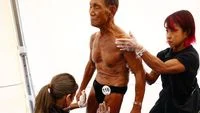
In an extraordinary demonstration of human longevity, discipline, and physical resilience, 90-year-old Japanese bodybuilder Toshisuke Kanazawa has once again stepped onto the competitive stage, participating in a major international bodybuilding competition. Proving that chronological age is not an absolute barrier to high-level athletic performance, Kanazawa’s continued participation in the sport challenges conventional paradigms regarding aging, health, and physical capability. The milestone event highlights not only a remarkable personal achievement but also shifts the discourse surrounding geriatric fitness on a global scale.
Main Facts of the Competition and Athlete Profile
Toshisuke Kanazawa, a native of Hiroshima, Japan, entered the international competition under stringent professional standards, competing against athletes decades younger in various categories or within specialized veteran brackets designed to showcase lifelong athletic dedication. Standing on stage with a physique defined by decades of meticulous training, strict dietary adherence, and unwavering mental fortitude, Kanazawa drew widespread acclaim from both judges and fellow competitors.
Bodybuilding at the age of 90 requires an exceptional physiological equilibrium. At this stage of life, maintaining muscle hypertrophy—commonly known as muscle growth—is severely challenged by sarcopenia, the natural age-related loss of muscle mass and function. Furthermore, joint integrity, bone density, and cardiovascular recovery times are significantly altered compared to younger athletes. Kanazawa’s ability to present a symmetrical, conditioned, and lean physique underscores a lifetime of optimized biological management through rigorous resistance training and nutritional science.
Chronology and Background of Kanazawa’s Athletic Journey
Kanazawa’s journey into the upper echelons of competitive bodybuilding was not linear, marked by decades of persistence, temporary retirements, and triumphant comebacks. His relationship with the sport began in his early twenties, a time when physical fitness in post-war Japan was gaining traction as a means of national physical rejuvenation.
During his early career in the 1950s and 1960s, Kanazawa established himself as a dominant force within the domestic Japanese bodybuilding circuit, securing multiple regional and national titles. However, like many athletes, family commitments, professional responsibilities, and the natural physiological toll of heavy lifting eventually prompted him to step away from active competition in his middle years.
The turning point that cemented Kanazawa’s legacy as a longevity icon occurred decades later. After a lengthy hiatus, he made the monumental decision to return to competitive bodybuilding in his late 70s, motivated in part by the passing of his wife, who had always supported his athletic passions. Promising her that he would live a long, healthy life and continue pursuing what he loved, Kanazawa dedicated his twilight years to redefining what is physically possible for a nonagenarian.
In the years leading up to his latest international appearance, Kanazawa systematically rehabilitated his training methodologies, shifting from the heavy, joint-stressing loads of his youth to higher-repetition, tension-focused movements designed to stimulate muscle growth while protecting fragile skeletal structures. His participation in international events represents the culmination of this rigorous, decades-long rehabilitation and training cycle.
Supporting Data on Aging, Fitness, and Longevity
Kanazawa’s athletic feats align with a growing body of gerontological and sports science research examining the effects of lifelong exercise on healthspan—the period of life spent in good health, free from chronic disease or debilitating disabilities. According to data from the World Health Organization (WHO) and international sports medicine journals, regular resistance training in older adults can mitigate the progression of sarcopenia, improve metabolic rate, enhance cognitive function, and significantly reduce the risk of falls and fractures.
However, competitive bodybuilding at the nonagenarian level remains a statistical anomaly. While millions of older adults engage in light resistance training or walking for general health, fewer than one percent of individuals aged 90 and above engage in high-intensity resistance training sufficient to induce muscle hypertrophy for competitive staging.
Nutrition plays an equally vital role in Kanazawa’s regimen. Historically known for adhering to a traditional Japanese diet rich in high-quality proteins, fermented foods, and micronutrient-dense vegetables, Kanazawa adjusted his caloric intake and macronutrient distribution as he aged to support recovery without placing undue stress on his digestive and cardiovascular systems. Sports nutritionists note that protein synthesis slows significantly in older adults, requiring nonagenarian athletes to consume precise amounts of amino acids to repair muscle tissue micro-tears induced by weight training.
Official Responses and Industry Reactions
The international fitness and bodybuilding communities have responded to Kanazawa’s sustained presence with a mixture of awe, professional respect, and academic interest. Representatives from major international bodybuilding federations have noted that athletes like Kanazawa serve as living case studies for the limits of human adaptability.
Coaches, trainers, and sports physiologists who have observed Kanazawa’s preparations emphasize that his success is not merely a product of favorable genetics, but of intelligent programming and psychological discipline. "What we see in Mr. Kanazawa is a masterclass in bio-mechanical self-awareness," noted a sports science researcher specializing in geriatric kinesiology. "At 90, the margin for error is razor-thin. A single miscalculated lift can result in a catastrophic injury. His ability to train intensely while avoiding major trauma speaks volumes about his neurological control and movement economy."
Furthermore, peers within the bodybuilding community have frequently cited Kanazawa as an inspirational figure. Younger competitors half a century his junior have expressed deep admiration during backstage preparations, often seeking his advice on mental resilience, contest preparation, and the psychological fortitude required to face public judgment under the bright lights of a competitive stage.
Broader Impact, Sociological Implications, and Future Outlook
Toshisuke Kanazawa’s continued participation in international bodybuilding carries profound implications for how modern societies view aging and retirement. As global populations age—with life expectancies rising across developed nations, particularly in Japan—the traditional model of passive aging is undergoing a radical transformation.
Sociologists point out that figures like Kanazawa challenge ageist stereotypes that relegate older adults to sedentary lifestyles. By demonstrating that high-level physical competition is achievable at age 90, Kanazawa contributes to a cultural shift that redefines advanced age as a period of potential vitality rather than inevitable decline. This paradigm shift has direct economic and public health ramifications; if more older adults adopt elements of structured resistance training inspired by role models like Kanazawa, healthcare systems could experience a reduction in the burden of age-related chronic illnesses, mobility issues, and long-term care costs.
From an industry perspective, Kanazawa’s ongoing career expands the demographic scope of bodybuilding and fitness marketing. Historically targeted toward youth and young adults seeking aesthetic enhancement, the fitness industry is increasingly recognizing the economic and cultural value of the "active senior" demographic. Fitness equipment manufacturers, supplement companies, and event organizers are beginning to tailor products and categories specifically to accommodate and celebrate older athletes.
As Toshisuke Kanazawa looks toward the future, his primary objective remains unchanged: to continue training, inspiring others, and pushing the boundaries of what the human body can achieve across nearly a century of life. Whether he stands on the podium or simply completes his routine to the applause of a captivated audience, his journey has already secured a permanent place in the annals of sports history as a testament to the enduring power of human will and physical perseverance.