Socio Today
The relentless scrutiny that follows modern football’s most lethal goalscorers often transcends simple metrics like goals scored, delving into the nuanced mechanics of their overall contribution. For Manchester City striker Erling Haaland, the debate surrounding his statistical involvement in matches reached a familiar crescendo following a hard-fought Manchester derby at Old Trafford. Despite enduring prolonged periods of anonymity in terms of ball possession, the Norwegian international once again proved that efficiency outweighs volume, netting the decisive goal to secure a crucial three points for Pep Guardiola’s side.
The fixture, played on a tense Sunday evening in September 2026, showcased the unique tactical burden and psychological resilience required to lead the line for a dominant Premier League powerhouse. Rather than shying away from criticisms regarding his scarce touches during the initial phases of the match, Haaland offered a pragmatic and uncompromising defense of his playing style, emphasizing that his primary currency is decisive impact rather than superficial participation in build-up play.
Tactical Context and Match Chronology
The encounter at Old Trafford began with Manchester City asserting their customary territorial dominance. Pep Guardiola’s men deployed their trademark patient possession game, probing for openings in a compact and disciplined opponent’s defensive structure. However, the tactical landscape of the match shifted dramatically in the 23rd minute.
A high-stakes challenge involving City playmaker Phil Foden resulted in a straight red card, reducing the visitors to 10 men for the remainder of the contest. The numerical disadvantage immediately forced a structural recalibration from Manchester City, compelling them to cede territorial control and adopt a more pragmatic, low-block defensive posture designed to absorb pressure and strike through calculated transitions.
Even before the red card fundamentally altered the dynamics of the pitch, Haaland’s involvement in the game had been exceptionally sparse. Tactical analysts tracking the opening exchanges noted that the Norwegian striker registered a mere two touches of the ball during the first twenty minutes of play. By the time the halftime whistle blew, signaling a tense stalemate, Haaland had accumulated only ten touches in total—a remarkably low figure for a central striker operating within a team traditionally accustomed to dominating the lion’s share of possession.
As the match wore on and Manchester City fought valiantly to protect their numerical equilibrium while seeking a breakthrough, Haaland’s overall touch count eventually rose to 30 by the final whistle. While playing with a man down for more than two-thirds of the match naturally provided tactical context and justification for reduced involvement, the striker acknowledged that observers and pundits would inevitably scrutinize his quiet opening period when both teams still possessed a full complement of eleven players on the pitch.
The Philosophy of Efficiency over Volume
Addressing the media after the final whistle, Haaland articulated a clear and unwavering philosophy regarding his role within the team. Far from expressing frustration at the lack of service or his isolation during the early phases of the match, the striker embraced the necessity of patience and economy of movement.
"It is my job to score goals, to be completely honest with you," Haaland stated in a post-match interview with the BBC. "People might talk about me not touching the ball much in the first half, but that is completely fine. I didn’t touch the ball for the first twenty minutes, but what was the point of dropping deep? I wouldn’t have had anything productive to do. It is a game that demands extreme patience, and I simply had to wait for the exact right moment to strike."
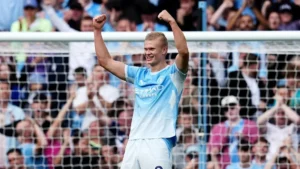
That moment arrived precisely on the hour mark. In the 60th minute, amidst a fiercely contested derby where every centimeter of space was heavily guarded, Haaland executed a textbook movement to exploit a momentary lapse in the defensive line. Translating minimal preparation into maximum execution, he converted his opportunity with clinical precision, securing a 1-0 victory that would ultimately stand as the decisive margin between the fierce crosstown rivals.
"I managed to find the moment when it mattered most, and I am delighted with the outcome," Haaland added, reflecting the ruthless pragmatism that has defined his career in English football.
Statistical Analysis of Haaland’s Playing Profile
To understand Haaland’s performance at Old Trafford is to examine a broader statistical trend that has characterized his tenure in the Premier League. Elite center-forwards traditionally fall into two distinct categories: those who function as tactical focal points, dropping deep to link play and orchestrate attacks, and those who operate purely as predatory finishers, maximizing space in the final third while minimizing unnecessary physical expenditure elsewhere on the pitch.
Haaland firmly belongs to the latter category, pushed to an unprecedented level of specialization. Data analytics from his Premier League campaigns consistently reveal that the Norwegian registers significantly fewer touches per 90 minutes than traditional target men or modern false-nines. Yet, his conversion rate relative to those touches remains among the highest in the history of European football.
Sports scientists and tactical researchers point out that Haaland’s apparent isolation is frequently a deliberate tactical mechanism. By stationing himself constantly on the shoulder of the last defender, Haaland pins opposing central defenders deep into their own half, effectively creating space between the opponent’s defensive and midfield lines for attacking midfielders and inverted wingers to exploit. When opponents step up to compress the space, the illusion of his absence vanishes, replaced instantly by explosive acceleration and lethal finishing.
The Old Trafford derby served as a microcosm of this phenomenon. Operating with ten men forced Manchester City to rely almost exclusively on defensive resilience and isolated counter-attacks. In such scenarios, a striker who expends energy tracking back or contesting meaningless aerial duels in the middle third risks rendering himself physically depleted when a transition opportunity finally arises. Haaland’s calculated preservation of energy is not a sign of disengagement, but rather a sophisticated form of match management.
Broader Implications for Manchester City and the Title Race
The victory at Old Trafford carries profound implications for Manchester City’s trajectory in the ongoing Premier League campaign. Securing three points away from home in a high-intensity derby while playing for nearly seventy minutes with a numerical disadvantage demonstrates the psychological fortitude and tactical flexibility instilled by Pep Guardiola.
For Haaland personally, the match reinforces his indispensable value to the squad. In an era where football discourse is increasingly saturated with complex metrics—such as Expected Goals (xG), progressive carries, and pressing pressures—Haaland remains a comforting throwback to the purest definition of a center-forward: a player whose worth is measured not by how often he touches the ball, but by how decisively he changes the scoreboard.
As the season progresses and opponents continue to devise elaborate tactical schemes designed to starve him of service, Haaland’s performance against Manchester United serves as a blueprint for success. It highlights that containment is an illusion against a striker who requires only a single moment of perfection to alter the course of a match. For a player of his caliber, patience is not a passive virtue, but a weapon of mass disruption.