Socio Today
The peaceful mountain route connecting Wamena to Mbua in the Jayawijaya Regency of Papua Pegunungan has once again become the site of a harrowing security incident, claiming the life of Aris Sanda, a professional driver known to the local community as Bapak Tasya. The victim, who hailed from Toraja, was intercepted by an armed criminal group, leading to a sequence of events that began with a forced stop, evolved into a high-stakes hostage situation, and culminated in his death and the incineration of his vehicle near the iconic Danau Habema.
A Chronology of a Targeted Attack
The tragic incident unfolded on Tuesday, September 15, at approximately 06:00 WIT. Aris Sanda was operating a "lajuran"—a local term for inter-district transport vehicles that serve as a lifeline for residents and supply chains in the rugged interior of Papua. He was transporting passengers from Wamena toward Mbua when his vehicle was flagged down at a junction near the picturesque Danau Habema in the Gunung Boy area, within the Trikora District.
According to official reports provided by the Head of Information for the Koops TNI Habema, Lieutenant Colonel Inf M. Wirya Arthadiguna, the interception was swift and calculated. Upon stopping the convoy, the armed assailants conducted a thorough search of the driver and his passengers. While the passengers were ultimately ordered to turn back toward Wamena, Aris Sanda was singled out and separated from the group. He was then forcibly taken deeper into the Danau Habema area.
By Wednesday morning, the situation escalated from a disappearance into a confirmed fatality. Following intensive search and sweep operations hampered by extreme weather and dense fog, joint security forces discovered the charred remains of a vehicle near the lake. Aris Sanda’s body was found inside the wreckage, having been subjected to a fire that destroyed both the transport unit and, tragically, the victim.
The Hostage Phase and Digital Evidence
The severity of the incident was compounded by the circulation of disturbing digital evidence. Before his death, Aris Sanda was held as a hostage, a fact confirmed by video footage that emerged on social media platforms. In the video, Aris is seen standing in the middle of a remote road, surrounded by multiple individuals brandishing firearms. The footage depicts the perpetrators compelling the victim to hold the Bintang Kejora flag—a symbol associated with the Free Papua Organization (OPM)—and recite political statements.
Law enforcement agencies and military intelligence are currently analyzing the video to identify the individuals involved and to establish the precise timeline of the duress the driver faced. The existence of this video has become a pivotal piece of evidence for investigators as they attempt to map out the movements of the perpetrators through the mountainous terrain.
Official Investigations and Forensic Processing
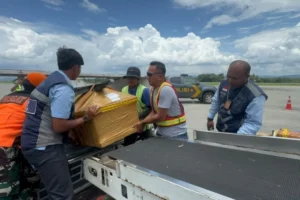
Following the discovery of the vehicle and the victim’s remains, the area was cordoned off for a forensic examination. The body was subsequently transported to the Wamena Regional General Hospital (RSUD) for post-mortem examinations to confirm the exact cause of death beyond the injuries sustained in the fire.
Security forces have identified the perpetrators as members of the OPM Kodap III Ndugama group, a faction known for its disruptive activities in the Nduga and Jayawijaya regions. Military and police personnel are engaged in active pursuit operations, utilizing tactical intelligence to track the group’s escape routes. The investigation is not merely focused on the act of violence but is also probing the broader logistics of the group, including how they were able to orchestrate such a targeted attack on a civilian transport route.
Broader Implications for Security in Papua Pegunungan
The killing of Aris Sanda serves as a stark reminder of the fragile security environment in Papua Pegunungan. For years, the road networks connecting regional hubs like Wamena to isolated districts like Mbua have been the primary targets for armed groups. These roads are not only essential for human mobility but are also the primary arteries for logistical support, medical supplies, and food distribution.
When drivers—who are often seen as neutral parties—are targeted, the immediate effect is a "chilling effect" on the local economy. Transport services, which are already hazardous due to geography, become paralyzed. This leads to increased prices for basic commodities in remote villages and limits the ability of the government to provide basic services.
Legislative voices have already begun to weigh in on the implications. Members of the House of Representatives (DPR RI) and the Regional Representative Council (DPD RI) have expressed grave concern, noting that the incident signifies an escalation in threats against civilians. Parliamentary committees have called for an immediate evaluation of the government’s conflict resolution strategies in Papua. The argument being presented is that the current security approach may be insufficient to protect the fundamental rights of civilian workers, necessitating a shift toward more robust community protection protocols.
Humanitarian and Economic Consequences
The loss of Aris Sanda is not just a security statistic; it represents the loss of a provider and a member of the community who played a crucial role in the development of the region. As a "lajuran" driver, his work was inherently service-oriented. By connecting Wamena to the hinterlands, he was part of a network that bridged the gap between urban centers and rural development.
The incident has reignited debates regarding the "Humanitarian Pause" and the effectiveness of security posts along the main roads in Papua Pegunungan. While the military maintains a presence in the area, the vastness of the terrain and the tactical guerrilla style of the armed groups make constant protection of every transport vehicle logistically challenging. Experts in conflict studies suggest that such incidents often serve as a recruitment tool or a psychological tactic to demonstrate the armed groups’ influence over territory, further complicating the central government’s efforts to maintain order.
Looking Ahead: The Path to Stability
As the investigation enters its third day, the focus remains on the identification of the perpetrators and the prevention of further violence. The incident has prompted calls for a coordinated effort between the Indonesian National Armed Forces (TNI) and the Indonesian National Police (Polri) to enhance intelligence gathering.
The government is under increasing pressure to ensure that the investigation into Aris Sanda’s death is transparent and leads to accountability. Families of victims in similar cases have often waited years for justice, and the public outcry regarding this incident underscores a growing impatience with the persistent instability in the region.
Furthermore, the incident has highlighted the need for better communication technology and emergency response infrastructure along the Wamena-Mbua corridor. Had there been earlier reporting or more rapid response capabilities, the outcome of the kidnapping might have been different. As the nation mourns the loss of Aris Sanda, the focus must shift toward creating a security architecture that prioritizes the safety of civilian workers, ensuring that the essential movement of goods and people in Papua is no longer synonymous with a high risk of death.
In the coming weeks, the results of the forensic investigation and the progress of the military pursuit will likely set the tone for regional security policies. For now, the people of Papua Pegunungan remain in a state of heightened vigilance, waiting to see if this tragedy will be the catalyst for the structural changes required to secure their roads and their future.