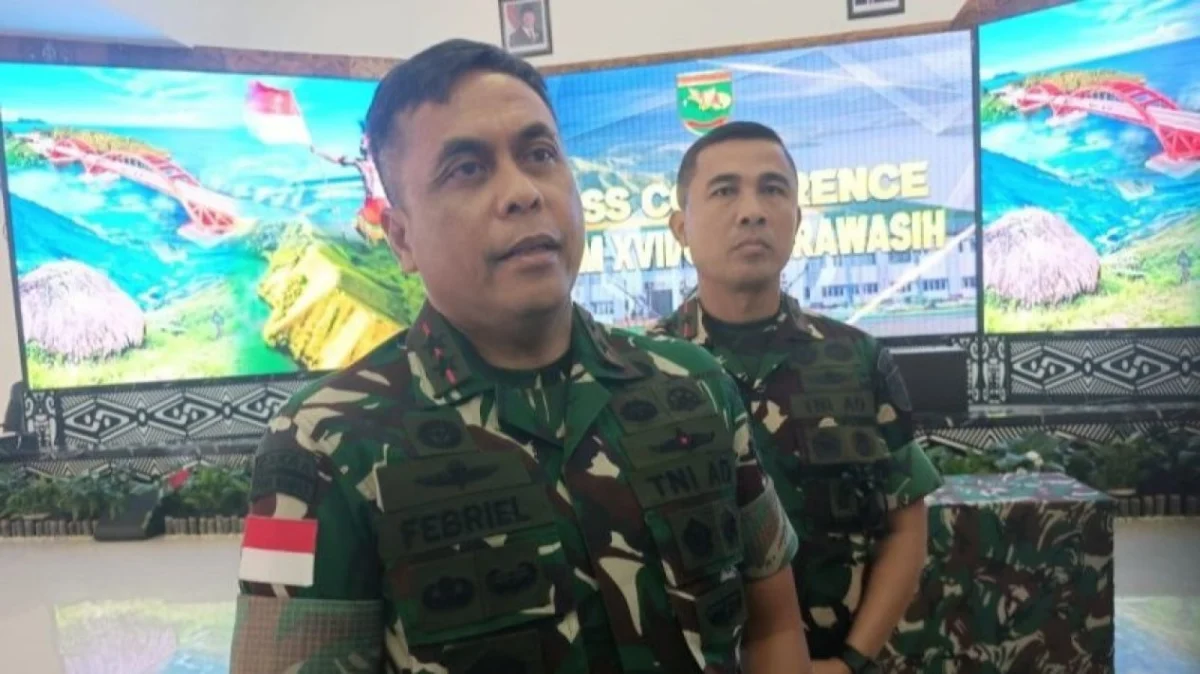
The Indonesian National Armed Forces (TNI) is set to mark a significant milestone in its organizational restructuring and territorial defense strategy with the official inauguration of the new Kodam (Regional Military Command) in Central Papua. Pangdam XVII/Cenderawasih, Major General TNI Febriel Buyung Sikumbang, confirmed on Sunday, September 27, 2026, that the establishment of the new command, headquartered in Nabire, is scheduled to coincide with the 81st anniversary of the TNI on October 5, 2026. This expansion represents a pivotal shift in the military’s administrative and operational footprint in the easternmost provinces of Indonesia, aiming to enhance security, logistics, and development support in the rapidly evolving region of Central Papua.
Strategic Restructuring and Operational Command
The formation of the Kodam Papua Tengah is part of a broader national initiative spearheaded by the Chief of Staff of the Indonesian Army (KSAD), General TNI Maruli Simanjuntak. The objective is to align military territorial structures with the recent administrative division of provinces in Papua. By establishing a dedicated Kodam for Central Papua, the TNI seeks to provide more focused leadership and command for its subordinate units, including Korem (Military Resort Commands), Kodim (Military District Commands), and various specialized battalions.
Under the new organizational framework, Kodam Papua Tengah will assume responsibility for several key regional commands that were previously under the jurisdiction of Kodam XVII/Cenderawasih. Specifically, the command will oversee the Korem 173/Praja Vira Braja (PVB). This integration encompasses a robust network of Military District Commands (Kodim), including:
- Kodim 1705/Nabire
- Kodim 1703/Deiyai
- Kodim 1718/Intan Jaya
- Kodim 1714/Puncak Jaya
- Kodim 1717/Puncak
- Kodim 1710/Mimika
This realignment is designed to streamline the chain of command, reduce the span of control for regional commanders, and improve the responsiveness of forces deployed across the challenging topography of the Central Highlands.
Territorial Development and the Role of Yon TP
Beyond the traditional combat-ready units, the TNI is placing an increasing emphasis on its "Territorial Development" (Teritorial Pembangunan) units. Major General Febriel Buyung Sikumbang emphasized that alongside the inauguration of the Kodam, the Army is actively forming two Batalyon Teritorial Pembangunan (Yon TP) and one Brigade Infanteri Teritorial Pembangunan (Brigif TP).

These units represent a hybrid approach to military deployment, where soldiers are equipped not only for national defense but also for community assistance and regional development tasks. As the new Kodam comes into existence, these units—which currently operate under existing structures—will be absorbed into the new Kodam Papua Tengah or remain under the strategic oversight of Kodam XVII/Cenderawasih depending on specific operational requirements.
The presence of these units has already begun to yield tangible results. In areas characterized by difficult access and infrastructure gaps, the Yon TP units have been instrumental in disaster relief, such as fire suppression, forest fire management, and emergency response. By embedding soldiers within the community to facilitate development, the TNI aims to foster stronger civil-military relations and provide a stabilizing presence in areas prone to socio-economic challenges.
Chronology and the Path to Expansion
The announcement of the new Kodam in Nabire follows a long-term roadmap established by the TNI leadership to reorganize the country’s territorial defense. The expansion has been under active preparation throughout 2026, following the national policy of creating new autonomous regions in Papua.
- August 2026: General Maruli Simanjuntak publicly outlined the national expansion plan, identifying five new Kodam locations, including NTT, Yogyakarta, and Central Papua.
- September 2026: Intensive coordination between regional military commands and the central headquarters in Jakarta finalized the logistical and personnel requirements for the new command.
- October 5, 2026: The official ceremony in Nabire will coincide with the national TNI Day, a symbolically significant date chosen to emphasize the modernization and growth of the armed forces.
The transition process involves not only the physical construction of military facilities but also the complex task of reassigning personnel, redistributing equipment, and integrating administrative databases to ensure that the new command is fully operational from its first day.
Broader Implications for Regional Security and Development
The creation of the Kodam Papua Tengah is viewed by military analysts as a response to the dual needs of maintaining national sovereignty and supporting the government’s developmental agenda in the Papua region. As the province of Central Papua grows, the state requires a more robust institutional presence to manage security and coordinate with local government agencies.
1. Enhanced Security Coordination
The concentration of Kodim units under one command in Nabire allows for better coordination of security operations. This is particularly relevant in the Central Highlands, where geography complicates communication and logistics. A closer command center means faster decision-making and more efficient resource deployment during crises.

2. Facilitating Infrastructure and Economic Development
In many parts of Indonesia, the TNI plays a vital role in supporting infrastructure projects, particularly in remote regions. The presence of the new Kodam is expected to act as a catalyst for deeper collaboration between the military and civil authorities, particularly in building roads, supporting public health initiatives, and ensuring that development projects can proceed without interference.
3. Civil-Military Relations
The emphasis on the "Territorial Development" units highlights a shift toward a more proactive, humanitarian-oriented military presence. By helping local populations during forest fires and providing essential services, the TNI is looking to build social capital. This approach is essential in a region where the relationship between the central government and local communities has historically been complex.
Challenges and Future Outlook
While the establishment of the new Kodam provides a clearer structure, it also brings challenges. The logistics of supplying and maintaining units in the rugged terrain of Papua are substantial. Furthermore, the TNI must balance its security responsibilities with the need to maintain an environment conducive to peace and dialogue.
The success of Kodam Papua Tengah will depend on its ability to integrate with the local community and the provincial government. According to military observers, the "soft approach" of focusing on development and community aid—as demonstrated by the Yon TP units—will be a defining feature of the new command’s operations.
As of late September 2026, preparations for the inaugural ceremony remain on track. The TNI leadership has expressed confidence that the transition will be seamless. With the official establishment just over a week away, the focus in Nabire is now on final logistical preparations and ensuring that the command structure is ready to assume its duties immediately upon the sounding of the ceremonial bell on October 5.
This development marks a significant chapter in the history of the TNI in Papua. By decentralizing its command structure, the Indonesian military is signaling a commitment to a more localized, responsive, and development-focused strategy, ensuring that the defense of the nation is as robust as the support provided to its growing, diverse, and vital regions. As the date approaches, all eyes remain on Nabire, as the inauguration is set to be one of the most prominent displays of the military’s evolving role in 21st-century Indonesia.