The modern intersection of artificial intelligence and physical robotics has given rise to unconventional employment opportunities in major metropolitan technology hubs. Dimensional, an emerging artificial intelligence startup based in the Dogpatch neighborhood of San Francisco, California, has initiated a unique recruitment campaign offering a compensation rate of $20 per hour. The company is actively seeking human operators to walk quadrupedal robotic units through urban environments, an initiative designed to gather critical environmental data and accelerate the development of autonomous machine learning systems.
This recruitment drive highlights a persistent technological bottleneck in contemporary automation: while artificial intelligence software has advanced exponentially in digital domains, the integration of algorithmic intelligence with physical hardware remains imperfect. By deploying human handlers to navigate these machines through real-world conditions, Dimensional aims to bridge the gap between theoretical software models and physical operational realities.
Operational Framework and Job Requirements
According to the official job listing published on October 5, the position requires individuals to operate four-legged robotic units during outdoor testing phases lasting between four to six hours per shift. Despite the specialized nature of the technology involved, the startup has stipulated that prior experience in robotics or engineering is not a mandatory prerequisite for applicants. To ensure operational readiness, the company provides comprehensive, paid training for all newly hired personnel.
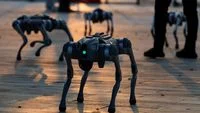
The duties involve controlling the robotic units—which weigh approximately 33 pounds or 15 kilograms—along designated outdoor testing routes in San Francisco. While the premise may sound straightforward, operators must remain vigilant and prepared to address potential technical malfunctions. Because the technology is still in an experimental phase, the robotic units are susceptible to hardware anomalies, including overheating and unexpected system shutdowns. When these incidents occur, handlers are required to intervene manually, lifting and carrying the equipment back to the testing base.
Employment terms emphasize immediate hiring, with compensation disbursed directly upon the completion of each work shift. The physical demands of the role, combined with the technical oversight required, underscore the hands-on nature of current robotics research and development phases.
The Technological Rationale: Why Human Handlers Remain Indispensable
The strategic decision to employ human operators stems from a fundamental limitation in current artificial intelligence architectures. Stash Pomichter, the founder of Dimensional, explained that autonomous agents currently lack the sophisticated motor coordination and environmental adaptability required to safely operate complex hardware independently in unstructured public spaces.
During the testing protocols, human operators take direct control of the robotic units via handheld remote controllers or mobile applications. Simultaneously, an array of onboard cameras and precision sensors embedded within the hardware harvest vast quantities of environmental data. This telemetry is subsequently funneled back to the startup’s development teams to train neural networks on how physical spaces are navigated.
"What we concluded from our experiments walking our dogs is that agents are still very bad at controlling hardware. And humans are still needed in the process," Pomichter noted, emphasizing the irreplaceable role of human oversight in the current developmental paradigm.
Corporate Background and Infrastructure Investment
Dimensional operates out of San Francisco’s vibrant Dogpatch district, positioning itself at the bleeding edge of embodied artificial intelligence. The startup is currently engineering an open-source operating system designed to enable diverse AI agents to seamlessly command various robotic form factors.
To support this ambitious research and development pipeline, Dimensional has amassed a substantial hardware inventory. Reports from industry publications indicate that the startup has procured more than 100 robotic dogs and 50 humanoid robots sourced from manufacturers across the United States, China, and Germany.
The quadrupedal units utilized in the San Francisco street trials are manufactured by Unitree, a prominent Chinese robotics firm. Each individual unit carries an acquisition cost of approximately $2,000, representing a significant capital expenditure in physical testing infrastructure. By diversifying its hardware fleet across multiple manufacturers and form factors, Dimensional aims to build a hardware-agnostic operating system capable of standardizing automation protocols across different industries.
Broader Industry Implications and Future Applications
The ultimate commercial trajectory for the technology being tested by Dimensional extends far beyond urban recreational walks. The startup envisions its AI-driven operating systems and robotic hardware being deployed across high-demand industrial sectors, including manufacturing plants, data processing facilities, large-scale construction sites, and corporate security infrastructure.
Proponents of this technology argue that integrating advanced robotics into heavy industry will eventually eliminate the need for human workers to perform hazardous or ergonomically damaging tasks. Pomichter expressed a strong conviction regarding the moral imperative of automation in heavy labor, characterizing the continued reliance on human physical endurance for repetitive lifting and material transport as antiquated.
"To be honest, it is savage that humans are still doing these physical tasks," Pomichter stated, pointing to strenuous manual labor such as lifting and carrying heavy inventory boxes as prime targets for automation displacement.
Industry analysts observe that while startups like Dimensional are blazing trails in hardware-software integration, several regulatory, ethical, and economic challenges remain on the horizon. The deployment of autonomous and semi-autonomous machinery in public spaces invites rigorous scrutiny regarding public safety, data privacy, and pedestrian interaction. Furthermore, as robotic systems transition from controlled testing environments to dynamic urban landscapes, municipal authorities may seek to establish clearer legal frameworks governing autonomous devices operating on public sidewalks and thoroughfares.
Despite these multifaceted challenges, the aggressive recruitment of human handlers by San Francisco technology firms signifies that the evolution of physical artificial intelligence is accelerating. As companies continue to gather empirical data from real-world trials, the threshold between science fiction and industrial reality continues to narrow, reshaping the future of labor, engineering, and human-machine collaboration.