Socio Today
The Indonesian Communist Party (PKI) stands as one of the most consequential and controversial entities in the annals of modern Indonesian history. From its origins as a radical anti-colonial movement in the early 20th century to its dissolution as a proscribed organization in 1966, the PKI’s trajectory serves as a mirror to the volatile political evolution of the Indonesian nation. Its existence was marked by cycles of insurgency, electoral success during the parliamentary era, deep involvement in the ideological battles of the Guided Democracy period, and a cataclysmic collapse following the events of 1965. Understanding the history of the PKI requires a nuanced examination of documented facts, state-sanctioned narratives, and the ongoing academic discourse surrounding the events that fundamentally reshaped the Southeast Asian geopolitical landscape.
The Genesis of Communism in the Dutch East Indies
The roots of the communist movement in Indonesia can be traced back to 1914 with the establishment of the Indische Sociaal-Democratische Vereeniging (ISDV) by Dutch socialist Henk Sneevliet. Operating within the colonial framework of the Dutch East Indies, the ISDV sought to bridge European socialist ideology with the burgeoning anti-colonial sentiments of the local population. By 1920, the organization underwent a pivotal transformation, rebranding itself as the Perserikatan Komunis di Hindia (PKH), which eventually solidified into the Partai Komunis Indonesia (PKI).
The party’s early years were characterized by a militant stance against colonial rule. In 1926, the PKI orchestrated a widespread insurrection against the Dutch administration. The uprising, though ambitious in its attempt to overthrow the colonial order, lacked sufficient coordination and logistics. The Dutch colonial authorities responded with overwhelming force, leading to mass arrests, executions, and the long-term exile of key party leaders to penal colonies such as Boven Digoel. This defeat pushed the communist movement into a period of deep suppression and clandestine activity that lasted until the final years of World War II and the subsequent Indonesian proclamation of independence in 1945.
The 1948 Madiun Affair: A Defining Schism
The post-independence era brought new opportunities for the PKI, but it also introduced deep-seated ideological fractures within the Indonesian nationalist struggle. The most significant early crisis occurred in September 1948, known as the Madiun Affair. At the time, the Republic of Indonesia was embroiled in a complex diplomatic and military struggle against the Dutch, who were attempting to reassert control.
Tensions erupted between the government led by President Sukarno and Mohammad Hatta, and a coalition of leftist groups known as the Front Demokrasi Rakyat (FDR), which included the PKI. On September 18, 1948, an armed conflict broke out in Madiun, East Java, where leftist elements proclaimed a "Soviet Republic of Indonesia." The government, viewing this as a treacherous "stab in the back" during the national revolution, mobilized the military to suppress the revolt. Within months, the rebellion was neutralized; key leaders, including Musso, were killed, and the party’s organizational structure was decimated. This event solidified a deep, lasting distrust between the PKI and the Indonesian military, particularly the Army, which would culminate in the tragedies of 1965.
Resurgence and Electoral Dominance in the 1950s
Following the devastation of 1948, the PKI underwent a remarkable political metamorphosis under the new leadership of D.N. Aidit. Abandoning the path of immediate armed insurrection, the party focused on grassroots mobilization. By targeting the marginalized segments of society—laborers, farmers, and youth—the PKI successfully repositioned itself as a legitimate, populist force.
This strategic shift was validated during the 1955 general elections, the first democratic legislative contest in the history of the Republic. The results stunned the political establishment: the PKI secured 6,179,914 votes, translating to 16.36 percent of the national tally. This achievement granted the party 39 seats in the House of Representatives (DPR) and an even stronger foothold in the Constituent Assembly, where they held 80 seats. By the mid-1950s, the PKI had effectively returned from the brink of total annihilation to become one of the "Big Four" political powers, standing alongside the Indonesian National Party (PNI), the Islamic party Masyumi, and the Nahdlatul Ulama (NU).
The Guided Democracy Era and Political Polarization
The declaration of Guided Democracy by President Sukarno in 1959 radically altered the political landscape. Sukarno sought to consolidate power by balancing the three major forces in the country: the nationalists, the religious groups, and the communists. This tripartite balance was conceptualized as "Nasakom" (Nasionalisme, Agama, Komunisme).
Throughout the early 1960s, the PKI exploited this state-sanctioned inclusion to expand its influence within the bureaucracy and the arts, while simultaneously radicalizing its rhetoric regarding land reform (Aksi Sepihak). The party’s growing influence, however, placed it on a collision course with the Indonesian Army. Military leaders grew increasingly alarmed by the PKI’s demands for the creation of a "Fifth Force"—an armed civilian militia—which they perceived as a direct threat to the Army’s monopoly on the use of force and national security.
The 1965 Crisis: G30S and Its Aftermath
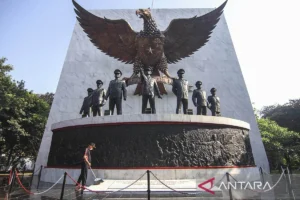
On the night of September 30 and the early hours of October 1, 1965, a clandestine operation—subsequently referred to as the Gerakan 30 September (G30S)—resulted in the abduction and murder of six Army generals and one lieutenant. The bodies were disposed of at Lubang Buaya, Jakarta.
The historiography of this event remains the most contested period in modern Indonesian history. The official narrative established during the New Order era identified the PKI as the sole mastermind behind the coup attempt. Conversely, contemporary academic researchers, utilizing newly declassified documents from the United States, Japan, and the National Archives of Indonesia (ANRI), suggest a far more complex web of actors, internal military factions, and international interests.
The immediate aftermath triggered a systemic purge. General Soeharto, acting as a stabilizer, moved to neutralize the PKI. A nationwide campaign of violence ensued, characterized by mass arrests, extrajudicial killings, and widespread human rights violations. According to reports by the National Commission on Human Rights (Komnas HAM), the violence between 1965 and 1966 resulted in systematic human rights abuses, including forced disappearances, torture, and mass killings, affecting not only party members but also millions of citizens suspected of having any affiliation with the organization or its mass affiliates.
Dissolution and the Legacy of 1966
The political demise of the PKI was formalized on March 12, 1966, when Soeharto, wielding the authority granted by the Supersemar (Order of March 11), issued a decree banning the party. This was subsequently codified into law via the Provisional People’s Consultative Assembly (MPRS) Decree No. XXV/1966. The decree remains a foundational pillar of the current legal order, explicitly prohibiting the propagation of Marxism, Leninism, and Communism within Indonesian territory.
The dissolution of the PKI effectively marked the end of the parliamentary experiment and the transition into the New Order era, a period of authoritarian rule under Soeharto that would last for over three decades until 1998. The ban reshaped the ideological landscape of the country, stripping away the influence of leftist thought and establishing a national narrative centered on the preservation of the state ideology, Pancasila, against the perceived threat of communism.
Contemporary Historiography and Research
Six decades later, the events surrounding the PKI and the 1965 tragedy remain a sensitive subject in Indonesian discourse. The National Archives of the Republic of Indonesia (ANRI) continue to emphasize the importance of a multi-perspective approach to history. By encouraging the study of diverse archival sources—including diplomatic cables, internal party records, and oral histories—historians aim to reconcile the various interpretations that persist to this day.
The legacy of the PKI is not merely a chronicle of a failed political movement, but a critical case study in the dynamics of power, the volatility of radical ideologies, and the long-term consequences of political violence. As Indonesia continues to navigate its path as a democratic nation, the study of the PKI remains essential, not for the revival of its ideology, but for a comprehensive understanding of the structural changes that defined the 20th-century Indonesian experience. Through ongoing academic research and archival preservation, the nation continues to engage with this complex history, balancing the need for historical accuracy with the requirements of national stability and human rights.