Socio Today
The brutal killing of Aris Sanda, a professional transport driver hailing from Toraja, has sent shockwaves through the Papua Pegunungan region, highlighting the persistent and escalating dangers faced by civilian transport workers in high-conflict areas. Known locally as Bapak Tasya, Aris was intercepted, held hostage, and eventually killed by an armed group while operating his vehicle on the critical supply route between Wamena and Mbua in Jayawijaya Regency. His remains were discovered inside his incinerated vehicle near the remote and rugged landscape of Lake Habema, marking another somber chapter in the ongoing security instability affecting the highlands of Papua.
Chronology of the Incident: From Interception to Tragedy
The incident unfolded on the morning of Tuesday, September 15. At approximately 06:00 WIT (Eastern Indonesian Time), Aris Sanda was performing his routine duties as a "lajuran" driver—a vital profession in the highlands where commercial vehicles serve as the primary lifeline for transporting goods, medical supplies, and passengers between isolated districts.
According to official reports from the Kepala Penerangan Koops TNI Habema (Information Chief of the Habema Military Operations Command), Lieutenant Colonel Inf M. Wirya Arthadiguna, Aris’s vehicle was part of a small convoy when it was flagged down by a group of unidentified armed individuals at a junction near Lake Habema, located in the vicinity of Mount Boy, Trikora District. The armed group immediately took control of the situation, conducting a systematic inspection of the vehicle, the driver, and his passengers.
In a move that initially suggested a selective abduction, the armed group ordered the passengers to return to Wamena, effectively clearing the scene of witnesses. Aris Sanda, however, was separated from the group and taken deeper into the Lake Habema territory. Throughout the day, the whereabouts of the driver remained unknown, triggering an immediate mobilization of security forces tasked with locating the victim.
Evidence of the harrowing ordeal surfaced later through a circulating video recording. The footage showed Aris being held at gunpoint in the middle of a road, surrounded by armed men. In the video, the victim was coerced into holding a Bintang Kejora flag—the emblem associated with the Free Papua Organization (OPM)—and was forced to make a political statement. Security analysts and law enforcement officials are currently subjecting this footage to forensic analysis to determine the precise circumstances of the coercion and to identify the individuals present in the video.
On Wednesday, September 16, after extensive search and rescue efforts—which were hampered by dense fog and extreme high-altitude weather conditions—a joint team from the military and police finally located the wreckage. The vehicle was found completely destroyed by fire in the Lake Habema area, with the remains of Aris Sanda inside.
The Strategic Importance of the Wamena-Mbua Route
The route between Wamena and Mbua is more than just a road; it is a critical artery for the economy and social survival of the Papua Pegunungan province. Because of the rugged mountainous terrain, air transport is often prohibitively expensive for local residents, making road transport the primary method for moving essential logistics.
"Lajuran" drivers like Aris Sanda perform a high-risk, high-reward service. They navigate some of the most dangerous terrains in Indonesia, often acting as the sole connection between the regional capital of Wamena and the isolated inland districts. The targeting of these drivers has a multiplier effect: it disrupts the supply chain, increases the cost of living for mountain communities, and creates an atmosphere of fear that paralyzes public transport.
Security experts note that the area surrounding Lake Habema, located at a significant elevation, offers tactical advantages to armed groups due to its remoteness and the difficulty of rapid deployment by government security forces. This incident serves as a stark reminder of the "asymmetric warfare" tactics employed by local armed factions, who frequently target infrastructure and civilians to exert pressure on the state.
Official Investigations and Attribution
The Indonesian National Armed Forces (TNI) have publicly identified the group likely responsible for the attack as elements of the OPM Kodap III Ndugama. This faction has been active in the Nduga and Jayawijaya regions and has previously been linked to various acts of violence against civilians and infrastructure projects.
Following the recovery of the body, the victim was transported to the RSUD Wamena (Wamena General Hospital) for a post-mortem examination. The police are currently conducting an extensive crime scene investigation (Olah TKP), gathering forensic evidence from the burnt vehicle and the surrounding area. Investigators are also looking into the potential use of specific firearms in the incident, which could provide further links to the perpetrator group’s arsenal.
Lieutenant Colonel Inf M. Wirya Arthadiguna emphasized that the military is committed to bringing those responsible to justice. "We are conducting a thorough investigation to ensure that the chain of events—from the initial interception to the final, tragic outcome—is reconstructed with total accuracy," he stated.
Broader Implications and Political Reactions
The death of Aris Sanda has sparked a fierce debate within the Indonesian legislature regarding the effectiveness of current security strategies in Papua. Members of the Commission I of the DPR (House of Representatives) have voiced their deep concern, noting that the targeting of civilian transport workers is an alarming escalation that threatens the safety of all non-combatants in the region.
"This is not just a localized criminal act; it is a direct challenge to the safety of the civilian population and the rule of law," said one committee member in a press briefing following the incident. Legislators have called for an immediate evaluation of the military and police presence in the highlands to ensure that supply routes are adequately protected.
Similarly, the DPD RI (Regional Representative Council) has urged the central government to conduct a comprehensive audit of the ongoing conflict resolution strategy in Papua. The council noted that while security operations are necessary, a more holistic approach that considers the socio-economic vulnerabilities of the local population is required to prevent further loss of civilian life.
Human Impact: The Loss of a Breadwinner
Beyond the statistics and the political fallout, the loss of Aris Sanda is a profound tragedy for his family and the community of transport workers in Wamena. Known as a hardworking and dedicated individual, Aris’s death leaves a void in the lives of those he supported. The transport community in Wamena has expressed deep grief, with many drivers calling for better protection and safety guarantees when operating in the highlands.
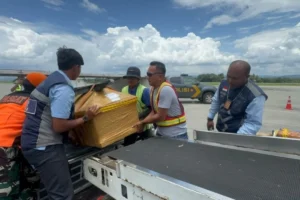
The evacuation of Aris Sanda’s remains to his hometown in Makassar marks the end of his final journey, but the investigation into his death is far from over. As the government grapples with the complexities of the Papua conflict, the memory of the "Bapak Tasya" case will likely serve as a focal point for future discussions on how to better safeguard the civilian backbone of the Papuan economy.
Conclusion and Future Outlook
The killing of Aris Sanda near Lake Habema represents a chilling reminder of the volatility in the Papua Pegunungan region. As the investigation progresses, the focus remains on two fronts: the immediate apprehension of the perpetrators involved in the abduction and murder, and the long-term security policy required to protect essential service workers.
For the people of the highlands, the road to Mbua remains a symbol of their connection to the rest of the country. Ensuring that this road remains open and safe is not merely a logistical necessity—it is a moral imperative. As government forces continue their pursuit of the responsible elements, the public, the transport sector, and political stakeholders await a resolution that promises more than just investigation, but a meaningful restoration of security for all who travel the rugged, often dangerous, roads of the Papuan interior.