Socio Today
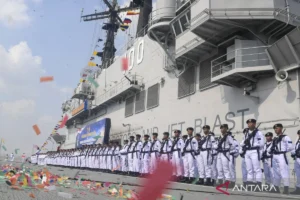
The arrival of the former ITS Giuseppe Garibaldi at Pier 107 of Tanjung Priok Port, North Jakarta, on Friday, September 18, 2026, represents a transformative milestone for the Indonesian Navy (TNI AL). As the vessel docked under the clear morning sky, it signaled more than just a logistical acquisition; it marked the formal introduction of the nation’s first-ever aircraft carrier. Once fully commissioned and rechristened as KRI Sriwijaya, the ship will serve as a centerpiece of Indonesia’s maritime defense strategy, bridging the gap between coastal defense and blue-water power projection.
The Chronology of an Acquisition
The journey of the vessel from the Italian Navy to the Indonesian fleet has been a meticulous diplomatic and technical endeavor. The transfer process, which began with high-level bilateral discussions between Jakarta and Rome, gained significant momentum in early 2026. After years of service with the Italian Marina Militare—during which the ship participated in NATO missions and Mediterranean security operations—the vessel was identified as a strategic fit for Indonesia’s archipelagic requirements.
Following the arrival on September 18, the vessel entered a period of administrative and technical processing. The formal handover ceremony, which will include the symbolic lowering of the Italian flag and the hoisting of the Indonesian Merah Putih, is slated for September 24, 2026. This date will serve as the official birthday of KRI Sriwijaya, transitioning the vessel from a decommissioned asset of a European power to a flagship of the Indonesian Navy.
Defining the Aircraft Carrier: More Than Just Size
The public discourse surrounding the arrival of KRI Sriwijaya has often conflated "size" with "capability." In naval architecture, an aircraft carrier is defined not merely by its displacement, but by its core functionality as a mobile airbase. Unlike a standard cruiser or frigate, which relies on surface-to-surface missiles and deck-mounted guns for primary engagement, an aircraft carrier serves as a floating platform for aviation assets.
An aircraft carrier functions as a sea-based hub for fixed-wing aircraft, rotary-wing helicopters, and unmanned aerial vehicles (UAVs). It incorporates a flight deck for launch and recovery, internal hangars for maintenance, and specialized systems for fuel storage and munitions handling. By bringing an airfield to the theater of operations, the vessel removes the constraint of relying on land-based runways, which are often thousands of miles away from remote maritime boundaries or disaster zones.
Strategic Rationale: The "Mobile Base" Doctrine
For an archipelagic nation like Indonesia, the strategic value of such a platform is profound. The Indonesian Navy has emphasized that the KRI Sriwijaya will not necessarily be utilized in the same manner as the "super-carriers" of the United States Navy, which are designed for high-intensity power projection and strike missions. Instead, the focus for the Indonesian variant will be on "Operations Other Than War" (OMSP).
The Chief of Staff of the Indonesian Navy, Admiral Muhammad Ali, has noted that the ship will undergo significant refitting. These modifications are intended to align the ship’s aging systems with the specific operational demands of the Indonesian military. By serving as a floating base for helicopters and drones, the ship acts as a force multiplier for maritime domain awareness. In a vast archipelago where radar coverage can be obstructed by weather or geography, having a mobile sensor platform that can remain at sea for extended periods significantly enhances national security.
Humanitarian Assistance and Disaster Relief (HADR)
Perhaps the most critical application for the KRI Sriwijaya lies in its capacity for humanitarian assistance and disaster relief. Indonesia, situated on the Pacific Ring of Fire, frequently faces natural disasters such as earthquakes, tsunamis, and volcanic eruptions. In many cases, these events cripple ground infrastructure, rendering roads impassable and airports damaged.
A vessel with the deck space and logistical capacity of the KRI Sriwijaya becomes an invaluable asset in these scenarios. It can serve as a primary command center for disaster relief, providing a platform for medical evacuation, heavy-lift helicopter support for supplies, and command-and-control communication for distributed teams. The inclusion of medical facilities onboard allows for on-the-spot triage and treatment, reducing the "golden hour" delay that often leads to fatalities in remote island chains.
Technical Specifications and Historical Context
The former ITS Giuseppe Garibaldi (hull number C551) was the first through-deck aviation cruiser built for the Italian Navy. Commissioned in 1985, it served for over four decades, demonstrating remarkable versatility. The ship is capable of operating V/STOL (Vertical/Short Take-Off and Landing) aircraft, most notably the AV-8B Harrier II, and a variety of medium and heavy-lift helicopters.
While the Indonesian Navy has expressed a desire to equip the ship with modern vertical take-off assets, the immediate priority remains the integration of rotary-wing aircraft and long-endurance drones. The vessel’s design, featuring a "ski-jump" ramp, allows for efficient aircraft launch, a feature that distinguishes it from flat-deck amphibious assault ships. This design heritage makes it a sophisticated piece of military engineering that requires specialized maintenance, training, and logistical support—a challenge that the Indonesian Navy is currently addressing through training programs with Italian technical advisors.
Official Responses and Future Integration
The acquisition has sparked significant debate regarding the modernization trajectory of the TNI AL. Defense analysts suggest that the gift of the carrier, while reducing the financial burden of procurement, places the onus on Indonesia to maintain a high-tech platform. Admiral Muhammad Ali has defended the decision, citing the necessity of keeping pace with regional maritime trends and the need for a vessel that can project presence in the South China Sea and beyond.
"The presence of KRI Sriwijaya is an investment in our sovereignty and our ability to protect our citizens, whether in conflict or in crisis," a spokesperson for the Ministry of Defense hinted during a recent press briefing. The government’s decision to accept the ship reflects a broader policy of "smart modernization," where strategic capabilities are acquired through diverse channels to ensure national readiness.
Implications for Regional Stability
The introduction of an aircraft carrier into the Indonesian fleet carries geopolitical weight. While Indonesia maintains a policy of non-alignment and defensive posture, the ability to project air power from the sea inevitably shifts the regional security calculus. Neighbors and regional powers are watching closely to see how the Indonesian Navy integrates the KRI Sriwijaya into its existing combat groups.
Standard naval doctrine suggests that an aircraft carrier rarely operates in isolation. It is typically surrounded by a "Carrier Strike Group" or "Surface Action Group," composed of frigates for anti-submarine warfare, destroyers for air defense, and replenishment vessels for logistics. The integration of the KRI Sriwijaya will likely prompt a restructuring of the Indonesian fleet’s deployment patterns, potentially necessitating the procurement of additional escort vessels to protect the carrier.
Conclusion: A New Chapter for the TNI AL
As the countdown to September 24 approaches, the mood at Tanjung Priok is one of professional anticipation. The KRI Sriwijaya stands as a testament to Indonesia’s growing ambitions in the maritime domain. While the ship represents a leap forward in technology, its success will ultimately depend on the skill of the personnel operating it and the sustainability of its maintenance cycle.
The shift from a regional coastal navy to a force with blue-water aspirations is a long-term transition. The KRI Sriwijaya is the most visible sign of that transition, offering a platform that can defend, monitor, and assist. Whether it is used to deter foreign encroachment, conduct counter-piracy operations, or deliver life-saving aid to a disaster-stricken island, the carrier is poised to redefine the Indonesian Navy’s role in the 21st century. The nation now watches as the "Bandara Terapung" (Floating Airport) begins its service, marking a bold chapter in the history of the Indonesian Armed Forces.