Socio Today
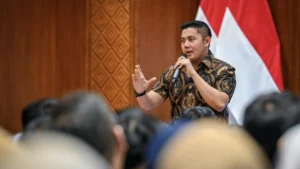
JAKARTA — In a strategic push to solidify political support at the grassroots level, Golkar Party Chairman Bahlil Lahadalia has called upon female members of the Al-Hidayah Islamic organization to actively engage communities in remote areas. Bahlil emphasized that these women must serve as the vanguard in spreading the message that Golkar is a party deeply committed to championing the rights and welfare of the common people. This directive was delivered during the opening ceremony of the 9th Muktamar (National Congress) of Pengajian Al Hidayah, held at the Sultan Hotel in Central Jakarta on Monday, October 20, 2025.
The appeal highlights Golkar’s ongoing strategy to expand its voter base through targeted community outreach, particularly among female demographics and religious study groups. By leveraging the extensive network of Al-Hidayah—one of Golkar’s most prominent autonomous wing organizations—the party leadership aims to counter rival political influences at the neighborhood level and reinforce its standing as a pro-people political entity.
Acknowledging Organizational Resilience Amid Adversity
Addressing the assembly of delegates from across the archipelago, Bahlil opened his address by expressing profound appreciation for the dedication and resilience demonstrated by the Al-Hidayah leadership board spanning the 2020–2025 tenure. He specifically commended the organization’s ability to navigate unprecedented structural challenges, noting that the current leadership was inaugurated during the height of the global COVID-19 pandemic. Despite the severe operational restrictions imposed during that period, the organization managed to expand its footprint and maintain effective internal consolidation.
"I must express my highest appreciation for the performance of the 2020–2025 management board, who were inaugurated during the COVID-19 pandemic yet managed to steer this organization into an extraordinary institution," Bahlil stated before the audience of female leaders and scholars.
This historical context underscores the adaptability of religious-social organizations in Indonesia, which often serve as vital safety nets and community support systems during crises. The successful navigation of the pandemic era has positioned Al-Hidayah as a robust pillar within Golkar’s broader sociopolitical ecosystem, making it a critical asset for future electoral campaigns.
Combating Digital Disinformation in Religious Spaces
Beyond political mobilization, Bahlil issued a stern warning regarding the pervasive threats emanating from the digital landscape. He cautioned members against the unchecked proliferation of disinformation, defamation, and divisive rhetoric—collectively referred to in Indonesian political discourse as Disinformasi, Fitnah, dan Kebencian (DFK)—which increasingly saturates social media platforms.
Bahlil specifically instructed Al-Hidayah members to exercise rigorous critical thinking when consuming and sharing online content, advising them not to allow unverified or misleading social media narratives to infiltrate religious study sessions (pengajian). Given the influential role that religious study groups play in shaping community opinions and moral frameworks across Indonesia, the Golkar leader underscored the importance of maintaining the integrity and factual accuracy of discussions held within these forums.
"We must not be fooled, esteemed mothers and brothers. Do not let incorrect content from social media serve as study material for our religious gatherings. This is something we must actively avoid," Bahlil warned.
The caution reflects growing concerns among political leaders and civil society organizations regarding the weaponization of digital platforms for political polarization. By addressing the issue directly, the Golkar leadership aims to insulate its constituent bases from polarizing narratives while promoting media literacy among grassroots communities.
Financial and Operational Backing for Grassroots Penetration
To translate these strategic directives into tangible outcomes, Bahlil announced that the central leadership board (DPP) of the Golkar Party is fully prepared to provide comprehensive operational support to all regional chapters (DPD) of Al-Hidayah at the provincial level. This financial and logistical backing is intended to empower local boards to execute high-impact community programs and significantly enhance Golkar’s electoral visibility in remote districts and villages.
Bahlil urged the members not to lag behind rival political factions that also utilize religious networks for outreach. He called for an aggressive, door-to-door engagement strategy that reaches down to the neighborhood (RT), hamlet, village (lurah), and sub-district (kecamatan) levels.
"Create quality activities so that Golkar achieves deep penetration among all neighborhood mothers. Do not lose out to the study groups of other political parties. Therefore, remain enthusiastic, enter the alleys, enter the village offices, enter every sub-district to convince the public that the party that genuinely loves the people and continues the struggle is the Golkar Party," Bahlil asserted.
This directive outlines a classic yet highly effective Indonesian political campaigning model: combining grassroots social welfare initiatives with direct interpersonal communication. By empowering women’s organizations to spearhead this outreach, Golkar taps into trusted community networks where female leaders often wield significant social influence.
Al-Hidayah’s Consolidation and Commitment to Public Service
Echoing the Chairman’s emphasis on organizational strength, the General Chairperson of Al-Hidayah, Hetifah Sjaifudian, detailed the systematic consolidation efforts undertaken by her administration. Hetifah reported that the organization has successfully executed comprehensive consolidation protocols across all structural tiers, ranging from plenary sessions and national coordination meetings (Rapimnas) to the culmination of the current national congress.
"From our internal DPP conducting meetings, plenums, and rapimnas, culminating in the muktamar, and similarly in the regions, we have focused on organizational strengthening. However, an organization is only strong so that we can better serve the community," Hetifah stated during the event.
Hetifah highlighted that Al-Hidayah’s mandate extends far beyond political objectives. Alongside its foundational mission of religious propagation (dakwah), the organization has consistently implemented a wide array of public service programs aimed at societal upliftment. These initiatives encompass educational programs designed to improve human capital, as well as socio-economic welfare projects aimed at alleviating financial hardships among underprivileged families.
Furthermore, Hetifah affirmed that the organization’s strategic roadmap aligns closely with broader national development objectives. The activities spearheaded by Al-Hidayah are designed not only to fulfill the spiritual and social obligations of its Muslimah members but also to actively support the strategic programs initiated by the central government.
"Therefore, everything will certainly be based on our acts of worship as Muslimahs, serving the community while simultaneously helping to ensure the success of the government’s strategic programs," she added.
Background Context and Electoral Implications
The timing of the 9th Muktamar of Pengajian Al Hidayah and Bahlil Lahadalia’s subsequent directives arrive during a critical inter-election phase in Indonesia. Following the complex dynamics of the 2024 general elections—which encompassed simultaneous legislative and presidential contests—political parties are proactively repositioning themselves for future electoral cycles, notably the upcoming regional head elections (Pilkada) and laying the groundwork for 2029.
Golkar, historically known as one of Indonesia’s most structurally disciplined and enduring political forces, relies heavily on its functional groups (karykek) and affiliated mass organizations (tata kelola hasta karya) to maintain a continuous connection with the electorate. Organizations like Al-Hidayah function as crucial structural bridges between the party elite and the broader populace, particularly among female voters who constitute a vital demographic majority in Indonesian elections.
Political analysts observe that directing grassroots outreach through religious and social networks remains one of the most resilient campaigning methods in Indonesia. Unlike fleeting media campaigns, community-based organizations foster deep personal ties and trust. By mobilizing women’s networks to counter disinformation and spearhead community service, Golkar is attempting to secure a stable and loyal constituency immune to sudden shifts in digital public opinion.
However, the success of this strategy will depend heavily on the effective utilization of the operational support promised by the central leadership and the ability of local Al-Hidayah chapters to translate ideological messaging into tangible local benefits. As the political landscape grows increasingly competitive, the capacity of parties to maintain authentic grassroots engagement while navigating digital complexities will likely determine their long-term electoral sustainability.
The conclusion of the 9th Muktamar marks a new chapter for Al-Hidayah under the continued stewardship of its leadership, with a renewed mandate to balance religious devotion, social welfare, and political mobilization in alignment with Golkar’s broader national ambitions.