Socio Today
The quiet agricultural landscape of Karangnongko district in Klaten regency, Central Java, holds layers of ancient history that continue to emerge from beneath the volcanic ash and fertile soil. For travelers and archaeology enthusiasts, the region serves as an open-air museum where remnants of classical-era Hindu-Buddhist kingdoms remain deeply intertwined with the daily lives of local farming communities. Recent explorations of two prominent archaeological sites in the area—Candi Karangnongko and Candi Merak—have shed light not only on the architectural brilliance of ancient Mataram-era artisans but also on the remarkable preservation efforts driven by community solidarity and modern discovery.
Unearthing the Enigma of Candi Karangnongko
The journey into Klaten’s historical depth often begins unexpectedly. While navigating the narrow rural pathways of Karangnongko, travelers frequently encounter signposts designating official cultural heritage sites (cagar budaya) managed by local preservation authorities. One such site, Candi Karangnongko, presents an enigmatic profile that continues to puzzle historians and field archaeologists alike.
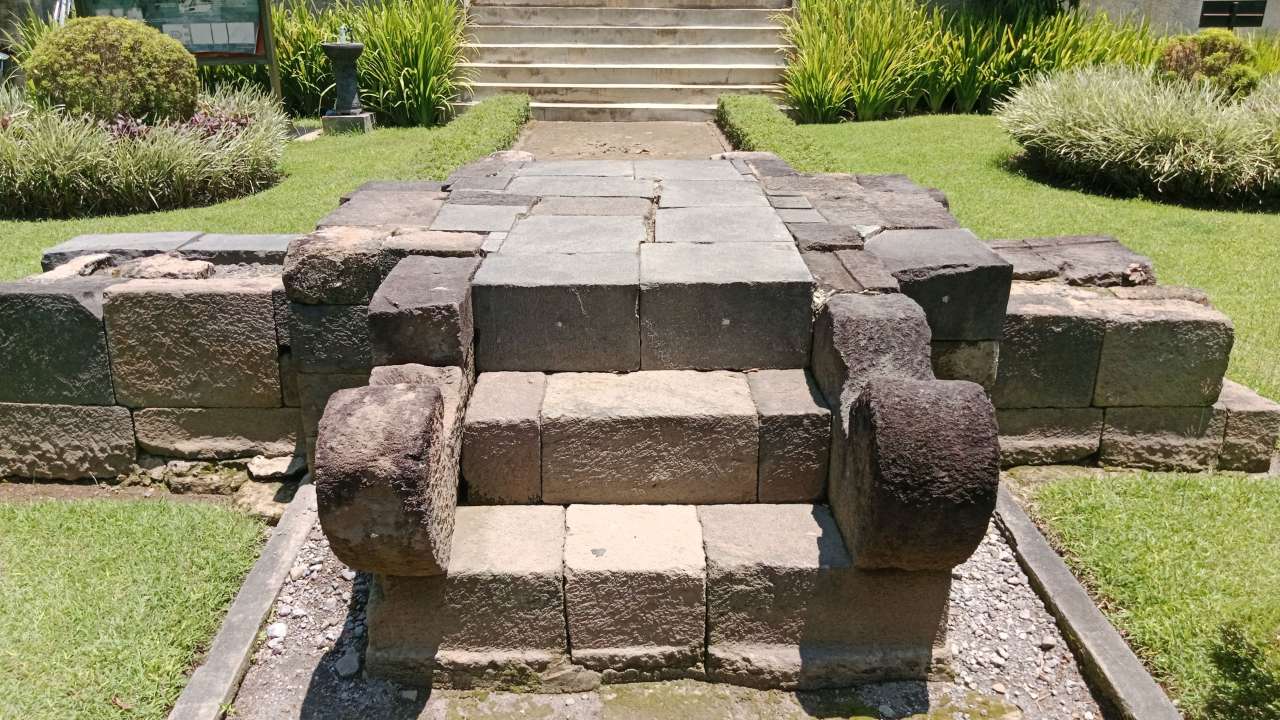
Unlike major temple complexes that boast towering spires and well-documented royal inscriptions, Candi Karangnongko was brought to light in the modern era entirely by chance, discovered by a local farmer while cultivating his paddy field. Today, the surface structure of the temple has collapsed almost entirely, leaving only the foundational base buried beneath the modern soil level. According to site caretakers, comprehensive excavation remains incomplete, suggesting that the broader architectural footprint of the complex extends significantly further than what is currently visible above ground.
Physical evidence at the site points to a catastrophic natural event in antiquity. Fragments of stone doorframes and architectural blocks bear signs of displacement that align with historical volcanic activity. Experts note strong indicators that the temple complex was heavily impacted, and perhaps ultimately destroyed, by ancient lahar flows originating from the nearby Mount Merapi. The directional scatter of the structural ruins mirrors the natural topography of local ravines, which historically served as primary drainage paths for volcanic debris.
Despite the scarcity of epigraphic data to definitively establish whether Candi Karangnongko belongs to the Hindu or Buddhist tradition, the site yields fascinating material culture. Among the debris are faint relief fragments featuring floral, faunal, and human motifs. Furthermore, exploration of the surrounding terrain reveals ancillary features of the ancient settlement, including an ancient freshwater spring surrounded by structural stone blocks located just a short descent down a nearby embankment. Local caretakers also maintain a growing collection of imported historical artifacts recovered from the soil, including fragmented shards of Chinese ceramics dating back centuries, indicating active trade networks during the temple’s operational period.

Candi Merak and the Legacy of Batara Gana
Roughly 800 meters northwest of Candi Karangnongko stands Candi Merak, a site offering a starkly contrasting level of historical preservation and documentation. Easily accessible along a rural roadway, Candi Merak presents a striking structural profile that has benefited from extensive archaeological reporting dating back to the Dutch colonial period.
First formally documented in 1925 through the archaeological surveys of the former Dutch East Indies administration, the site was initially reported by Prince Hadiwijoyo of Surakarta. Early colonial records indicate that the temple was historically referred to by local residents and regional officials as Candi Batara Gana, a designation derived from the prominent discovery of a Ganesha statue among the ruins. Over time, however, the vernacular name "Candi Merak"—reportedly inspired by the historical presence of peacock nests (merak) in the surrounding vicinity—superseded the formal administrative title in local discourse.
The architectural chronology of Candi Merak reveals a unique history of partial destruction and remarkable civic recovery. Historical excavation logs indicate that while the base and the upper roof sections of the main shrine survived initial seismic disturbances due to being buried under protective humus layers, the middle section of the temple structure remained exposed for centuries. During the colonial era and prior to strict heritage protection laws, portions of these exposed stones were dismantled by local residents and industrial operators for use in general construction, including flooring materials for a nearby factory warehouse.

Community Solidarity and Structural Reconstruction
The recovery of Candi Merak stands as a testament to the power of community-driven cultural preservation. Upon realizing the historical significance of the building materials in their possession, local residents and regional factory management demonstrated extraordinary civic cooperation. Warehouse floors constructed from the temple’s original stones were voluntarily dismantled, and the building blocks were systematically returned to the site to facilitate official architectural reconstruction.
Today, the meticulously reassembled main shrine of Candi Merak reflects classical Central Javanese Hindu architecture. The western exterior niche features a well-preserved statue of Ganesha, which traditionally serves a protective function in Hindu iconography as an obstacle-clearing deity guarding sacred spaces. The northern niche houses a six-armed representation of Goddess Durga, while the southern niche, intended for the sage Agastya, remains vacant as no corresponding statue has been recovered to date. Inside the primary sanctum, a well-preserved yoni confirms the site’s undisputed Hindu affiliation. The eastern sector of the complex features the foundations of three subsidiary shrines (candi perwara), alongside remnants of an ancient gateway and perimeter wall.
Broader Implications for Regional Heritage Management
The juxtaposition of Candi Karangnongko and Candi Merak highlights critical challenges and opportunities in Indonesia’s cultural resource management. While well-documented sites like Candi Merak attract consistent academic interest and heritage tourism, countless minor sites remain vulnerable to agricultural disruption, natural erosion from volcanic activity, and incomplete documentation.

Archaeological experts emphasize that sites lacking immediate epigraphic evidence—such as Candi Karangnongko—still hold vital data regarding ancient settlement patterns, rural religious practices, and pre-Islamic socioeconomic networks in the interior of Java. The integration of local community participation, as demonstrated by the caretakers and residents of Karangnongko and Klaten, remains an indispensable component of safeguarding these fragile historical assets for future generations.