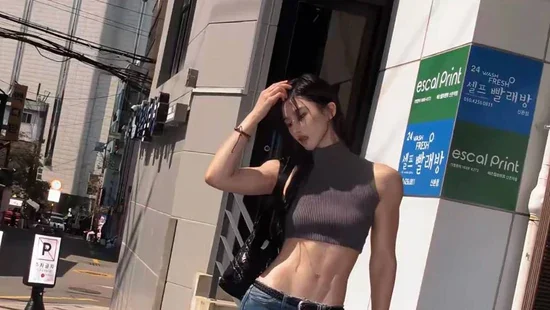
The bustling streets of South Korea recently served as the backdrop for a viral moment that has since captivated internet users across Asia and beyond. A series of candid photographs and short videos capturing a woman strolling through a metropolitan area in South Korea quickly disseminated across major social media platforms, most notably Weibo, before spilling over into global digital spaces. The subject of the viral media was immediately identifiable by a striking combination of features: a remarkably sculpted physique defined by pronounced abdominal muscles—commonly referred to as "six-pack abs"—and well-defined, muscular arms, contrasted with a striking, classical facial structure.
As the digital footprint of these street-style captures grew, public curiosity intensified regarding the identity of the athletic individual. Investigations by netizens and fashion insiders soon revealed that the woman at the center of the viral sensation is Zi Lang, a professional fashion model originating from China. Zi Lang’s unexpected emergence in South Korean public view, coupled with her bold sartorial choices, has reignited critical conversations regarding contemporary body image, the evolution of Asian beauty standards, and the rising appreciation for health-centric, athletic physiques over traditional, ultra-slender ideals.
Chronology of the Viral Sensation
The timeline of the event began in late October 2026, when pedestrian-captured images and videos of Zi Lang first surfaced on Chinese social networking sites. According to initial reports, the media was captured spontaneously by onlookers and street photography enthusiasts navigating a busy commercial district in South Korea. In the footage, Zi Lang is seen walking through the urban environment, naturally drawing the attention of passersby. The visual impact of her physique was so profound that several individuals on the street reportedly approached her to request photographs, captivated by her commanding physical presence.
Within days of the initial upload, the content transitioned from localized novelty to mainstream viral phenomenon. The posts accumulated millions of views, shares, and commentary across Weibo, Xiaohongshu, and subsequently Western platforms such as Instagram and TikTok. Fashion and fitness commentators quickly identified the model, charting her background in the competitive Chinese fashion industry. The rapid diffusion of the content underscored the immense power of digital street photography in catapulting niche fashion figures into international spotlights.
Sartorial Choices and the "Handsome Girl" Aesthetic
Zi Lang’s distinctive personal style played a pivotal role in the amplification of her viral moment. Known for embracing avant-garde and body-conscious streetwear, the model was photographed wearing a minimalist crop top paired with low-rise trousers. This deliberate sartorial framing accentuated her exceptionally lean waist, lack of subcutaneous body fat, and sharply defined abdominal musculature.
Fashion analysts have noted that Zi Lang’s aesthetic taps into a growing cultural archetype often described in Asian media markets as the "handsome girl" or cool girl persona. This persona breaks away from conventional hyper-feminine tropes by blending sharp, assertive facial features with a physically empowered, robust stature. Rather than adopting the fragile, ethereal aesthetic historically favored in high-fashion modeling, Zi Lang projects an aura of disciplined athleticism, confidence, and modern strength. Her ability to seamlessly merge high-fashion sensibilities with raw physical conditioning has earned her a rapidly expanding demographic of devoted followers, particularly among younger generations seeking alternatives to traditional beauty norms.
Challenging Conventional Beauty Standards in East Asia
The widespread acclaim and intense discussion surrounding Zi Lang’s viral appearance highlight a profound cultural shift occurring across East Asia, particularly within China and South Korea. Historically, the dominant beauty paradigm for women in these regions emphasized an ultra-slim, delicate frame—frequently characterized by terms such as "paper-thin," slender limbs, and an absence of visible muscle mass. Fitness regimes for women traditionally focused strictly on weight loss and maintaining a slender silhouette, with heavy resistance training and muscular hypertrophy often discouraged due to outdated societal expectations.
However, Zi Lang’s emergence challenges these conventional boundaries head-on. Her physique represents years of rigorous athletic dedication, structural weight training, and nutritional discipline. The enthusiastic public reception—characterized by admiration rather than skepticism—suggests a growing societal appreciation for health, vitality, and functional strength. Commentators have pointed out that Zi Lang’s popularity signals a broader democratization of fitness culture, where women are increasingly celebrated for building powerful, resilient bodies rather than merely conforming to passive standards of thinness.
Supporting Data and the Rise of Functional Fitness
The viral reception of Zi Lang aligns with broader macroeconomic and cultural trends within the health and wellness sectors across East Asia. According to market research data compiled throughout the mid-2020s, participation rates among women in structured strength training, CrossFit, and bodybuilding in urban centers such as Beijing, Shanghai, Seoul, and Tokyo have experienced double-digit year-on-year growth.
Furthermore, data from digital fitness applications indicate a significant surge in searches related to core strengthening, hypertrophy training, and macronutrient tracking among female demographics. This behavioral shift reflects a departure from cardio-centric weight loss regimens toward performance-based health metrics. Zi Lang’s physical presentation serves as a living embodiment of this statistical trend, providing a high-profile visual reference point for the modern fitness movement. Her extremely low body fat percentage and sculpted musculature are indicative of elite-level athletic conditioning, requiring meticulous dedication to both physical training protocols and dietary management—attributes that have garnered widespread respect from professional trainers and nutritionists alike.
Broader Implications and Socio-Cultural Impact
The implications of Zi Lang’s sudden international visibility extend far beyond the realms of internet celebrity and street fashion. From a socio-cultural perspective, media figures who defy traditional aesthetic boundaries play a crucial role in redefining public perceptions of health and beauty. By presenting an image of muscular strength that is simultaneously deemed high-fashion and socially desirable, models like Zi Lang help normalize athletic femininity on a global scale.
In the fashion industry, the demand for diverse body types has steadily increased, yet muscular definitions outside of traditional fitness modeling categories remain relatively rare on mainstream runways. Zi Lang’s viral moment demonstrates to brand marketers, fashion houses, and media agencies that consumer appetite for authentic, strength-based imagery is robust and commercially viable. Audiences, particularly younger women navigating digital spaces, increasingly gravitate toward role models who demonstrate agency over their physical health through hard work and discipline.
As the conversation surrounding Zi Lang’s street style continues to evolve, her accidental spotlight serves as a potent reminder of the changing tides in global fashion and culture. The celebration of her chiseled physique points toward a future where beauty standards are increasingly inclusive of strength, athleticism, and personal empowerment, permanently altering what it means to make an impression on the streets of a global metropolis.