The advent of the foldable smartphone market has ushered in a new era of mobile computing, yet it has also presented significant challenges for software developers tasked with bridging the gap between traditional vertical displays and expansive, multi-state folding screens. Apple’s entry into this segment, the iPhone Duo, has proven to be a particularly complex case for developers, including the leadership at Meta’s Instagram. Adam Mosseri, head of Instagram, recently admitted that optimizing the platform for the iPhone Duo’s unique form factor has been a considerably more daunting task than the development team initially anticipated. Despite the device being marketed as a premium, "Made for iPhone Duo" certified experience, the technical nuances of the device’s interface—specifically the placement of navigation controls—have necessitated a major overhaul of the application’s architecture.
The Technical Challenge of the iPhone Duo Form Factor
The iPhone Duo represents a departure from the monolithic, static glass slabs that have defined the smartphone industry for nearly two decades. By utilizing a hinge-based mechanism that allows the screen to expand into a tablet-like aspect ratio, Apple has forced developers to abandon the "one-size-fits-all" design philosophy. The primary technical hurdle identified by Mosseri stems from the iPhone Duo’s unique edge-based navigation system.
Unlike the standard iPhone, which utilizes a swipe-up gesture from the bottom of the screen, the iPhone Duo utilizes a proprietary navigation bar located on the right side of the outer display. When the device is folded, this edge-based navigation interface creates a conflict with Instagram’s core interaction points. Specifically, the "Like," "Comment," and "Share" buttons—which are staples of the Reels interface—often sit directly underneath the system navigation controls. This overlapping creates a "fat-finger" environment where users accidentally trigger system-level gestures when attempting to engage with social content.
A Chronology of Software Integration Issues
The development timeline for the iPhone Duo’s app ecosystem has been marked by rapid iteration and public feedback.
- October 2026 (Launch Phase): Following the official retail release of the iPhone Duo, early adopters noted that major applications were not optimized for the device’s expanded display. Users reported that Instagram, when opened in its full-tablet mode, simply centered the mobile-sized interface, leaving large, unsightly black bars on either side of the screen.
- Early November 2026: Users identified further interface bugs, including the misplacement of the back button in the top-left corner and the truncation of Instagram Stories, which failed to scale to the device’s resolution.
- Mid-November 2026: Apple reported that the number of optimized applications reached 100,000, spurred by the release of the iOS 27.1 Software Development Kit (SDK).
- November 20, 2026: Adam Mosseri publicly addressed the friction on the Threads platform, confirming that his team was working on a bifurcated approach to the UI, acknowledging the difficulty of managing two distinct display states: folded and unfolded.
The Shift to a Two-Column Architecture
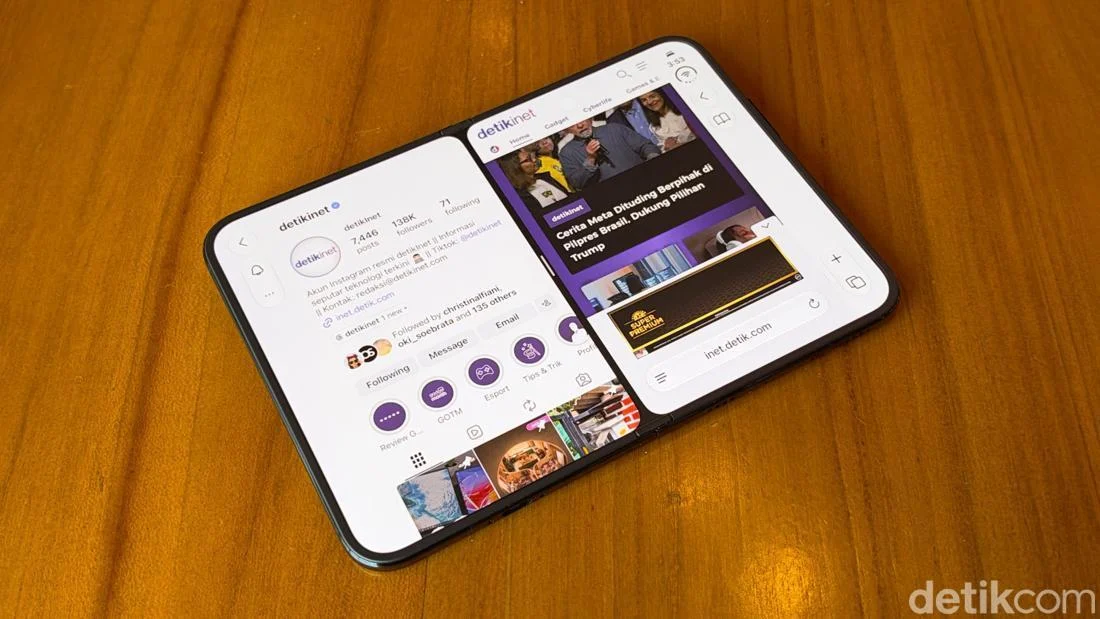
To rectify these usability issues, Instagram has rolled out a significant update that fundamentally alters how the application behaves on the iPhone Duo. The most prominent change is the implementation of a dynamic two-column layout. When the device is opened to its full landscape orientation, the main timeline now stretches to utilize the available width.
More importantly, the Reels interface has been re-engineered. Rather than overlaying comments on top of the video—which often obscures the visual content—the new version places the video in the left pane and the comment section in the right pane. This side-by-side arrangement allows for continuous video playback while the user engages with the community, a feature that was previously impossible without interrupting the viewing experience.
Furthermore, the integration of Direct Messages and Notifications has been overhauled. By adopting a "Master-Detail" view, the app now displays the list of conversations on the left and the active chat window on the right. This layout effectively maximizes the screen real estate of the iPhone Duo, transforming it from a mere "large phone" into a productive, multi-tasking workspace.
Broader Ecosystem Growth and Developer Implications
The difficulties faced by the Instagram team are not isolated. They represent a microcosm of the growing pains currently being experienced by the broader iOS developer community. Greg Joswiak, Apple’s Senior Vice President of Worldwide Marketing, revealed in mid-November that the number of applications optimized for the iPhone Duo had surged to over 200,000 in less than a month. This rapid growth is largely attributed to the updated iOS 27.1 SDK, which provides developers with the tools to manage the device’s status bar, side-mounted controls, and adaptive resolution.
However, the rapid growth in numbers masks the complexity of the task. For many developers, "optimization" is not a one-time update but an ongoing process of testing, debugging, and refining. The requirement to support both a narrow, tall external screen and a nearly square internal screen requires two distinct UI logic paths within a single application package.
The Remaining Hurdles
Despite the recent success in updating the tablet-mode interface, the Instagram team has yet to solve the core issue of the folded state. Mosseri’s commentary confirms that the current update focuses primarily on the unfolded experience. The "folded" state, where the device acts as a standard smartphone, continues to suffer from the button-overlap issue.
Industry analysts suggest that the solution may not lie solely with app developers, but potentially with future updates to Apple’s iOS interface. There is speculation that Apple may introduce a "safe zone" for third-party apps, effectively pushing interactive content away from the right-hand edge when the device is folded. For now, users must navigate a hybrid experience where the app performs optimally in one mode but remains flawed in the other.
Strategic Implications for Social Media Platforms
The shift toward foldable devices marks a pivotal moment for social media platforms that have historically optimized for a 9:16 vertical ratio. Instagram, TikTok, and other video-centric platforms are now forced to consider a "Responsive Social Design" (RSD) approach. This entails:
- Context-Aware UI: Applications must detect the state of the device’s hinge (0 degrees, 90 degrees, or 180 degrees) and adjust the interface elements in real-time.
- Adaptive Content Delivery: Server-side architecture must support high-resolution assets that can scale fluidly without pixelation or aspect ratio distortion when transitioning between screen states.
- User Preference Retention: The app must remember the user’s preferred state, ensuring that if a user is mid-reel and decides to fold the device, the transition is seamless rather than forcing a reload or a reset of the content feed.
Conclusion
The struggle of Instagram to fully integrate with the iPhone Duo highlights the tension between hardware innovation and software compatibility. While Apple has succeeded in delivering a highly anticipated piece of hardware, the burden of ensuring a premium user experience rests heavily on the shoulders of software developers.
For the time being, the Instagram experience on the iPhone Duo remains a work in progress. While the latest updates have vastly improved the utility of the unfolded display, the persistence of interface conflicts in the folded mode serves as a reminder that the foldable era is still in its infancy. As the user base for the iPhone Duo expands, the pressure on Meta and other tech giants to deliver perfectly optimized interfaces will only intensify, pushing the boundaries of what is possible in mobile application design. The industry will be watching closely to see if the next iteration of the iOS SDK provides a more comprehensive solution to the navigation challenges that currently plague the platform’s most popular applications.