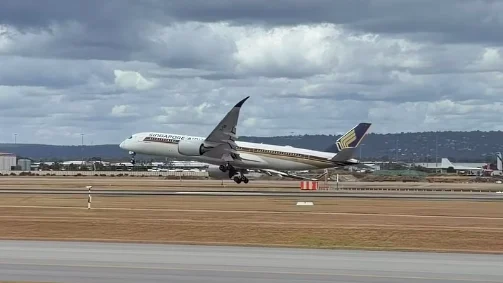
A Singapore Airlines flight crew is receiving international acclaim following a high-stakes display of aeronautical skill at Perth Airport, Western Australia, where a routine arrival was transformed into a harrowing test of safety protocols. On October 31, 2026, flight SQ213, operated by an Airbus A350-900, was forced to execute an emergency go-around after encountering severe wind shear and turbulent crosswinds during its final approach. The incident, captured by an observer near the perimeter of the tarmac, showcased the pilot’s split-second decision-making to abort a landing that had become dangerously unstable, preventing a potential aviation disaster.
Chronology of the Incident
The sequence of events began as flight SQ213, arriving from Singapore Changi Airport, initiated its descent into Perth International Airport. Weather conditions in the region had been identified as challenging, with the Australian Bureau of Meteorology reporting localized wind speeds of 32 km/h, punctuated by gusty conditions reaching up to 43 km/h. As the aircraft neared the threshold of the runway, it was buffeted by sudden, powerful wind gusts, causing the massive Airbus A350-900 to experience a significant bank to the right.
In footage widely circulated on social media, the aircraft is seen struggling to maintain a level flight path as its right wing dips precariously low, nearing the tarmac surface. Recognizing that the aircraft was drifting outside of the acceptable safety parameters for a stable landing, the flight crew immediately applied maximum thrust, retracted the landing gear, and initiated a climb back into the airspace. This maneuver, technically known as a "go-around," is a standard safety procedure, yet its execution under such volatile conditions highlighted the high level of training required of Singapore Airlines personnel. Following the initial aborted attempt, the crew circled the airport to recalibrate their approach and eventually completed a safe touchdown at 12:30 p.m. local time, taxying to the gate without further incident.
The Anatomy of a Go-Around
According to the Federal Aviation Administration (FAA) and international aviation safety standards, a go-around is a deliberate, controlled procedure performed to ensure the integrity of flight safety when an approach becomes unstable. Reasons for initiating this maneuver include runway incursions, fluctuating weather patterns, or the aircraft being out of the "stabilized approach" window—a set of parameters defined by altitude, airspeed, and descent rate.
In the case of SQ213, the pilot’s decision to execute the go-around was the primary factor in preventing a more severe outcome. In aviation safety culture, the "unstabilized approach" is a leading cause of runway excursions. By choosing to climb back to a safe altitude, the pilot prioritized the preservation of the aircraft and the lives of those on board over the desire to complete the landing on the first pass. This decision reflects the "safety-first" ethos championed by global aviation leaders and reinforced by the rigorous training programs at Singapore Airlines.
Public Reaction and Expert Commentary
The viral nature of the video—initially shared by an individual identified as Chris Perry, whose sister was a passenger on the flight—sparked a robust conversation regarding the dangers of aviation and the technical proficiency of pilots. On various digital platforms, netizens expressed relief and admiration for the crew.
"The footage is truly chilling; the wing was only inches away from the ground," noted Yolanda Malojer, one of many social media users who praised the composure displayed by the flight deck. Others, such as Sampath Gur, highlighted the psychological impact on passengers, noting that while the maneuver may have been terrifying for those in the cabin, the result was a testament to the high standards of pilot recruitment and recurrent training that Singapore Airlines maintains. The consensus among aviation enthusiasts and industry observers is that the outcome was not a matter of luck, but a direct result of disciplined adherence to safety protocols during a critical phase of flight.
Official Response and Airline Policy
A spokesperson for Singapore Airlines confirmed the details of the incident, acknowledging that flight SQ213 faced "adverse wind conditions" during its final approach to Perth. The airline’s statement emphasized that the crew acted in strict accordance with standard operating procedures.
"The safety of our passengers and crew is always our top priority," the spokesperson stated. "The flight crew made the correct decision to conduct a go-around in response to the prevailing weather conditions."
While the airline declined to release the identities of the pilots involved, citing privacy and internal policy, the move to not disclose names is standard for major international carriers during investigations of non-catastrophic events. The airline further confirmed that the flight landed safely on its second attempt, and no injuries were reported among the passengers or crew. The aircraft, a modern Airbus A350-900, was inspected following the incident as part of routine post-flight safety checks, though no significant damage was reported.
The Role of Meteorology in Aviation Safety
The incident at Perth serves as a critical case study in how atmospheric conditions impact modern commercial aviation. The Australian Bureau of Meteorology’s data for the day confirms that the airport was experiencing significant wind fluctuations. For an aircraft as large as an A350, crosswinds of 43 km/h—while within the structural limits of the aircraft—can create sudden "pockets" of air that require rapid input from the fly-by-wire flight control systems and the pilot.
Aviation experts note that wind shear—a sudden change in wind speed or direction—can be particularly deceptive. It can cause an aircraft to lose lift or gain excessive airspeed in seconds. This highlights the importance of real-time communication between Air Traffic Control (ATC) and flight crews, as well as the necessity for pilots to maintain a high level of situational awareness during the landing phase.
Broader Implications for Airline Training
The praise surrounding the SQ213 crew underscores the public’s high expectations for airline transparency and safety. In an era where air travel is increasingly common, incidents like this serve as a reminder of the inherent risks involved in commercial aviation. For airlines, such events are often used as training materials in flight simulators to help other pilots practice handling similar crosswind scenarios.
The incident also reinforces the effectiveness of the "Stabilized Approach Policy" adopted by most major carriers. This policy encourages pilots to abandon an approach if the aircraft is not in the correct configuration, at the correct speed, and on the correct flight path by a specific altitude (usually 1,000 feet for instrument approaches). By strictly adhering to these rules, the pilots of SQ213 demonstrated that the aviation industry’s commitment to safety is not merely a slogan, but an actionable, moment-to-moment practice.
Looking Forward
As the aviation industry continues to recover and grow following the challenges of the early 2020s, the focus on pilot competency and safety technology remains paramount. The A350-900, which is known for its advanced flight deck and maneuverability, played a crucial role in allowing the pilots to regain control quickly after the aborted landing.
This event is unlikely to lead to any formal investigations by aviation safety regulators beyond the standard internal review conducted by Singapore Airlines, as the go-around was a textbook execution of a safety procedure. Instead, the incident will likely be remembered as a successful demonstration of professional airmanship. It serves as a reassuring signal to the traveling public that, despite the volatility of nature, the training and judgment of modern flight crews remain the ultimate defense against the unpredictable challenges of the skies. The passengers on SQ213 arrived at their destination safely, and the crew’s calm execution under pressure has set a positive example for pilots worldwide, reinforcing the importance of prioritizing safety over schedule.