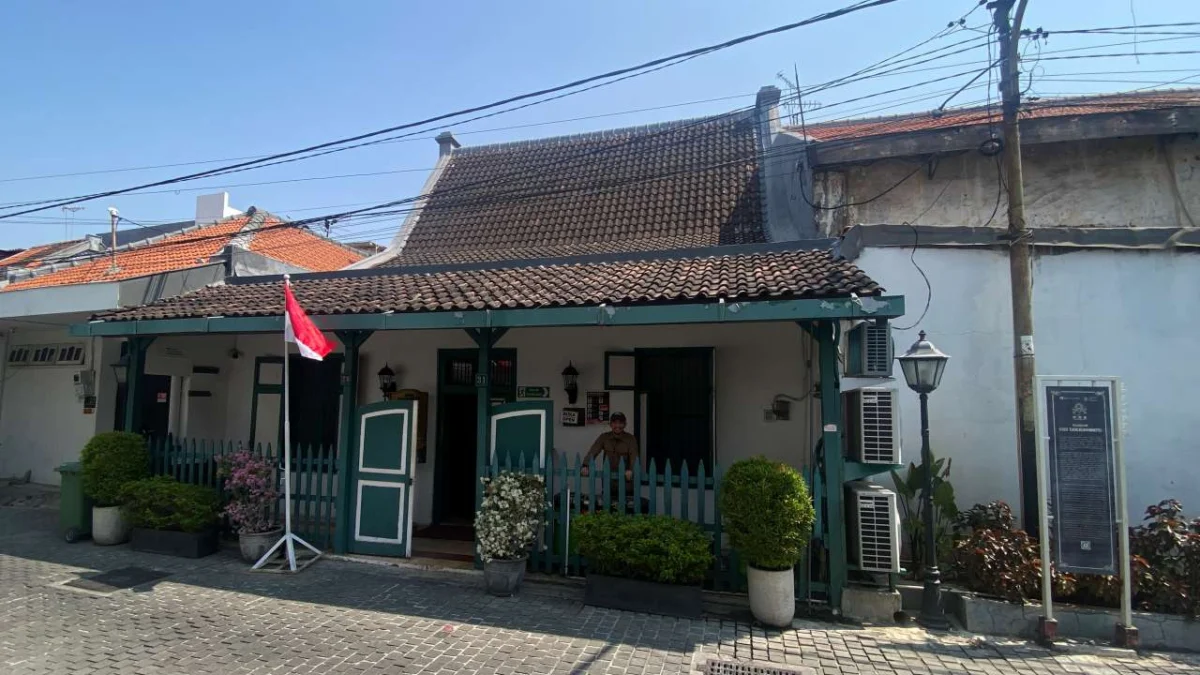
Standing quietly amid the densely populated neighborhood of Peneleh in Surabaya, an aging two-story structure bearing a green wooden fence and a weather-beaten tiled roof continues to bear silent witness to Indonesia’s formative political history. Located at Jalan Peneleh Gang VII Nomor 29–31, this unassuming building was once the epicenter of the nation’s early nationalist movement, serving as the residence of the prominent Sarekat Islam leader Haji Oemar Said (H.O.S.) Tjokroaminoto. Decades after serving as a crucible for some of Indonesia’s most influential political figures—including a young Sukarno—the property functions today as a meticulously preserved museum that offers profound insights into the country’s turbulent journey toward independence.
The physical architecture of the house bridges the gap between late-colonial domesticity and institutional memory. Upon entering the premises, visitors are greeted by a classic front room featuring wooden chairs arranged around a marble-topped circular table, low storage cabinets, and a disciplined array of historical photographs depicting the leadership of the Sarekat Islam. The dark wooden ceiling panels and yellowish floor tiles imbue the space with an atmosphere vastly distinct from contemporary, sterile museum environments. According to architectural assessments and records provided by the Surabaya City Government, the building is estimated to have been erected in the 1870s, making it well over a century and a half old and predating Tjokroaminoto’s tenancy by several decades.

The historical significance of the Peneleh residence extends far beyond its age; it lies primarily in its role as a boarding house and intellectual salon for ambitious youths from across the archipelago. When Tjokroaminoto and his wife, Soeharsikin, occupied the home, they opened its doors not only to their own family but also to indigenized students pursuing secondary education in Surabaya. Living under the strict socio-political constraints of the Dutch colonial administration—which systematically marginalized bumiputra (native) populations—these young lodgers were exposed to radical anti-colonial discourses. Tjokroaminoto, renowned as the "King without a Crown" (Koning zonder kroon) and a master orator, cultivated an environment where future leaders with divergent political ideologies could debate the future of the nation under one roof. Among these boarding students was a young Sukarno, who arrived in Surabaya in 1916 to attend the Hogere Burgerschool (HBS).
Accessing Sukarno’s former quarters requires navigating a narrow, steep iron staircase painted green that leads directly to the building’s low-ceilinged attic. The space is sparse, featuring exposed wooden flooring, a small window cutout in the wall, a modest cupboard, and a signboard designating the area as the "Soekarno Room." Far from being a romanticized sanctuary, the physical austerity of the attic reflects the genuine poverty experienced by its most famous resident. In his autobiography, "Bung Karno: As the Tongue of the Indonesian People," compiled by Cindy Adams, the nation’s future first president recalled the stark reality of his living conditions. Sukarno noted that the room lacked both doors and windows, forcing him to rely on artificial illumination even during daylight hours, while his meager furnishings consisted of a wobbly table, a wooden chair, a clothes hanger, and a single sleeping mat devoid of mattresses or pillows.
This stark reality underscores the multifaceted evolution of the Peneleh property over the course of more than a century. Historical documentation from the Surabaya Museum reveals that Tjokroaminoto sold the house in 1921, marking the end of its era as the headquarters of radical domestic intellectualism. For decades following the departure of its most famous occupants, the building drifted into an uncertain chapter. In 1958, during his presidency, Sukarno revisited his former boarding quarters and expressed a strong desire to preserve the historical site, a vision that materialized in 1968 when the government assumed control of the property.

However, the transition from private residence to historical monument was neither immediate nor straightforward. Between 1968 and 2016, the building was utilized primarily as a communal public facility for local residents. For nearly half a century, the site absorbed the daily routines of the surrounding neighborhood, functioning as a civic space rather than a curated memorial. It was not until 2016 that municipal authorities, under the administration of then-Mayor Tri Rismaharini, initiated comprehensive restoration efforts to transform the building into an official museum. The site was formally inaugurated on November 27, 2017, housing approximately 143 curated collections consisting of both authentic artifacts and interpretive replicas designed to recreate the socio-political atmosphere of the early 20th-century nationalist movement.
The broader historical implications of the H.O.S. Tjokroaminoto Museum resonate deeply within contemporary Indonesian historiography. Academic analyses, such as those documented by the National Awakening Museum, emphasize that Tjokroaminoto’s leadership transformed Sarekat Islam from a localized merchant association into the first mass-based political movement in the Dutch East Indies. By advocating not only for commercial rights but also for fundamental political enfranchisement and human dignity for native populations, the Sarekat Islam congresses—particularly the pivotal gathering in 1916—laid the ideological groundwork for the Indonesian national awakening. The museum preserves this legacy by displaying key archival materials, including photographic documentation from 1914 and 1916, alongside preserved garments such as Sukarno’s HBS school uniform and Tjokroaminoto’s official congress attire.
Today, the Peneleh residence stands as a testament to the fluid and layered nature of architectural heritage conservation. Accessible via a streamlined digital ticketing system managed through the official Surabaya tourism portal, the museum attracts domestic and international visitors eager to connect with the roots of Indonesian independence. Yet, beyond its appeal as the birthplace of presidential ambitions, the building’s enduring value lies in its complex biography: a 19th-century colonial-era home, a nationalist incubator, a post-colonial communal space, and ultimately, a preserved national treasure. Through its cyclical transformations, the house at Jalan Peneleh Gang VII continues to challenge visitors to look beyond static historical narratives and recognize the dynamic intersection of domestic life, political struggle, and community memory in the shaping of modern Indonesia.