The preservation of colonial-era architecture and Peranakan heritage in Medan, North Sumatra, has increasingly become a focal point for cultural tourism and urban historical studies. Among the most prominent landmarks representing this rich cross-cultural synthesis is the Tjong A Fie Mansion, located in the historic Kesawan district. Originally constructed in the late 19th and early 20th centuries, this architectural marvel serves as a physical testament to the profound socioeconomic transformation of the Deli region under colonial rule, as well as the enduring legacy of one of Southeast Asia’s most influential philanthropists and business magnates.
Architectural Splendor and Urban Context in Kesawan
Situated at Jalan Ahmad Yani No. 105 in West Medan, the Tjong A Fie Mansion stands as an iconic symbol of Peranakan Chinese architecture seamlessly blended with European, Malay, and traditional Chinese design elements. The surrounding Kesawan district itself retains much of its historical layout, characterized by wide, pedestrian-friendly sidewalks that invite both local and international visitors to explore the preserved colonial-era streetscape.

Upon approaching the property, visitors are greeted by an authentic entrance gateway adorned with traditional Chinese architectural motifs, flanked by two stone guardian lions and illuminated by rows of red lanterns. The estate occupies a significant plot of land featuring lush, manicured gardens that provide a stark contrast to the bustling urban environment outside. Designated as an official cultural heritage building by the Medan City Government under a decree issued on October 28, 2021, the mansion is currently managed as an engaging house museum, welcoming the public daily from 9:00 AM to 5:00 PM, with closures exclusively observed during the Lunar New Year celebrations.
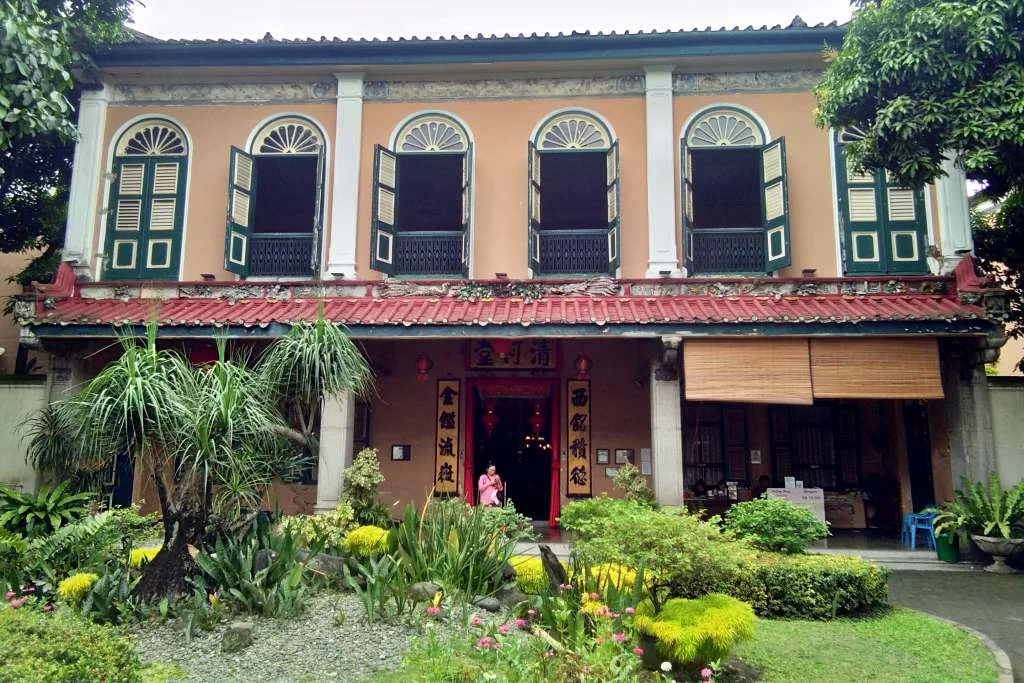
The main building’s facade exhibits classic Peranakan characteristics, featuring intricate roof designs, expansive second-story louvered windows, and prominent Chinese character inscriptions above the primary entrance. Inside, the estate preserves an extensive collection of period-appropriate furnishings, including intricately carved wooden tables, chairs, and cabinets. Glass display cases and shelves hold numerous Chinese ceramic vases of varying shapes and sizes, underscoring the cultural identity of the original occupants. The interior also features unexpected elements such as a vintage piano and classic hanging chandeliers, reflecting the cosmopolitan lifestyle of a wealthy late-colonial elite household.
Chronology and Historical Background of Tjong A Fie
The history of the Tjong A Fie Mansion is intrinsically linked to the economic boom of the Deli region during the mid-to-late 19th century. The chronology of this era was heavily shaped by Dutch colonial expansion into Sumatra’s east coast. In the 1860s, Dutch entrepreneur Jacobus Nienhuys obtained land concessions from the Sultan of Deli, Sultan Mahmud Perkasa Alam, to cultivate tobacco. The immense success of Deli tobacco prompted Nienhuys to relocate the headquarters of the Deli Maatschappij from Labuhan to Medan Putri in 1869, laying the foundation for modern Medan’s emergence as an economic hub.

Amidst this rapid agricultural and commercial development, Tjong A Fie arrived in Deli. Born in 1860 in Meixian District, Guangdong, China, Tjong A Fie migrated to Sumatra at the age of 17 to join his elder brother, Tjong Yong Hian. Starting humbly by working in his brother’s enterprise, Tjong A Fie eventually expanded their business empire across multiple sectors. The brothers accumulated vast wealth and influence, ultimately controlling extensive portfolios in real estate, mining, banking, railways, and large-scale plantations producing tobacco, tea, rubber, palm oil, coconut, and sugar.
By 1911, Tjong A Fie’s leadership within the local Chinese community was officially recognized when colonial authorities appointed him as the Majoor der Chinezen (leader of the Chinese community) in Medan. In acknowledgment of his substantial contributions to regional commerce and society, the Dutch colonial government bestowed upon him the prestigious honor of the Order of Orange-Nassau.
Philanthropy and Community Impact
Beyond his status as a corporate titan and financial magnate, Tjong A Fie was widely celebrated as a visionary philanthropist. His guiding philosophy is encapsulated in a frequently cited personal creed displayed within his former residence: "Success and glory consist not in what I’ve gotten but in what I’ve given."

Unlike many contemporary tycoons of the colonial era whose investments remained insular, Tjong A Fie’s charitable endeavors transcended ethnic, cultural, and religious boundaries. He actively financed the construction of essential public infrastructure, including schools, hospitals, houses of worship such as mosques, temples, and churches, as well as welfare facilities for the broader multi-ethnic population of Medan. His ability to foster harmonious coexistence among diverse communities—including the Peranakan Chinese, indigenous Malays, Javanese, Batak, South Asians, and Europeans—played a crucial role in shaping the cosmopolitan identity of modern Medan. Tjong A Fie passed away on February 4, 1921, leaving behind a legacy of civic engagement that remains influential to this day.
Preservation Efforts and International Recognition
Following decades of private occupancy by descendants, the preservation of the Tjong A Fie Mansion transitioned into a structured heritage conservation project. A significant milestone in these conservation efforts occurred in 2013, when the property received a substantial grant from the United States government through the Ambassadors Fund for Cultural Preservation (AFCP). This international funding facilitated critical restoration work, focusing primarily on structural roof repairs and comprehensive architectural repainting to safeguard the fragile interior and exterior against tropical weathering.
The success of these preservation initiatives was officially recognized in October 2016, when the Tjong A Fie Mansion was awarded the Anugerah Purwakalagrha Museum Award in the category of "Engaging Museum." Cultural analysts and tourism experts have noted that the mansion serves as a benchmark for historic preservation in Indonesia, demonstrating how privately owned heritage sites can be successfully maintained and operated as educational public institutions.

Broader Implications for Cultural Tourism and Urban Development
The enduring popularity of the Tjong A Fie Mansion highlights the growing economic and educational value of heritage tourism in urban centers across Indonesia. By positioning historical sites as living classrooms, local governments and cultural foundations can educate younger generations on the complex migration histories and multicultural foundations that built modern Indonesian cities.
Furthermore, the integration of pedestrian-friendly urban planning around the Kesawan district serves as a model for sustainable urban regeneration. Officials note that maintaining historic landmarks while enhancing public infrastructure encourages longer tourist stays, stimulates local small-scale commerce, and fosters civic pride in regional history. As Medan continues to develop into a major metropolitan center, the careful stewardship of the Tjong A Fie Mansion ensures that the lessons of cross-cultural cooperation and philanthropic leadership demonstrated by its founder will endure for future generations.