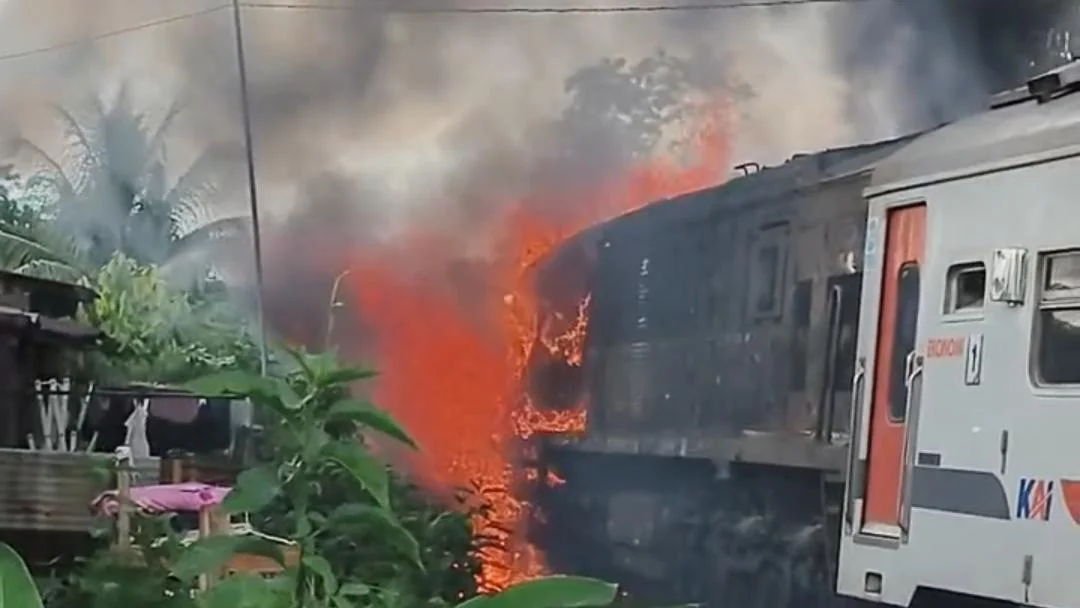
A tragic collision between the Siantar Ekspres train, traveling the Pematangsiantar-Medan route, and a Sinar Tani minibus has ignited a critical national discourse regarding safety standards at railway crossings. The incident, which occurred on Friday, November 20, 2026, in the Sinaksak area of the Tapian Dolok district, Simalungun Regency, resulted in the death of the minibus driver and left three railway crew members suffering from severe burn injuries. The violent impact caused both the train’s locomotive and the minibus to catch fire, turning a routine transit operation into a scene of devastation. While the 264 passengers on board the train remained unharmed, the incident has highlighted the persistent and lethal vulnerability of non-gated railway crossings across the country.
Chronology and Immediate Aftermath
The collision took place during the morning transit hours when the Siantar Ekspres was navigating through a segment of the track characterized by an unauthorized or poorly signaled level crossing in Sinaksak. Preliminary reports indicate that the minibus attempted to cross the tracks without yielding to the approaching train. Due to the lack of automatic gates or formal warning systems, the minibus entered the path of the oncoming locomotive, resulting in an immediate collision.
The force of the impact was sufficient to derail the front of the locomotive and ignite a fire that quickly engulfed the minibus and the train’s head carriage. Emergency responders were dispatched to the site, where they focused on evacuating the 264 passengers and providing medical aid to the three injured railway personnel. Despite the swift response, the minibus driver was confirmed dead at the scene. The fire caused significant operational disruption, forcing the suspension of the Pematangsiantar-Medan line for several hours as investigators cleared the wreckage and assessed the structural integrity of the tracks.
The Legal Framework of Liability
The question of accountability in such incidents is complex, involving statutory obligations under Indonesian law. Joni Martinus, a railway expert and head of the Railway Division at the Indonesian Transportation Society (MTI) for the South Sumatra region, emphasizes that legal responsibility is determined by the provisions of Law Number 22 of 2009 concerning Road Traffic and Transportation.
Under Article 114 of this legislation, motorists are strictly required to stop when a train signal is audible, when gates begin to close, or when other warning signs are present. Crucially, the law grants trains the "right of way" at all level crossings. According to Martinus, if a motorist ignores these signals or attempts to beat a train at an unmanned crossing, the primary legal liability falls upon the driver. In the eyes of the law, such actions constitute negligence. If the driver survives, they may face criminal charges and potential imprisonment or fines. Because the driver in the Sinaksak incident is deceased, the legal proceedings typically shift toward the investigation of civil liability and the potential for insurance claims, though the findings of negligence against the driver often limit the liability of the train operator, PT Kereta Api Indonesia (KAI).
Institutional Responsibilities: KAI and Employee Welfare
While the driver may bear primary responsibility for the collision, PT KAI carries a distinct set of obligations toward its employees and passengers. For the three crew members injured in the fire, PT KAI is legally and ethically bound to provide full medical coverage and support for their recovery. As an employer, the state-owned enterprise must ensure that these workers, who were performing their professional duties at the time of the accident, receive appropriate workers’ compensation and long-term care for their injuries.
Regarding the passengers, the Railway Law (Law Number 23 of 2007) mandates that the rail operator is responsible for the safety of those on board. This includes, but is not limited to, medical costs for those injured in an accident, compensation for the families of any deceased passengers, and restitution for lost or damaged property. In the Sinaksak incident, the fact that no passengers were killed or seriously injured is a testament to the safety features of the carriages, yet it does not absolve the operator of the duty to review safety protocols in the wake of such a significant operational disturbance.
The Crisis of Unmanned Crossings
The Sinaksak incident is not an isolated event but rather a symptom of a systemic issue. Statistics from the past four years reveal a grim trend in accidents at non-gated or "unmanned" railway crossings. In 2022, there were 245 reported accidents at these locations, resulting in 110 fatalities. The following year, 2023, saw an increase to 274 accidents with 94 deaths. In 2024, there were 213 incidents causing 123 deaths, and by 2025, there were 171 accidents with 106 fatalities.
These numbers confirm that thousands of unauthorized or improperly managed crossings serve as "ticking time bombs." The lack of infrastructure—specifically the absence of barriers, clear warning signs, and professional guards—creates an environment where human error, however minor, results in a fatal outcome. Experts argue that the current approach of "blaming the driver" is insufficient, as it fails to address the underlying lack of physical barriers that prevent drivers from entering the tracks at the wrong time.
Strategic Solutions and Recommendations
To prevent further loss of life, the MTI and other transport advocates are calling for a three-pronged strategy involving infrastructure, enforcement, and public education.
1. Infrastructure Reform
The most permanent solution is the physical separation of road and rail traffic. This involves the construction of flyovers or underpasses at high-traffic crossings. While these projects are capital-intensive and often delayed by land acquisition issues, they are the only way to eliminate the risk of collision entirely. For smaller, rural crossings, the installation of automatic gates and proper signaling is a mandatory, if interim, requirement.
2. Strengthening Law Enforcement
Increased surveillance and stricter enforcement are necessary to deter reckless driving behavior. This includes utilizing CCTV and automated monitoring systems at crossings to identify and fine motorists who violate traffic signals. Creating a culture of accountability through punitive measures for those who bypass safety barriers or cross illegally is essential for long-term behavior change.
3. Cultural Shift and Education
Technological and physical infrastructure must be supported by public awareness. Many drivers in Indonesia do not fully grasp the braking distance of a train or the importance of waiting at a crossing. Mass education campaigns focusing on the "Stop, Look, and Listen" protocol must be integrated into driver training programs and public safety announcements.
A Call for Immediate Action
The tragedy in Simalungun has acted as a catalyst for a renewed demand for accountability from the local government, the Directorate General of Railways (DJKA), and PT KAI. The call to action is clear: the authorities must immediately audit all railway crossings in Sumatra and across Indonesia. Any crossing deemed dangerous must be upgraded or closed permanently.
Joni Martinus emphasized that one death is one too many. "The incident at Sinaksak should serve as a final wake-up call. We cannot continue to treat these accidents as mere statistics. Every unmanned crossing represents a failure to protect the public. The government, the operators, and the local administrations must stop passing the responsibility and begin the systematic closure and upgrading of these dangerous points."
As the investigation into the Sinaksak accident continues, the broader implications for the national transport network remain clear. Without a dedicated national budget for rail crossing safety and a more aggressive stance on infrastructure development, the cycle of accidents at level crossings will inevitably continue, endangering both the lives of motorists and the safety of thousands of daily rail commuters. The time for reactive measures has passed; the current situation demands a proactive, unified national safety policy.