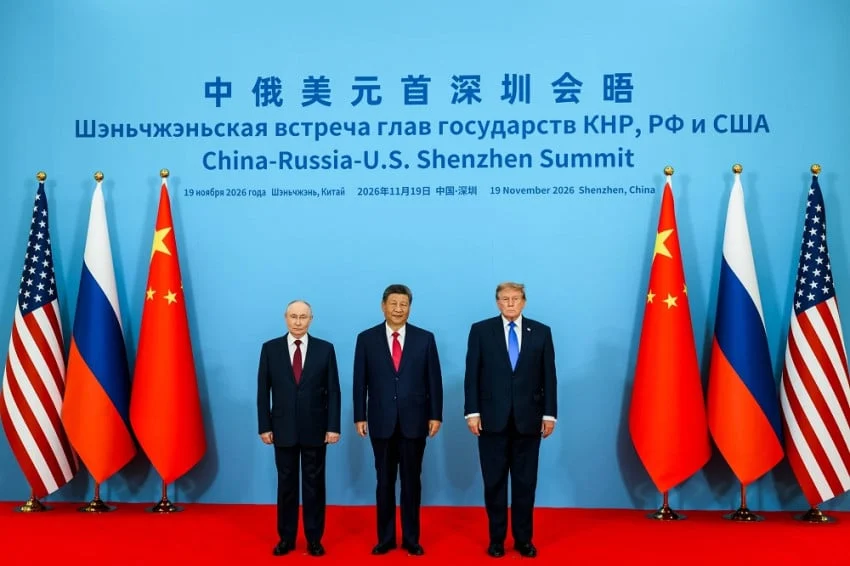
WASHINGTON — In what is being hailed by the current administration as a landmark diplomatic realignment, United States President Donald Trump has returned from the Asia-Pacific Economic Cooperation (APEC) summit in Shenzhen with glowing assessments of his interactions with Russian President Vladimir Putin and Chinese President Xi Jinping. Describing his four-day tour of Asia as one of the most successful presidential visits in American history, Trump highlighted a historic trilateral meeting that he claims has fundamentally altered the trajectory of global geopolitics. Amid lingering anxieties regarding the potential escalation of major power conflicts, the American leader’s assertions of a “fantastic relationship” with Beijing and Moscow have ignited an international debate over whether the looming specter of a third world war has effectively been averted.
The diplomatic tour, which culminated in a high-profile press conference at the White House upon Trump’s return, brought together the world’s three premier nuclear-armed superpowers. While the broader APEC summit featured delegations and bilateral engagements with more than 20 world leaders, the proceedings were undeniably overshadowed by the unprecedented three-way dialogue between Washington, Beijing, and Moscow. According to Trump, the concentration of global influence among these three nations became the focal point of the international gathering, prompting discussions that could redefine multilateral diplomacy for decades to come.
The Tripolar Reality of Global Geopolitics
The institutional gravity of the trilateral summit underscored a growing consensus among international relations experts: the unipolar moment of post-Cold War American dominance has decisively given way to a competitive, multipolar—or specifically tripolar—global order. During his post-summit address, President Trump candidly addressed the dynamic observed during the proceedings in Shenzhen. He noted that while numerous heads of state were in attendance to discuss regional trade and economic integration, the primary attention of the global community was fixated on the interactions between the United States, China, and Russia.
“Other leaders felt a little left out because they wanted to see—in this particular case, they wanted to see three countries—so it really became a three-country summit,” Trump remarked to reporters gathered in the White House briefing room. The acknowledgment reflects a pragmatic acceptance of realpolitik, wherein the management of global stability is increasingly recognized as the exclusive purview of the globe’s foremost military and economic superpowers.
Trump characterized the closed-door trilateral talks as one of the most significant international summits in recent memory. Central to the discussions was the shared responsibility of managing nuclear arsenals and preventing catastrophic conflict. The American president emphasized that the rapport established between himself, President Xi, and President Putin was instrumental in lowering geopolitical temperatures that had reached post-Cold War highs following the outbreak of war in Ukraine and mounting tensions in the South China Sea and Taiwan Strait.
Chronology of the Diplomatic Breakthrough
The path toward this historic trilateral engagement was paved through months of quiet backchannel negotiations, culminating in the high-stakes environment of the Shenzhen APEC summit.
- Pre-Summit Preparations: Senior diplomatic envoys from the United States, China, and Russia held clandestine preparatory talks in neutral European and Asian capitals to outline a framework for strategic stability discussions, bypassing traditional bureaucratic hurdles to secure direct leadership engagement.
- Day One and Two (APEC Opening): President Trump arrived in Shenzhen, immediately engaging in a series of tightly choreographed bilateral meetings. Economic cooperation dominated the public sessions, but intelligence and security briefings focused heavily on crisis management protocols.
- Day Three (The Trilateral Summit): In an unannounced closed-door session, President Trump, President Xi, and President Putin convened for their first official trilateral meeting. The talks lasted nearly three hours and superseded the scheduled multilateral agenda of the broader APEC schedule.
- Day Four (Declarations and Departure): Following the conclusion of the summit, President Putin held a separate press conference outlining areas of diplomatic convergence, while President Trump departed for Washington, carrying what he termed a nascent framework for permanent global de-escalation.
- White House Press Conference: Upon his return to Washington, President Trump briefed the White House press corps, declaring the diplomatic mission an unprecedented success and unveiling the contours of the newly minted trilateral understandings.
Substantive Outcomes: The Trilateral Peace Declaration
While skeptics routinely caution against interpreting rhetorical warmth as concrete policy shifts, the administration insists that the Shenzhen meetings yielded tangible diplomatic deliverables. Foremost among these is what President Trump termed the first-ever trilateral peace declaration between the United States, Russia, and China.
Though the full text of the declaration remains under review by respective foreign ministries, preliminary briefings indicate that the document establishes formal commitments in several critical areas:
- Strategic Risk Reduction: The three nuclear powers agreed to establish upgraded, direct military-to-military communication channels to prevent miscalculations in contested regions, including Eastern Europe and the Western Pacific.
- Non-Proliferation and Arms Control: Discussions laid the groundwork for future trilateral dialogues on strategic stability, aiming to incorporate emerging military technologies and hypersonic delivery systems into modernized arms control frameworks.
- Regional Hotspots: The leaders engaged in detailed consultations regarding ongoing crises, specifically addressing diplomatic pathways for the war in Ukraine, the denuclearization of the Korean Peninsula, and stability in the Middle East, with a particular focus on Iran’s nuclear program.
- Economic and Energy Coordination: Recognizing the interconnected nature of global markets, the parties discussed frameworks to stabilize global energy supplies and mitigate supply chain disruptions exacerbated by ongoing geopolitical friction.
The Ukrainian Conflict: A Pivot Toward Diplomacy?
A cornerstone of the bilateral engagements on the sidelines of APEC was the ongoing war in Ukraine. For months, international observers have debated whether a diplomatic off-ramp was achievable given the deeply entrenched territorial demands of Kyiv and Moscow. President Trump’s meetings with President Putin appear to have injected new momentum into stalled peace initiatives.
According to the White House readout, Putin expressed a renewed willingness to explore political and diplomatic settlements to bring the conflict to a close. While details regarding territorial concessions or security guarantees remain closely guarded, the mere inclusion of the Ukraine conflict as a primary agenda item in a constructive trilateral framework marks a notable departure from the isolationist posture previously maintained by Western allies toward Moscow.
In his post-APEC press briefing, President Putin echoed sentiments of cautious optimism regarding the prospects for dialogue, emphasizing that Moscow remains open to comprehensive security arrangements that address the root causes of the European security crisis. European capitals have responded with a mixture of relief and apprehension, eager for an end to the devastating conflict but deeply concerned about being sidelined in negotiations that directly impact continental security architecture.
Global Reactions and Geopolitical Implications
The international community has reacted to the Trump-Putin-Xi summit with a complex blend of cautious optimism and strategic anxiety. Allies of the United States, particularly within NATO and the European Union, are carefully analyzing the long-term implications of a U.S. foreign policy that increasingly prioritizes direct, high-level deal-making among major powers over traditional institutional alliances.
Proponents of the administration’s approach argue that robust, pragmatic diplomacy between Washington, Beijing, and Moscow is the only viable method to prevent catastrophic military escalation. In an era where regional conflicts carry the inherent risk of cascading into global nuclear confrontation, open lines of communication at the highest executive levels are viewed as an indispensable safeguard.
Conversely, critics and foreign policy analysts warn against the potential marginalization of smaller sovereign states. The framing of global governance as a tripartite arrangement among three dominant superpowers risks reviving 19th-century spheres of influence politics, potentially undermining international law and the sovereignty of nations caught in the geopolitical crossfire—most notably Ukraine, Taiwan, and smaller nations within the Asia-Pacific region.
Furthermore, economic analysts point out that while diplomatic detente can soothe market jitters and reduce defense spending pressures, systemic rivalries regarding trade, technology transfer, and intellectual property rights between the U.S. and China remain largely unresolved. The temporary alignment demonstrated at APEC must be weighed against the structural economic decoupling that continues to reshape global supply chains.
Conclusion: Has World War III Been Averted?
The question of whether World War III has been averted cannot be answered by a single diplomatic summit, no matter how historic. Geopolitical stability is an ongoing process maintained through institutional resilience, adherence to international norms, and continuous, verifiable diplomatic engagement.
President Trump’s triumphant portrayal of his relations with Vladimir Putin and Xi Jinping reflects an enduring belief in personal diplomacy as a force multiplier in international relations. By bringing the world’s three primary nuclear adversaries to the table in a focused, high-stakes environment, the Shenzhen summit has undeniably lowered immediate tensions and opened new channels for dialogue on arms control and conflict resolution.
Whether this trilateral rapport translates into enduring peace or proves to be a fleeting diplomatic photo-op will depend entirely on the follow-through of the respective governments. As the world watches to see if the commitments made in Shenzhen materialize into formal treaties and lasting resolutions in Ukraine and beyond, the specter of global conflict has undeniably receded—replaced, for the moment, by the fragile yet hopeful architecture of great power diplomacy.