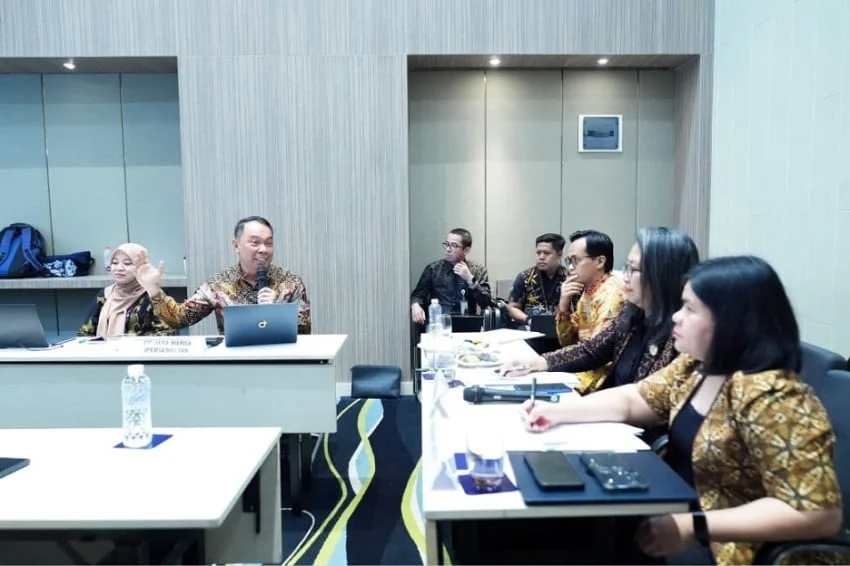
PT Jasa Marga (Persero) Tbk, Indonesia’s premier toll road developer and operator, has reaffirmed its unwavering dedication to corporate transparency, accountability, and public service excellence. This commitment was prominently displayed during the Public Test Presentation for the 2026 Monitoring and Evaluation of Public Information Disclosure (Monev KIP), an esteemed national evaluation organized by the Central Information Commission (Keterbukaan Informasi Pusat) in Jakarta. The high-profile evaluation event, held on Wednesday, November 11, 2026, serves as a vital benchmark for state-owned enterprises, government agencies, and public bodies to measure their compliance with national transparency mandates, specifically under Law Number 14 of 2008 concerning Public Information Disclosure.
The active participation of Jasa Marga in this rigorous evaluation process underlines its strategic shift toward institutional modernization. Rather than viewing transparency as a mere regulatory obligation, the corporation has integrated information disclosure into the core of its business operations, governance frameworks, and customer-centric service models. As an entity managing critical national infrastructure that impacts millions of citizens daily, Jasa Marga recognizes that open access to accurate, timely, and reliable information is a fundamental right of the public and a cornerstone of modern corporate governance.
Corporate Vision and Leadership Perspective on Transparency
During the evaluation proceedings in Jakarta, Jasa Marga’s President Director, Rivan A. Purwantono, delivered a comprehensive presentation highlighting the company’s strategic initiatives in digital governance and public communication. He emphasized that public information disclosure acts as a critical catalyst for organizational transformation, fostering a culture of openness that directly enhances the quality of services delivered to Indonesian motorists and stakeholders.
"We are fully committed to establishing Jasa Marga as a highly trusted public body through transparent, accountable, participatory, and digitally driven information management," stated Rivan A. Purwantono during the public test. He further elaborated that the company’s leadership views openness not simply as compliance with the law, but as a moral and operational imperative. By nurturing a corporate culture that values transparency across all organizational tiers, Jasa Marga aims to build a responsive ecosystem capable of anticipating and addressing the evolving informational needs of the public.
This leadership-driven vision is cascaded throughout the corporate structure, ensuring that every operational unit, from executive management to frontline toll booth operators and digital service teams, adheres to strict standards of information dissemination. The goal is to eliminate informational asymmetry between the corporation and its customers, thereby building long-term institutional trust and reinforcing public confidence in national infrastructure management.
Managing Vast Infrastructure Networks and High-Volume Traffic
To truly contextualize Jasa Marga’s heavy reliance on robust information systems, one must examine the sheer scale of its operational footprint across the Indonesian archipelago. As the dominant player in the country’s toll road sector, Jasa Marga currently holds concessions for 36 distinct toll road corridors spanning a total planned length of 1,736 kilometers. Of this extensive pipeline, an impressive 1,318 kilometers of operational toll roads are currently active and serving the public daily.
This vast network forms the logistical backbone of Indonesia’s economic mobility, connecting major industrial hubs, ports, residential centers, and agricultural regions, particularly across the islands of Java and Sumatra. The volume of daily traffic handled by Jasa Marga’s infrastructure is staggering. On any given ordinary day, approximately 3.6 million vehicles traverse the company’s network. During peak holiday seasons, such as Eid al-Fitr (Lebaran), Christmas, and New Year holidays, this volume surges exponentially, presenting immense logistical and informational challenges.
Given this heavy reliance by millions of daily commuters, the demand for accurate, real-time travel information is dynamic, constant, and critical. Drivers require immediate updates regarding traffic congestion, accidents, construction zones, weather conditions, alternative routes, and toll tariff structures. A failure to deliver timely information can lead to severe gridlock, increased logistical costs, and public dissatisfaction. Consequently, Jasa Marga’s commitment to public information disclosure is inextricably linked to its operational mandate of ensuring safe, smooth, and seamless mobility for the nation.
Technological Integration and the Role of the Jasa Marga Tollroad Command Center
To address the monumental task of managing millions of daily commuters and providing them with accurate data, Jasa Marga has heavily invested in advanced digital infrastructure. At the heart of this technological ecosystem is the Jasa Marga Tollroad Command Center (JMTC). Established as a state-of-the-art monitoring and control facility, the JMTC operates around the clock to oversee traffic flow across all managed corridors.
The JMTC is equipped with cutting-edge surveillance and data-processing tools, including more than 3,500 closed-circuit television (CCTV) cameras strategically positioned along the toll road network. These cameras are supplemented by various advanced traffic monitoring devices, automated sensors, and the Intelligent Transportation System (ITS). The ITS aggregates massive volumes of raw data, translating it into actionable intelligence that empowers operators to make swift tactical decisions.
When unexpected incidents occur—such as vehicular breakdowns, accidents, or adverse weather conditions—the JMTC processes the information rapidly. This integration allows for accelerated operational responses, such as dispatching mobile customer service teams, coordinating with highway police, deploying tow trucks, and simultaneously broadcasting real-time updates to the public. By leveraging big data analytics and automated monitoring systems, Jasa Marga ensures that its information dissemination is not only reactive but increasingly predictive and preventive.
Multi-Channel Public Communication and Digital Accessibility
Ensuring that vital operational data reaches the end-user effectively requires a diversified and accessible communication strategy. Jasa Marga has developed an omni-channel ecosystem designed to meet the diverse digital literacy and preferences of modern motorists. Through these integrated channels, travelers can access comprehensive information before and during their journeys.
The Travoy Application
Serving as the flagship digital assistant for Indonesian motorists, the Travoy application provides real-time information regarding traffic conditions, CCTV feeds across various toll segments, rest area availability, toll tariff calculations, and emergency assistance features. Travoy bridges the gap between the corporate command center and the individual driver’s smartphone.
Call Center Services and Dedicated Hotlines
For users seeking immediate verbal assistance or reporting emergencies on the road, Jasa Marga operates its dedicated Call Center 133. Staffed by trained professionals available 24/7, this hotline provides immediate support, guidance, and coordination for motorists in distress.
Official Web Portals and PPID Services
In alignment with legal mandates for public bodies, Jasa Marga maintains comprehensive corporate websites alongside a dedicated portal for the Pejabat Pengelola Informasi dan Dokumentasi (PPID) or Public Information and Documentation Management Officer. The PPID portal serves as the official repository where citizens can formally request public documents, financial reports, corporate governance disclosures, and regulatory compliance data.
Social Media Engagement
Recognizing the ubiquity of social media in daily life, Jasa Marga actively utilizes official platforms to broadcast live traffic advisories, safety campaigns, and operational updates, ensuring widespread visibility and direct engagement with younger, digitally native demographics.
Through this robust multi-channel network, travelers can effortlessly check real-time traffic speeds, estimate travel times, locate nearby rest areas equipped with specific amenities, and file grievances or requests for assistance without encountering administrative friction.
Proactive Disclosure and Institutional Strengthening of the PPID
Beyond reactive customer service and real-time traffic broadcasting, Jasa Marga has institutionalized a policy of proactive disclosure. Under this framework, the corporation systematically publishes information that the public is entitled to receive without waiting for formal information requests. This proactive approach is categorized into three primary domains as mandated by national transparency regulations:
- Periodic Information: Regularly updated financial statements, corporate governance reports, sustainability metrics, and annual summaries published on the corporate website and PPID portal.
- Immediate Information (Informasi Serta-Merta): Urgent operational announcements, such as emergency traffic diversions, major construction schedules, weather warnings, and unexpected disaster responses disseminated instantly across all communication channels.
- Information Available at All Times (Informasi Tersedia Setiap Saat): Essential corporate documents, standard operating procedures, concession agreements, and regulatory frameworks maintained in an organized archive for public inspection upon request.
To ensure the seamless execution of these proactive policies, Jasa Marga has systematically strengthened the institutional capacity of its PPID unit. This includes streamlining internal standard operating procedures for data verification, upgrading document management systems, and conducting regular training programs for personnel across all regional units and subsidiary companies. By embedding transparency metrics into the Key Performance Indicators (KPIs) of various departments, Jasa Marga ensures that information disclosure is treated as a continuous, measurable, and corporate-wide responsibility.
Broader Economic and Societal Implications of Corporate Transparency
The continuous refinement of public information disclosure by a major infrastructure provider like Jasa Marga carries profound implications for the broader Indonesian economy and society. In an era where infrastructure development is accelerating rapidly across the nation, public trust is a vital currency. When citizens and businesses have unfettered access to reliable data regarding toll operations, tariff policies, and corporate governance, market certainty improves significantly.
For the logistics sector, predictable and transparent traffic data allows fleet operators to optimize supply chain schedules, reduce fuel consumption, and minimize delivery delays, ultimately lowering operational costs and enhancing national economic competitiveness. For individual motorists, real-time access to accurate journey data reduces travel stress, improves road safety, and empowers consumers to make informed travel choices.
Furthermore, by actively participating in national evaluations such as the Central Information Commission’s Monev KIP, Jasa Marga sets a benchmark for other state-owned enterprises and private corporations. It demonstrates that transparency is not a vulnerability to be managed, but a strategic asset that drives
operational efficiency, builds institutional credibility, and fosters a collaborative relationship between state-owned infrastructure providers and the public they serve. As Jasa Marga continues to refine its digital command systems and expand its proactive disclosure frameworks, the company solidifies its position as a forward-thinking leader in modern public sector governance.