Socio Today
The landscape of Indian higher education and national governance has been thrust into a state of profound uncertainty following the resignation of Union Education Minister Dharmendra Pradhan. The high-profile exit comes after weeks of escalating civil unrest, characterized by large-scale demonstrations from students, educators, and youth activists across the country. The catalyst for this political upheaval was a series of high-stakes national examination scandals, involving allegations of widespread paper leaks, systemic corruption, and technical failures that have jeopardized the futures of millions of students.
Pradhan announced his departure through a statement on the social media platform X on Saturday, July 25. His resignation coincided with a day of intense volatility in the nation’s capital, New Delhi, where security forces deployed tear gas and baton charges to disperse crowds gathered near the historic Jantar Mantar observatory and Parliament Street. In his resignation letter addressed to Prime Minister Narendra Modi, Pradhan cited a desire to prevent "anti-national forces" from exploiting the student grievances to destabilize the country. He emphasized that while he recognized the legitimate frustrations of the youth, his continued presence in the ministry had become a lightning rod for broader political conflict.
The Genesis of the Crisis: A Systemic Failure in National Testing
The current crisis is rooted in the integrity of India’s centralized testing systems, specifically those managed by the National Testing Agency (NTA). For months, reports have circulated regarding the illicit sale of question papers for prestigious exams such as the National Eligibility cum Entrance Test (NEET-UG) for medical aspirants and the University Grants Commission-National Eligibility Test (UGC-NET) for academic and research fellowships.
In May and June, the scale of the discrepancies became impossible for the government to ignore. Thousands of students reported identical high scores in certain regions, while others came forward with evidence of leaked digital documents circulating on messaging apps hours before the examinations commenced. The NTA’s initial denial of these claims only served to fuel public anger. When the government eventually canceled the UGC-NET exam just a day after it was conducted, citing "compromised integrity," the move sparked a national outcry, leading many to question the validity of every major examination conducted under Pradhan’s tenure.
The Rise of the Cockroach Janta Party (CJP)
A unique feature of this wave of dissent is the emergence of the "Cockroach Janta Party" (CJP). What began as a satirical social media movement in May quickly transformed into a formidable grassroots political force. The name, a self-deprecating nod to the feeling among students that they are treated as "pests" or "scavengers" in a broken educational system, resonated with millions of Gen-Z Indians.
The CJP utilized digital platforms to organize offline protests, moving beyond simple online petitions to occupying key urban centers. Their demands were clear: the total overhaul of the National Testing Agency, the establishment of an independent judicial inquiry into the leaks, and the immediate resignation of the leadership at the Ministry of Education. By July, the CJP had successfully bridged the gap between different student unions and regional organizations, creating a unified front that the Modi administration could no longer dismiss as fringe activism.
Chronology of the Protests and Government Response
The path to Pradhan’s resignation was marked by a series of critical escalations:
- Early May: Initial reports of irregularities in the NEET-UG exams surfaced in Bihar and Gujarat. Local police arrested several individuals involved in "solver gangs" that allegedly sold papers for millions of rupees.
- June 4: The release of NEET-UG results showed an unprecedented number of perfect scores, leading to allegations of grace-mark manipulation and systemic fraud.
- Late June: The Ministry of Education canceled the UGC-NET and postponed several other exams, including the NEET-PG. Protests erupted in New Delhi, Kolkata, and Hyderabad.
- July 1-20: The "Cockroach Janta Party" launched a nationwide "Satyagraha for Education." Prominent activist Sonam Wangchuk began a hunger strike in support of the students, demanding constitutional protections for educational integrity.
- July 22-24: Protesters occupied Parliament Street. The government responded by suspending mobile internet services in parts of the capital and deploying paramilitary forces.
- July 25: Following a day of violent clashes between police and students at Jantar Mantar, Dharmendra Pradhan submitted his resignation.
Prime Minister Modi’s Intervention and Fast-Track Justice
In the hours preceding Pradhan’s resignation, Prime Minister Narendra Modi broke his silence on the matter through a televised address and a recorded message distributed via social media. Acknowledging the "deep pain and anxiety" of the student community, the Prime Minister vowed that "not a single culprit would be spared."
The Prime Minister announced the formation of a High-Level Committee of Experts to suggest reforms in the mechanism of the examination process and the functioning of the NTA. Furthermore, he promised the establishment of "fast-track courts" specifically dedicated to trying cases related to paper leaks. This move is seen as an attempt to restore public confidence in the rule of law, as many past scandals of this nature in India have languished in the judicial system for decades without reaching a resolution.
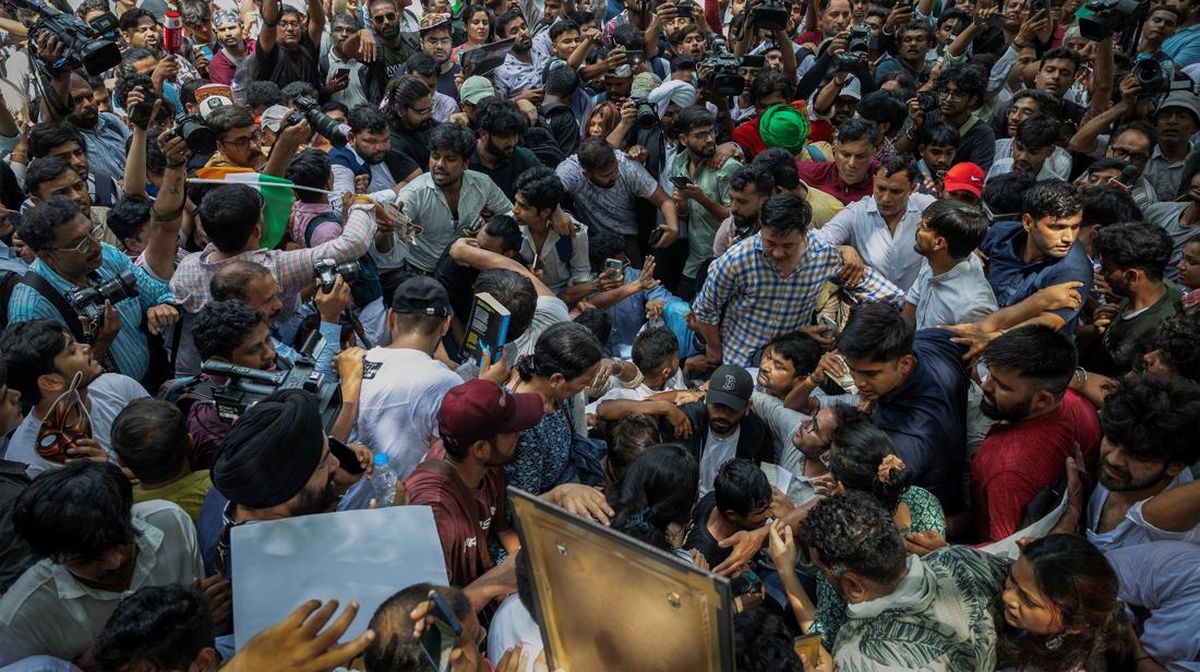
While the Prime Minister’s promises were welcomed by some, the student leadership remained skeptical. Activists from the CJP stated that while the resignation of the minister was a "victory for the streets," it was only the first step. They continue to demand a complete legislative framework—a "National Anti-Leak Law"—that would impose life imprisonment and massive fines on those involved in academic racketeering.
International Scrutiny and Human Rights Concerns
The government’s handling of the protests has drawn significant international attention. Human rights organizations, including Amnesty International and Human Rights Watch (HRW), issued statements condemning the use of "excessive force" against student demonstrators. The use of "baton-charges" (Lathi charge) and the preventive detention of student leaders were highlighted as violations of the right to peaceful assembly.
The suspension of internet services—a tactic frequently used by the Indian government during times of civil unrest—was particularly criticized. HRW noted that cutting off communication channels during a crisis involving students and education is counterproductive, as it prevents the dissemination of accurate information and further isolates a vulnerable demographic.
Supporting Data: The Scale of the Crisis
The magnitude of the examination scandal is reflected in the sheer number of affected individuals. Data from the Ministry of Education and independent educational NGOs provide a glimpse into the stakes involved:
- NEET-UG: Approximately 2.4 million students appeared for this exam in 2024, competing for roughly 110,000 medical seats.
- UGC-NET: Over 1.1 million candidates registered for the June session, which was eventually canceled.
- Economic Impact: Estimates suggest that the coaching industry in India, which prepares students for these exams, is valued at over $15 billion annually. The cancellation and rescheduling of exams impose a significant financial burden on families from lower-income backgrounds who often travel long distances to reach test centers.
- Historical Context: This is not India’s first major leak. Between 2017 and 2024, there have been more than 70 reported instances of paper leaks across various state and central recruitment and entrance exams, affecting an estimated 17 million job and seat seekers.
Broader Implications for the Modi Administration
The resignation of Dharmendra Pradhan is a significant blow to the Bharatiya Janata Party (BJP)-led government in its third term. Unlike the previous two terms, where the government enjoyed a comfortable majority, the current coalition dynamic makes it more sensitive to mass movements and public dissatisfaction.
The youth vote was a critical component of the 2024 general election discourse, and the perception that the government cannot protect the meritocratic foundations of the country could have long-term electoral consequences. Political analysts suggest that the education crisis has given the opposition a potent tool to challenge the "Modi Guarantee" of efficient and clean governance.
Furthermore, the crisis highlights the limitations of over-centralizing the examination process. The NTA was created to streamline testing and reduce the burden on students, but critics argue that by creating a single point of failure, the government has inadvertently made the system more vulnerable to large-scale sabotage.
Conclusion and Future Outlook
As of the night of July 25, the atmosphere in New Delhi remains tense. While Sonam Wangchuk has ended his 26-day hunger strike following Pradhan’s resignation, the CJP and other student unions have vowed to continue their "occupation" of Parliament Street until a formal roadmap for NTA reform is published.
The departure of Dharmendra Pradhan marks a turning point in the relationship between the Indian state and its youth. It serves as a stark reminder that in a country with a massive "demographic dividend," the integrity of the educational and competitive systems is not just a policy issue, but a matter of national security and social stability. The coming weeks will reveal whether the government’s proposed "fast-track" solutions and leadership changes will be enough to heal the rift and restore the broken trust of a generation.