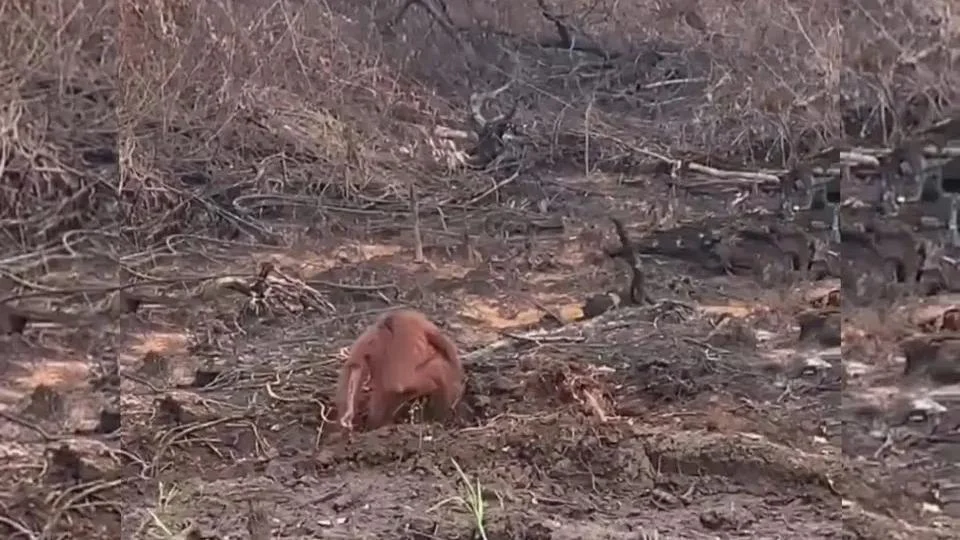
The devastating impact of recent forest and land fires in Central Kalimantan has reached a critical humanitarian and environmental juncture, as at least three orangutans have been sighted struggling to survive within the charred remains of their natural habitat near Bagendang Tengah Village, Mentaya Hilir Utara, Kotawaringin Timur. The displacement of these endangered primates highlights the escalating pressure on wildlife as fire-induced habitat destruction forces them into dangerous proximity with human agricultural activities in search of sustenance.
According to reports from the Natural Resources Conservation Agency (BKSDA) Pos Sampit, the presence of these individuals was confirmed following extensive field observations conducted by agency personnel. The once-lush ecosystems that served as a sanctuary for these great apes have been transformed into fragmented scrubland, leaving the animals vulnerable to starvation and forced migration into community-owned plantations and farms.
The Chronology of Displacement and Initial Rescue
The crisis came to light following a series of environmental disturbances in the Kotawaringin Timur region. The most significant indicator of the deteriorating conditions occurred on October 31, 2026, when local residents discovered a solitary juvenile female orangutan, estimated to be approximately four years old, wandering along the roadside in Bagendang Tengah.
The animal, separated from its mother and clearly distressed, was secured by villagers who recognized the importance of safeguarding the protected species. Following protocol, they reported the encounter to village authorities, who subsequently transferred the juvenile to the custody of the BKSDA Pos Sampit. This incident served as a catalyst for a more comprehensive survey of the surrounding forest edges, revealing the extent of the damage caused by the fires. Subsequent assessments conducted by BKSDA officers confirmed that the majority of the forest canopy in the area had been consumed by flames, with residual smoke still billowing from various smoldering hotspots throughout the region.
The Ecology of Survival: Why Orangutans Are Moving
The movement of the three remaining orangutans toward the fringes of human civilization is a direct behavioral response to the loss of their natural food sources. Orangutans are highly intelligent and specialized arboreal creatures that rely on complex forest structures for fruit, leaves, and bark. When fires ravage these ecosystems, the immediate removal of food sources forces the animals to traverse open ground, which is against their natural evolutionary instinct.
Muriansyah, the head of BKSDA Pos Sampit, noted that the situation is becoming increasingly precarious. "From the reports provided by the village head and the local residents we encountered on-site, it is estimated that at least three individual orangutans are currently lingering in the remnants of the forest or the scrubland, particularly along the banks of the Sampit River," he stated.
The proximity to the riverbank suggests that the animals are attempting to find areas that offer at least a modicum of cover and residual moisture. However, as the fires have expanded into agricultural zones and shrublands, the "buffer zone" between wildlife and human activity has effectively vanished. This creates a high-risk environment where conflict becomes inevitable.
Broader Implications of Habitat Destruction in Central Kalimantan
The situation in Kotawaringin Timur is symptomatic of a larger, systemic problem in the Indonesian archipelago. Forest fires in Central Kalimantan are often exacerbated by a combination of seasonal droughts, climate change-induced meteorological patterns, and the conversion of peatlands for agricultural use.
Data from environmental monitoring organizations indicates that when peatlands are drained or disturbed, they become highly flammable. The resulting fires are not merely surface events; they can burn underground for weeks, releasing significant amounts of carbon and destroying the subterranean root systems that underpin forest regeneration. For species like the Bornean orangutan (Pongo pygmaeus), which is listed as Critically Endangered by the International Union for Conservation of Nature (IUCN), the loss of habitat is a death knell for localized populations.
The fragmentation of the forest means that these animals are no longer part of a larger, healthy ecosystem but are instead trapped in "islands" of vegetation. These isolated pockets cannot support the nutritional needs of orangutans over the long term, leading to physical degradation, weakened immune systems, and, in the case of the juvenile discovered on October 31, the permanent separation of dependent offspring from their mothers.
Official Response and Public Safety Protocols
The BKSDA has mobilized its resources to monitor the situation continuously. The agency has implemented a strategy of ongoing surveillance to track the movements of the three identified orangutans. This monitoring is critical for two reasons: to ensure the welfare of the animals and to protect the local human population from potential defensive encounters.
"We continue to conduct surveillance at the location, and we have scheduled further monitoring activities over the coming days to anticipate the appearance of the orangutans in the vicinity of plantations and residential areas," Muriansyah explained.
The BKSDA has issued a strict set of directives for local residents to minimize the risk of human-wildlife conflict. The primary instruction is for citizens to refrain from any attempt to capture, approach, or intimidate the animals. Such actions, while perhaps born of curiosity or fear, can induce extreme stress in the primates, potentially leading to defensive aggression.
Key safety protocols issued to the public include:
- Immediate Notification: If an orangutan is spotted near a garden or village, residents should contact the BKSDA immediately rather than intervening.
- Maintaining Distance: Keeping a significant physical buffer between humans and the animal is essential to prevent zoonotic disease transmission and accidents.
- Restraint: Avoid the use of traps or makeshift barriers that could inadvertently injure the animals.
- Professional Intervention: Only trained BKSDA personnel are authorized to perform rescues or relocations to ensure that the process adheres to strict veterinary and behavioral welfare standards.
The Path Forward: Conservation Challenges
The challenge facing the Kotawaringin Timur administration is to balance economic agricultural activities with the legal requirement to protect endangered species. Under Indonesian law, the orangutan is a protected animal, and the destruction of its habitat constitutes a serious breach of conservation regulations.
Experts suggest that long-term solutions require more than just emergency intervention. Restoration of the damaged areas, the implementation of fire-prevention infrastructure within agricultural zones, and the creation of "wildlife corridors" are essential to prevent future iterations of this crisis. Without a cohesive strategy to manage the land-use conflict, the cycle of forest fires followed by wildlife displacement will continue to repeat.
The BKSDA’s current focus remains on the immediate survival of the three orangutans. By keeping a watchful eye on the periphery of the fire-damaged sites, they hope to mitigate the risk of these animals wandering into populated areas where they might face retaliatory violence or accidental harm.
Conclusion
The case of the displaced orangutans in Bagendang Tengah is a poignant reminder of the fragility of the Bornean ecosystem. As the smoke clears from the latest round of forest fires, the plight of these three individuals serves as a proxy for the hundreds of other species that are quietly suffering from the loss of their natural homes.
The collaboration between local villagers and the BKSDA demonstrates a growing awareness of the need for coexistence. However, the survival of these primates depends heavily on the agency’s ability to maintain a protective presence while local authorities investigate the underlying causes of the fires. As the region moves toward the end of the year, the priority remains clear: to ensure that these critically endangered animals are protected from the repercussions of a disaster they did not create, and to restore the integrity of the landscape they call home.
The BKSDA remains committed to its mandate of wildlife preservation, emphasizing that the health of the forest is inextricably linked to the well-being of the human communities that share the land. Further updates on the status of the three orangutans are expected as monitoring efforts continue into the next phase of the environmental assessment.