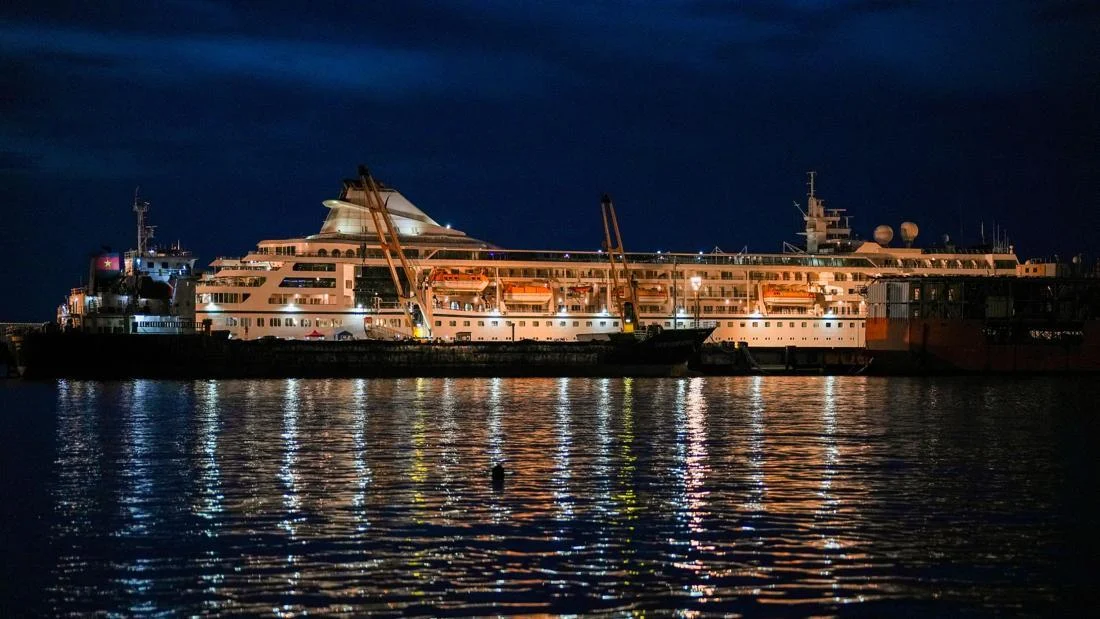
The ambitious dream of a perpetual, around-the-world cruise has met a somber reality as the Villa Vie Odyssey, a vessel once marketed as a floating residential paradise for retirees and digital nomads, has been seized by creditors. Following a sudden cessation of operations in Sihanoukville, Cambodia, late last month, the vessel is currently en route to Singapore under the control of its financiers, Sagar Capital. With no passengers on board and a skeleton crew of 85, the future of the 24,344-ton vessel remains shrouded in uncertainty, marking a dramatic collapse for a project that promised an endless horizon for its residents.
The movement of the Odyssey toward Singapore, tracked at a sluggish speed of seven knots—less than half its maximum cruising capacity of 17 knots—signals a transition from a luxury residential venture to a distressed asset liquidation process. This development brings an end to a turbulent chapter that began with high-minded promises of global discovery but ultimately buckled under the weight of mounting financial liabilities and operational mismanagement.
A Chronology of the Operational Collapse
The decline of the Villa Vie Odyssey was not instantaneous, but rather the result of a compounding series of financial missteps and market pressures. The following timeline outlines the rapid deterioration of the venture:
- Initial Launch and Operational Struggles: After significant delays in getting the vessel seaworthy, Villa Vie Odyssey finally embarked on its long-awaited global journey. However, the company quickly faced scrutiny regarding its ability to manage a 30-year-old ship that required constant maintenance and high fuel consumption.
- Late October 2026: Financial strain reached a breaking point. On October 27, the company made an abrupt announcement to all remaining residents on board. They were ordered to vacate their cabins within 24 hours, effectively leaving many without housing or a clear path forward.
- Late October – Early November 2026: As the company formally ceased operations, Sagar Capital, the primary lender, exercised its legal right to seize the vessel as collateral for unpaid debts.
- November 4, 2026: The vessel departed Cambodia, navigating toward the major maritime hub of Singapore. The move is widely interpreted by industry experts as a precursor to either a forced sale, an auction, or a restructuring under the oversight of the creditors.
Financial Instability and the Burden of Overhead
The central driver of this collapse, according to internal communications and industry reports, was an inability to manage soaring operational costs. While the company attempted to mitigate expenses by reducing cruising speeds and extending port stays, these austerity measures proved insufficient.
A critical revelation came from the creditors, who disclosed that the financial health of the operating firm was significantly more precarious than investors and residents had been led to believe. The debt load far exceeded the initial projections provided to stakeholders. Furthermore, the prospect of navigating a Chapter 11 bankruptcy filing in the United States—a process intended to reorganize the company’s debts—was deemed financially non-viable. Estimates suggested that the legal and administrative fees alone for the first 60 days of such a filing would reach approximately USD 3 million, a sum the company could not raise.
The failure of the residents to intervene serves as a testament to the depth of the crisis. A group of 169 residents had organized an attempt to pool personal capital to acquire the ship and save the project from liquidation. However, this proposal was summarily rejected by Sagar Capital, indicating that the creditors viewed the debt-to-asset ratio as irrecoverable under the current management structure.
Contextualizing the Odyssey: A Legacy of Maritime Transitions
To understand the current situation, one must look at the long and storied history of the Odyssey. Built in 1993, the vessel was originally launched as the Crown Dynasty for Crown Cruise Line. Throughout its three-decade tenure in the maritime industry, it has served various operators, including Majesty Cruise Line, Norwegian Cruise Line, and Fred. Olsen Cruise Lines.
As a vessel of its vintage, the Odyssey presents specific challenges in the modern cruise market. Regulatory requirements regarding emissions, safety standards, and energy efficiency have tightened significantly since its maiden voyage. Maintaining a 30-year-old hull and propulsion system to meet international standards requires significant capital expenditure—an expense that the business model of Villa Vie, which relied on long-term residential fees rather than traditional cruise revenue, struggled to sustain.
Official Responses and Creditor Stance
In messages disseminated to the former residents, Villa Vie management attempted to maintain a facade of hope, stating that the lender’s takeover did not necessarily signal the end of the Odyssey’s operational lifespan. "The lender has taken control of the vessel, but that does not mean the future of the Odyssey has been decided," the company stated in a brief communication.
However, this rhetoric stands in stark contrast to the actions of the creditors. Sagar Capital has maintained a focus on fiscal recovery, prioritizing the protection of their investment over the continuity of the residential cruise program. The lack of a confirmed schedule for the ship’s sale suggests that the creditors are currently evaluating their options, which include:
- Public or Private Auction: Selling the vessel to the highest bidder to recoup the principal loan amount.
- Sale to Another Cruise Operator: Finding a buyer interested in rebranding the vessel for a new, perhaps more localized, cruise circuit.
- Asset Liquidation: If the vessel is deemed no longer seaworthy or economically viable for passenger service, it may be sold for scrap metal.
Broader Implications for the Residential Cruise Industry
The collapse of the Villa Vie Odyssey offers a sobering lesson for the niche market of residential cruises. The model relies on the premise that residents will provide a steady, predictable stream of revenue to cover the high fixed costs of operating a ship. When those costs—primarily fuel, insurance, and crew wages—fluctuate, the entire financial ecosystem is threatened.
Furthermore, the legal complexity of international maritime law makes it difficult for individual passengers to protect their investments. Unlike land-based real estate, where property rights are clearly defined by local jurisdiction, residents of a cruise ship often have little recourse when a company enters financial distress. The situation serves as a cautionary tale regarding the risks of long-term investments in maritime ventures, which are inherently exposed to the volatility of global energy markets and the maintenance costs of aging hardware.
Looking Ahead: What Awaits in Singapore
As the Odyssey makes its slow progress toward Singapore, the maritime community is watching closely. Singapore is one of the world’s most significant shipping hubs, offering the infrastructure necessary for both ship surveys and, if necessary, decommissioning.
Industry analysts note that if the creditors choose the path of demolition, the ship cannot be scrapped in Singapore itself, as the nation lacks specialized facilities for ship breaking. It would likely be towed to a specialized yard in South Asia, where such operations are common.
For the former residents, the journey is effectively over. The promise of an endless, luxury-filled life at sea has been replaced by the reality of financial loss and a scramble to recoup assets. The odyssey of the Odyssey, it seems, has reached its final port of call, not as a symbol of freedom, but as a cautionary case study in the perils of speculative maritime business models. The coming weeks will determine whether the vessel is salvaged for a new purpose or finally retired after a long and turbulent career on the high seas.