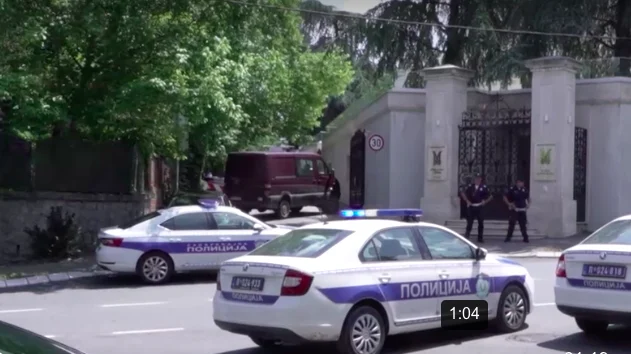
A critical security incident unfolded outside the Embassy of Israel in Belgrade, Serbia, when law enforcement officers neutralized an assailant who launched a violent knife attack against a diplomatic security guard. The event, officially classified by the Serbian government as an act of terrorism, immediately triggered the highest level of national security alert across the country. The confrontation highlights the persistent underlying threats facing foreign diplomatic missions globally and underscores the complex challenges law enforcement agencies face regarding self-radicalized individuals operating within local communities.
The incident has reverberated through diplomatic circles and prompted a swift, aggressive security response from the government of Serbia. As intelligence and counter-terrorism units dive deeper into the background of the assailant, authorities are re-evaluating the physical security postures surrounding sensitive foreign missions in Belgrade to prevent copycat incidents or coordinated secondary operations.
Chronology of the Attack
The security breach occurred shortly after midnight on a Wednesday, shattering the quiet atmosphere surrounding the Israeli diplomatic compound in the Serbian capital. According to official accounts provided by the Serbian Ministry of Interior, the assailant—subsequently identified as a minor whose exact age and legal identity have been withheld from public dissemination—approached the heavily guarded perimeter of the Israeli Embassy.
Equipped with two sharp knives, the individual targeted a uniformed police officer stationed outside the diplomatic facility to ensure the safety of the grounds. While launching the sudden physical assault, the attacker reportedly shouted religious phrases, drawing immediate hostility and forcing the on-duty officer into a life-or-death struggle.
Cornered and facing imminent danger of severe bodily harm or death, the wounded officer exercised his right to self-defense. Drawing his service weapon, the officer discharged his firearm, neutralizing the threat on the spot. Medical personnel and emergency response teams quickly arrived at the scene, but the assailant was pronounced dead from gunshot wounds sustained during the confrontation. The injured police officer sustained noticeable facial lacerations and knife-related defensive wounds, requiring immediate medical attention at a local hospital, where he was subsequently treated and monitored for non-life-threatening injuries.
Profile of the Assailant and Preliminary Investigations
In the hours following the violent confrontation, high-ranking security officials and investigators moved quickly to piece together the identity, motives, and digital footprint of the deceased minor. Serbian Minister of Interior Ivica Dacic revealed during comprehensive press briefings that the young perpetrator was known to domestic security and intelligence services prior to the attack.
Preliminary digital forensic investigations into the suspect’s online footprint—specifically his Instagram profile—revealed alarming indicators of radicalization. Law enforcement officials discovered that the teenager’s social media accounts prominently featured the black flag and official symbols associated with the Islamic State (IS), a designated terrorist organization. Investigators believe the minor hailed from Sabac, a city located in western Serbia, raising crucial questions regarding how a young individual residing outside the primary urban centers managed to undergo radicalization and execute a targeted terrorist attack against a foreign diplomatic post.
Security services are currently executing extensive raids, analyzing communication logs, and interviewing associates, family members, and acquaintances to determine whether the minor acted entirely as a lone wolf or maintained active links to local or international extremist cells that facilitated his ideological shift and provided tactical inspiration.
Government Response and the Elevation of National Threat Levels
In direct response to the attack at the Israeli Embassy, the Serbian government moved swiftly to mitigate further risks to public safety and foreign dignitaries. Minister Dacic formally announced that the national terrorism threat level had been elevated immediately to its highest threshold, commonly referred to as "red alert."
This heightened security posture mandates an immediate surge in protective measures across the nation. Citizens and foreign visitors alike will observe a visible increase in armed police presence, tactical patrols, and random security checkpoints surrounding critical national infrastructure, transportation hubs, government buildings, and other sensitive diplomatic facilities. Law enforcement agencies have been granted expanded authorities to conduct thorough identity checks and step up surveillance operations in densely populated areas and locations identified as potential targets for extremist aggression.
The Ministry of Interior emphasized that while the nation’s security forces remain fully equipped and prepared to handle internal security threats, the escalation to the maximum threat level is a necessary precaution to deter potential sympathizers or coordinated networks from capitalizing on the momentum of the Belgrade attack.
Historical Precedent: A Vulnerable Diplomatic Mission
While violent extremist attacks remain statistically rare within the borders of Serbia compared to other parts of Europe, the Israeli Embassy in Belgrade has unhappily established a concerning precedent as a target for targeted violence. The recent midnight assault is not an isolated incident, but rather the second major security breach directed at the same diplomatic compound within a relatively short timeframe.
In June 2024, the Israeli diplomatic mission became the site of a harrowing security breach when an armed assailant equipped with a crossbow launched a sudden attack against the police officer guarding the complex. In that previous instance, the on-duty officer sustained injuries before managing to return fire and neutralize the attacker.
The repetition of targeted assaults against the same diplomatic location has intensified scrutiny regarding the architectural, physical, and tactical security arrangements implemented around foreign embassies in Belgrade. Security experts note that diplomatic missions often represent high-value symbolic targets for disaffected individuals or radicalized actors seeking international media attention, necessitating constant adaptation and hardening of protective perimeters.
Broader Implications and Geopolitical Context
The assassination attempt and subsequent neutralization of the knife-wielding attacker outside the Israeli Embassy carry significant domestic and international implications. On a domestic level, the incident challenges the narrative of absolute internal stability in Serbia and forces the government to confront the creeping threat of homegrown radicalization and internet-driven extremism among minors. The involvement of a young perpetrator underscores the growing vulnerability of adolescents to online recruitment and extremist propaganda disseminated through social media platforms.
Internationally, the attack places Serbia within the broader framework of heightened global security concerns surrounding diplomatic missions representing Israel. Amid ongoing geopolitical tensions and conflicts in the Middle East, security agencies worldwide have remained on high alert for retaliatory actions or symbolic strikes targeting Jewish and Israeli institutions abroad.
Diplomatic analysts point out that the swift and decisive action taken by the Serbian police officer likely prevented a catastrophic escalation that could have resulted in multiple fatalities and severely strained diplomatic relations. However, the incident also serves as a stark reminder of the unpredictable nature of modern security threats, where lone-wolf actors utilizing rudimentary weapons can instantly disrupt public safety and trigger sweeping national security measures.
As the investigation progresses, Serbian authorities are expected to release further findings regarding the extent of the extremist network linked to the deceased minor. The international community, meanwhile, continues to monitor the situation closely, acknowledging both the bravery of the wounded police officer and the ongoing challenges of safeguarding diplomatic missions in an increasingly polarized global landscape.