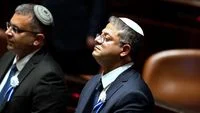
The political ambitions of Israeli National Security Minister Itamar Ben Gvir suffered a significant setback as his far-right party, Otzma Yehudit (Jewish Power), failed to secure its targeted share of seats in the parliamentary elections held on Tuesday. Despite an aggressive campaign centered on hardline security policies and unyielding nationalist rhetoric, exit polls and preliminary tallies indicated that the party would fall well short of its ambitious two-digit target, capturing only a fraction of the legislative influence Ben Gvir had envisioned.
According to data published by Israeli media outlets Channel 12 and Channel 13, Otzma Yehudit was projected to win merely six seats in the Knesset. The disappointing figures emerged late Tuesday evening, prompting an initial wave of silence from the firebrand minister upon his arrival at the party’s central campaign headquarters just before midnight. Addressing his supporters hours later, Ben Gvir attempted to project optimism, urging his base to remain steadfast as official votes continued to be tabulated across the country.
"The night is still young. We believe and hope that we are close to forming a right-wing government, with God’s help," Ben Gvir told the gathered crowd, maintaining that the initial exit polls frequently fail to capture the final, certified tally of military and absentee ballots.
Strategic Shift and the Cost of Going Solo
The electoral underperformance marks a stark contrast to Ben Gvir’s previous legislative campaigns. In the preceding parliamentary election, Otzma Yehudit ran on a joint ticket with the Religious Zionism party, headed by Finance Minister Bezalel Smotrich. That strategic alliance proved formidable, sweeping 14 seats and cementing the two far-right figures as indispensable kingmakers within the broader coalition led by Prime Minister Benjamin Netanyahu.
Buoyed by that historic success, Ben Gvir opted for a high-stakes political gamble ahead of this election cycle: he chose to sever ties with Smotrich’s faction and run independently. By charting an unalloyed, solo course, Otzma Yehudit sought to definitively establish its independent political footprint and command an even larger mandate, publicly targeting a double-digit seat haul that would rival or exceed their previous joint performance.
However, political analysts point out that running independently in Israel’s highly fragmented proportional representation system carries severe electoral risks. Parties that fail to clear the strict 3.25 percent electoral threshold are eliminated entirely, while those that survive often suffer from vote-splitting within their own ideological camp. By dividing the hardline nationalist electorate between Otzma Yehudit and Religious Zionism, Ben Gvir may have inadvertently suppressed his own ceiling of support, leaving the party vulnerable to voter fatigue and tactical voting shifts among the broader right-wing base.
Rejection of Unity Talk and Coalition Dynamics
Speaking to his supporters after the release of the early projections, Ben Gvir wasted no time addressing the immediate political fallout. He firmly dismissed swirling speculation that his weakened parliamentary standing might force him into an unlikely compromise or a unity government involving the political opposition.
Specifically, Ben Gvir rejected the prospect of aligning with a government featuring former military chief and opposition figure Gadi Eisenkot. The National Security Minister argued that any coalition incorporating moderate or centrist elements would inevitably become paralyzed by ideological friction.
"Only two minutes after the exit polls were released, we already heard talk regarding a unity government with Eisenkot," Ben Gvir remarked during his post-election address. "A government like that will only lead to paralysis."
Despite his reluctance to entertain overtures from the center-left opposition, the question of whether Ben Gvir will successfully reintegrate into a traditional right-wing coalition led by Prime Minister Benjamin Netanyahu remains open. Historically, Otzma Yehudit has functioned as a natural ideological ally to Netanyahu’s Likud party. Yet, the reduced leverage resulting from a six-seat outcome significantly diminishes Ben Gvir’s bargaining power in future coalition negotiations.
Where he once commanded immense influence as a pivotal pillar holding together a fragile governing majority, a diminished parliamentary bloc may relegate him to a more subordinate role within any future cabinet, complicating his ability to unilaterally push through his signature legislative and security agendas.
Broader Implications for Israeli Politics and Regional Stability
The apparent underperformance of Otzma Yehudit carries profound implications for the domestic political landscape of Israel, as well as its fraught security and diplomatic standing in the broader Middle East.
Domestically, the election results suggest a potential stabilization or slight recalibration within the Israeli electorate, where voters may be reassessing the practical governance outcomes of extreme ideological polarization. While the right-wing bloc as a whole retains significant structural backing, the fragmentation demonstrated by Ben Gvir’s solo run highlights the volatility inherent in Israel’s multi-party parliamentary system.
From a policy perspective, Itamar Ben Gvir’s tenure as National Security Minister has been defined by polarizing initiatives, including the expansion of civilian gun licensing, stringent crackdowns on civil unrest, and frequent, highly publicized visits to the sensitive Al-Aqsa Mosque compound—known to Jews as the Temple Mount. His hardline stance on security matters and Palestinian affairs has frequently drawn sharp international criticism and strained diplomatic relations with Western allies and regional partners alike.
A diminished legislative presence for Otzma Yehudit could slightly alleviate pressure on Prime Minister Netanyahu, who must balance the demands of his far-right ministers with the strategic necessity of maintaining cooperative ties with international allies and regional signatories to peace and normalization accords. Conversely, if Ben Gvir feels politically weakened, he may double down on provocative rhetoric and hardline policy demands in an effort to appease his core base and prove his continued relevance to the nationalist movement.
As election officials continue the meticulous process of counting paper ballots, verified results are expected to clarify the final distribution of seats in the Knesset. Only then will the true arithmetic of Israel’s next governing coalition come into sharp focus, determining whether the architects of the country’s nationalist right can successfully reconstitute their alliance or face a new era of political repositioning.