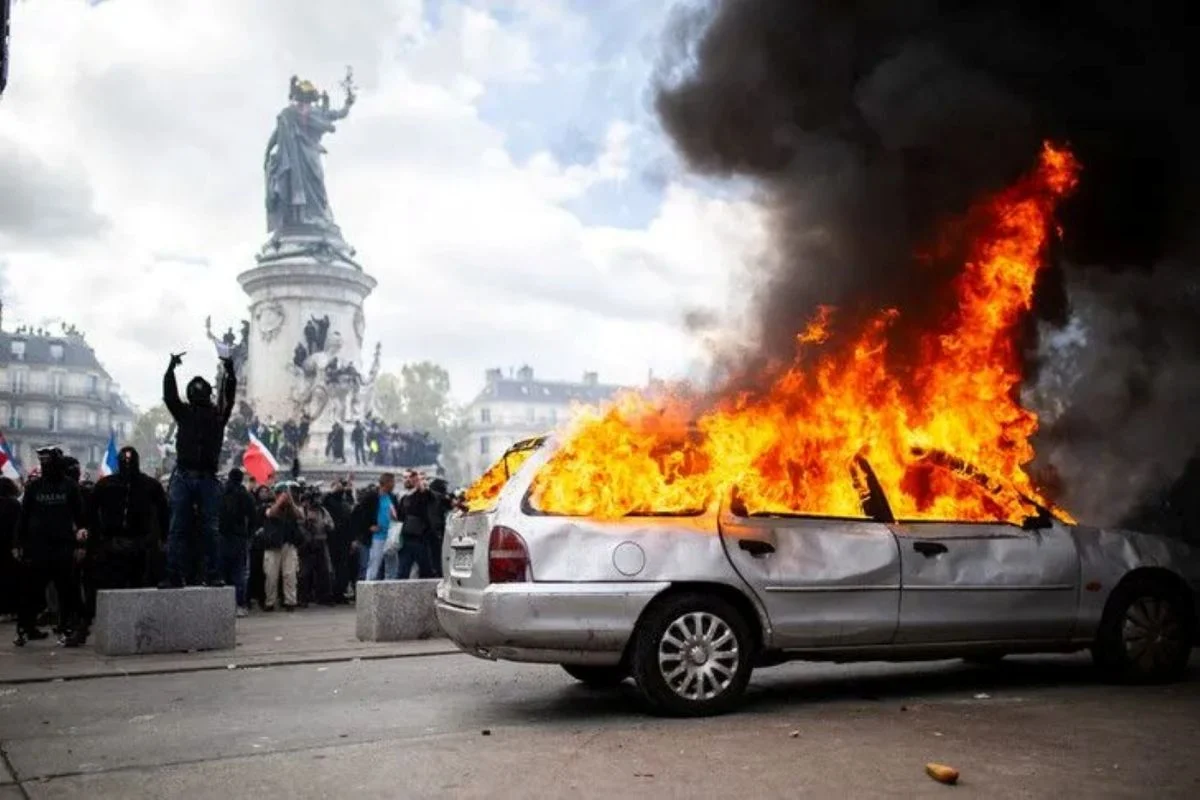
The French Republic finds itself in the grip of one of the most significant domestic crises of the decade, as a series of widespread demonstrations, which began as localized protests over educational deficiencies, spiraled into intense civil unrest across the nation in mid-October 2026. By Saturday, October 17, major metropolitan hubs including Paris, Marseille, Lyon, Lille, and Bordeaux witnessed hundreds of thousands of citizens flooding the streets. While the majority of participants expressed grievances through peaceful assembly, the emergence of fringe groups led to violent clashes with law enforcement, widespread property damage, and the looting of commercial establishments.
This wave of unrest serves as a critical juncture for the administration of President Emmanuel Macron, particularly as the nation looks toward the 2027 presidential election. With estimates of total turnout ranging from 550,000 to 800,000 participants, the mobilization reflects a deep-seated, systemic dissatisfaction with the current socio-economic trajectory of France.
The Spark: A Crisis in the Classroom
The origins of the current unrest trace back to mid-September 2026, when discontent within the French educational system reached a critical mass. The catalyst for the initial protests was a series of strikes centered at the Lycée Saint-Exupéry in Créteil. Teachers, staff, and students highlighted a profound degradation in the quality of public schooling, citing critical shortages of educators, inadequate infrastructure, and the erosion of resources necessary for a functional learning environment.
What began as a localized cry for better funding and more staff rapidly evolved into a national movement. Students and parents, frustrated by years of austerity measures, joined teachers in calling for a structural overhaul of the French education system. The persistence of the movement throughout September provided a platform for other aggrieved sectors of society to align their grievances with the educational cause, effectively turning a localized labor dispute into a broader national outcry against perceived governmental neglect.
Economic Pressure and the Ghost of the Yellow Vests
Beyond the walls of the classroom, the protesters are driven by a persistent cost-of-living crisis. Inflation, coupled with the rising price of fuel and basic commodities, has significantly strained the purchasing power of low- and middle-income households. For many French citizens, the current economic climate is reminiscent of the "Gilets Jaunes" (Yellow Vests) movement of 2018, which paralyzed parts of the country for months in response to regressive fuel taxes and widening economic inequality.
Economic analysts suggest that the 2026 protests represent a more heterogeneous coalition than the 2018 movement. While the Yellow Vests were largely defined by regional, fuel-related grievances, the current wave of unrest incorporates students, organized labor unions, and civil society groups. This diversity in the protester demographic complicates the government’s response, as the demands are no longer singular or easily addressed through one-off tax credits or subsidies. The protestors argue that the government has failed to provide a safety net capable of withstanding the global inflationary pressures that have characterized the post-2024 economic landscape.
Chronology of the October 2026 Upheaval
- September 17, 2026: Protests begin at Lycée Saint-Exupéry in Créteil, sparking a wave of school strikes across the Paris suburbs.
- Early October 2026: Labor unions and student organizations begin formalizing a coalition to address systemic economic inequality and school funding.
- October 15, 2026: Tensions escalate as isolated incidents of vandalism are reported in Lyon and Lille.
- October 17, 2026: The "Day of Mobilization" results in massive nationwide demonstrations. Violence breaks out in major cities; the Limoges City Hall is set on fire.
- October 18, 2026: Interior Minister Laurent Nuñez reports that 2,400 individuals have been arrested. Death of one demonstrator in Paris following cardiac arrest is confirmed during the dispersal of crowds.
- October 19, 2026: The government announces potential restrictions on protest permits in high-risk zones, while President Macron calls for a return to national order.
Official Response and the Challenge of Governance
The response from the Élysée Palace has been one of firm condemnation regarding the violence, paired with a cautious acknowledgement of the legitimate frustrations held by the public. President Emmanuel Macron has consistently attempted to draw a hard line between peaceful democratic expression and what his administration characterizes as criminal behavior.
"The expression of dissent is a fundamental right of every citizen," the President stated in a televised address on October 18. "However, the torching of public buildings, the looting of stores, and the intimidation of our police forces constitute a direct assault on the Republic. These are not acts of protest; they are acts of criminality."
The French Ministry of the Interior has deployed thousands of riot police to restore order, utilizing tear gas and non-lethal deterrents to break up pockets of unrest. However, the government’s rhetoric—which often attributes the violence to radical elements from the extreme left and criminal opportunists—has been met with skepticism by protest leaders, who argue that the violence is a symptom of the desperation caused by the government’s failure to address the core issues.
Societal and Economic Implications
The physical toll of the unrest is significant. Beyond the nearly 1,000 injured law enforcement officers and the 2,400 arrested individuals, the economic damage to the retail sector has been severe. Chains such as Carrefour have reported widespread looting and property destruction in several regions, which will inevitably lead to increased insurance premiums and potential store closures in vulnerable areas.
From an analytical standpoint, the implications for the French political landscape are profound. The 2027 presidential election is now cast in a shadow of uncertainty. The current administration is under intense pressure to reconcile its fiscal policy with the demands of a populace that feels increasingly left behind by the mechanisms of the state. Failure to provide a substantive policy shift may embolden opposition parties—both on the left and the right—to capitalize on the perceived failure of the Macron presidency.
Furthermore, the duration of this unrest remains a point of intense speculation. Historically, French protest movements have a high capacity for resilience, often stretching over months if the central government remains perceived as unresponsive. If the grievances regarding educational infrastructure and household economic stability are not met with tangible legislative action, the risk of a "long winter" of discontent increases significantly.
Conclusion: A Nation at a Crossroads
The events of October 2026 underscore a widening chasm between the governing elite and a significant portion of the French citizenry. The protests are not merely a reaction to school funding or fuel prices; they are a manifestation of a deeper crisis of confidence in the social contract.
As the government moves to restore public order, the secondary, more complex challenge remains: how to address the underlying economic malaise that has turned a localized school protest into a national security crisis. Whether the state chooses to adopt a policy of pacification through reform or one of containment through increased security measures will dictate the political stability of France for the remainder of the presidential term. For now, the streets of France remain volatile, serving as a stark reminder of the fragile balance between civil liberty and the maintenance of public order in a polarized society. The coming weeks will be a litmus test for the endurance of the Fifth Republic’s institutions and the capacity of its leadership to navigate one of the most turbulent periods in recent European history.