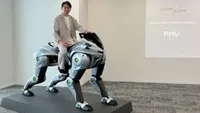
Japanese manufacturing giant Kawasaki is set to captivate the international automotive and technology sectors at the upcoming EICMA 2026 exhibition in Milan, Italy, by introducing a full-scale replica of the Corleo—an innovative, four-legged robotic personal mobility vehicle designed to be ridden like a horse. Scheduled to run from November 3 to November 8, 2026, at the sprawling Fiera Milano Rho convention center, the exhibition will position Kawasaki in Hall 11, booth N46. The company has confirmed that specialized engineering and development staff traveling directly from Japan will be present on-site to address technical inquiries from global media and industry attendees.
While the exact operational prototype will remain behind closed doors for further refinement, the full-scale model slated for public display marks a monumental leap in how engineering firms conceptualize personal transportation. Positioned alongside Kawasaki’s latest lineup of conventional internal combustion motorcycles and alternative-fuel vehicles, the Corleo represents a bold strategic endeavor by the brand to diversify personal mobility beyond traditional two-wheeled tarmac machines. Industry analysts view this move as a clear indication that legacy automotive and motorcycle manufacturers are aggressively exploring cross-disciplinary technologies, merging advanced robotics with sustainable power sources to carve out entirely new market segments.
The Mechanics and Engineering of the Corleo
At its core, the Kawasaki Corleo is classified as a multi-legged robotic personal mobility vehicle. The engineering behind the machine bridges the sophisticated off-road traversal capabilities typically reserved for quadrupedal industrial and rescue robotics with the dynamic, rider-centric handling principles cultivated through decades of motorcycle development. Unlike autonomous delivery robots or remote-controlled rovers, the Corleo is explicitly designed for a human rider to mount.
Operating the Corleo departs significantly from twisting a traditional throttle or steering a handlebar. Instead, the rider maintains control by intuitively shifting their body weight—a physical interaction that mimics the natural synergy found in horseback riding or leaning into a corner on a sportbike. This somatic control interface aims to create a deeply organic riding experience, blending machine precision with biological responsiveness.
Beneath its futuristic exterior, the Corleo relies on a sophisticated clean-energy architecture. According to official corporate releases, the vehicle utilizes a compact 150 cc hydrogen internal combustion engine coupled with a fuel cell and generator system to produce electrical power on demand. Hydrogen fuel is securely stored within specialized high-pressure tanks positioned at the rear of the quadruped chassis. This choice of powertrain underscores Kawasaki’s broader corporate commitment to hydrogen as a viable, zero-emission fuel source capable of delivering the high energy density required for demanding outdoor and off-road applications.
Furthermore, Kawasaki is engineering a bespoke intelligent navigation system specifically for the Corleo. This software suite is designed to analyze real-time environmental data, including local weather patterns, ambient temperature, ground surface friction, and the proximity of wildlife. Crucially, this vital information will be projected directly onto the vehicle’s integrated instrument panel as well as synchronized smart devices carried by the rider, ensuring optimal safety and environmental awareness during transit.
Timeline and Strategic Development Path
The development of the Corleo is not a sudden marketing stunt but rather the culmination of a targeted, long-term corporate initiative. The project is spearheaded by Kawasaki’s dedicated Safe Adventure Business Development team—a specialized division that reports directly to the President of Kawasaki Heavy Industries. This direct reporting line emphasizes the strategic importance the parent company places on unconventional mobility solutions and sustainable outdoor recreation technologies.
The official timeline for the Corleo outlines a rigorous multi-phase development and testing cycle:
- Late October 2026: Official global announcement of the Corleo’s upcoming public debut via a full-scale replica at EICMA 2026 in Milan.
- November 3–8, 2026: Public and media unveiling at EICMA Hall 11, booth N46, accompanied by technical briefings from Japanese engineering staff.
- 2026–2030: Ongoing field testing of autonomous stability algorithms, hydrogen powertrain efficiency, and environmental sensor integration.
- 2030: Alignment target with the Kawasaki Group Vision 2030 milestones concerning carbon neutrality and safe remote connectivity.
- Circa 2035: Projected target window for full commercialization and market availability of the Corleo platform.
This structured trajectory illustrates a methodical approach to bringing a disruptive technology from the conceptual drawing board to the commercial marketplace, ensuring that safety, reliability, and regulatory compliance are thoroughly addressed over the next decade.
The Safe Adventure Concept and Corporate Vision
The philosophical foundation of the Corleo project is rooted in Kawasaki’s proprietary "Safe Adventure" concept. This initiative is designed to foster a future where rugged natural landscapes—particularly mountainous terrain and dense forests—can be explored and enjoyed safely without degrading or disturbing the surrounding ecosystem. By utilizing a low-impact, multi-legged platform rather than heavy tracked or wheeled off-road vehicles, Kawasaki aims to minimize soil erosion and habitat disruption.
This philosophy directly reinforces the three core pillars of the Kawasaki Group Vision 2030:
- Creating a safe, secure, and remotely connected society through advanced automation and communication.
- Pioneering the future of mobility by developing radically new personal transport categories.
- Delivering comprehensive energy and environmental solutions that accelerate the global transition to a net-zero-carbon economy.
By integrating hydrogen power with biomimetic locomotion, the Corleo serves as a tangible demonstration of how heavy industry can pivot toward sustainability while preserving the spirit of outdoor exploration and personal freedom.
Official Statements and Industry Reception
Industry leaders have been vocal about the significance of Kawasaki’s latest technological showcase. Shigemi Tanaka, Managing Director of Kawasaki Motors Europe, emphasized the profound engineering depth required to bring such a concept to life.
"Corleo is a striking example, not only of the depth of our unique technical, industrial, and environmental experience across the entire enterprise, but also of our drive toward a net-carbon-neutral future—a future that embraces personal freedom through the concept of Safe Adventure," stated Tanaka in an interview with motorcycle industry publication Visordown. "We hope that, alongside all our 2027 motorcycle models and latest innovations, visitors will be just as captivated and energized by the Corleo as we are."
Automotive analysts and robotics experts have similarly praised Kawasaki for pushing the boundaries of what constitutes a "motorcycle company." While skepticism always exists regarding the commercial viability of multi-decade projections, the consensus within the engineering community is that the technologies developed for the Corleo—such as advanced quadruped balance control, lightweight hydrogen combustion, and contextual environmental sensing—will yield valuable spin-off benefits for Kawasaki’s mainstream motorcycle and powersports divisions well before 2035.
Broader Market Implications and Future Outlook
The introduction of the Corleo at EICMA 2026 highlights a broader paradigm shift within the global transportation sector. As urban centers become increasingly congested and traditional off-road recreational areas face stricter environmental regulations, manufacturers are forced to rethink how humans interact with nature and machines.
The convergence of robotics and hydrogen technology opens up new possibilities for emergency rescue operations, agricultural monitoring in rugged terrain, and eco-friendly tourism in protected ecological zones. If Kawasaki successfully navigates the technical hurdles of mass-producing a hydrogen-powered robotic quadruped, the Corleo could transition from a futuristic showpiece into an indispensable tool for sustainable wilderness navigation.
As the doors of Fiera Milano Rho open this November, all eyes will be on Kawasaki’s booth to witness firsthand the vision of a hydrogen-fueled, rider-operated robotic future. Whether attendees view the Corleo as a radical reimagining of horseback riding or a glimpse into the distant horizon of extreme mobility, the machine undeniably cements Kawasaki’s reputation as a fearless innovator willing to challenge the conventions of modern engineering.