In an unusual offering that has quickly captured the attention of automotive enthusiasts and bargain hunters alike, a former state-owned patrol sedan is currently up for public auction in Indonesia at a remarkably low starting price. The vehicle, a 2012 Mazda 6 previously utilized as an official escort (Patwal) car, has been put on the auction block by the Karangasem Regency Police Department in Bali. Managed in coordination with the Singaraja State Property and Auction Service Office (KPKNL), the entire fleet of decommissioned government vehicles offers a fascinating glimpse into the lifecycle of municipal and law enforcement assets, though the specific condition of this flagship sedan presents a unique challenge for prospective buyers.
The auction event, which features a total of 16 motorized vehicles, highlights the routine disposal process implemented by Indonesian government agencies for aging or heavily utilized operational fleets. Among the diverse array of cars and motorcycles, the 2012 Mazda 6 stands out not only for its former prestige as a high-performance government cruiser but also for its exceptionally modest entry barrier: an opening limit price of just IDR 6.652 million, roughly equivalent to a few hundred US dollars. However, this nominal asking price reflects the stark reality of the vehicle’s current physical state, which has suffered considerable wear and tear throughout its years of active service.
Main Facts and Vehicle Specifications
According to the official auction announcement released by the Karangasem Police, the 2012 Mazda 6 is being offered under an "as-is, where-is" condition through an open bidding scheme without the physical presence of participants, conducted via the official state auction portal, lelang.go.id. Interested parties looking to secure the vehicle must first register and submit a security deposit amounting to IDR 3.326 million—exactly half of the vehicle’s starting limit price.
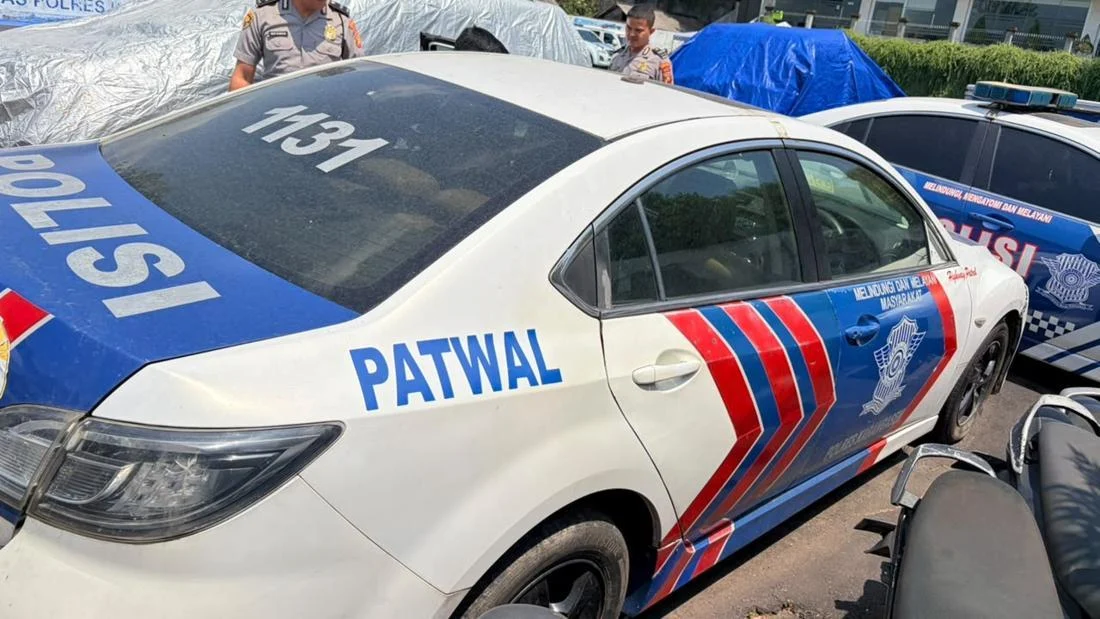
Photographs provided on the auction platform reveal a vehicle that is currently a far cry from its showroom condition. The exterior still prominently features the distinctive blue and red color scheme of the Indonesian Police escort division, complete with official decals stretching across the bodywork. A prominent police siren light bar remains mounted on the roof of the sedan, serving as a reminder of its former official duties. Closer inspection of the visual documentation highlights signs of heavy weathering and deterioration; the trunk section shows visible patches of rust, while the hood displays noticeable cracking and peeling across the aged police decals. Notably, interior photographs were not provided in the listing, leaving the condition of the cabin, dashboard, and mechanical components entirely to the imagination—or physical inspection—of potential bidders.
The integration of a mid-size executive sedan like the Mazda 6 into patrol and escort duties was part of a broader initiative in previous years to equip various regional police directorates with capable, high-speed interceptors and escort vehicles. Powered by a potent engine capable of swift acceleration, the Mazda 6 offered highway stability and presence suitable for VIP escort operations. However, after more than a decade of intensive municipal service, the harsh tropical climate and rigorous demands of law enforcement work have evidently taken a heavy toll on this particular unit.
Chronology and Important Auction Deadlines
The disposal of these state-owned assets follows a strict administrative timeline designed to ensure transparency and compliance with Indonesian state property regulations. The auction is scheduled to take place on Tuesday, November 10, 2026. Bidding will officially close on the same day at 09:45 Western Indonesia Time (WIB), which corresponds to 10:45 Central Indonesia Time (WITA), adhering strictly to the server timestamp of the official auction platform.
Prior to placing a bid, prospective buyers are given the opportunity to inspect the vehicle physically. Open-house viewings are being hosted at the Karangasem Police Headquarters, located on Jalan Bhayangkara No. 1, Amlapura. Interested participants can visit the station during standard working hours up until November 9, 2026. This pre-auction inspection period is critical, given the strict terms and conditions enforced by KPKNL.
Once the bidding concludes, the winner will be formally notified via their registered email address. The victorious bidder is bound by strict financial obligations: the final purchase price, along with a mandatory 2% government auction fee, must be settled in full no later than five working days following the auction date. Failure to complete the payment within this stipulated timeframe results in immediate default (wanprestasi). In such cases of default, strict administrative penalties apply, most notably the permanent forfeiture of the initial security deposit, which will be directly transferred to the state treasury. Furthermore, auction rules explicitly dictate that the winner is deemed to have fully inspected and accepted the vehicle’s condition, meaning no further physical checks of the lot are permitted after the payment window begins.
Background Context of State Asset Disposal
The auction of the Karangasem Police fleet is part of a standard, nationwide administrative procedure governed by the Ministry of Finance for the removal and liquidation of State-Owned Goods (Barang Milik Negara or BMN). Government agencies, including regional police forces, military branches, and ministerial departments, routinely audit their operational inventories. When vehicles reach the end of their economic useful life—typically due to age, high mileage, extensive repair costs, or technological obsolescence—they are decommissioned.
Rather than allowing these assets to deteriorate indefinitely in departmental parking lots, agencies partner with regional KPKNL offices to conduct public auctions. This mechanism serves a dual purpose: it clears valuable space within government facilities and generates non-tax state revenue (Penerimaan Negara Bukan Pajak or PNBP). Over the years, public fascination with decommissioned government assets has grown significantly. Enthusiasts frequently monitor these auctions in search of rare finds, project cars, or inexpensive restoration candidates, ranging from former operational sedans to rugged four-wheel-drive transport vehicles.
Fact-Based Analysis and Buyer Implications
While a starting price of just over IDR 6.6 million for a Mazda 6 sounds extraordinarily appealing to the budget-conscious consumer, financial and mechanical analysts urge caution. Purchasing an "as-is" vehicle from a government fleet—especially one classified as being in heavily damaged condition—carries substantial hidden financial risks.
First and foremost, the mechanical state of the 2012 Mazda 6 remains an absolute unknown outside of what can be observed externally. Modern executive sedans from this era are heavily reliant on complex electronic control units, advanced fuel-injection systems, and sophisticated multi-link suspension setups. Sourcing replacement parts for a Mazda 6 in a severely neglected state can be both challenging and costly. If the engine has seized, the transmission is damaged, or the electrical harness has suffered from rodent infestation or water damage, the cost of restoration could easily surpass the market value of a running, well-maintained used unit of the same year.
Additionally, successful bidders must factor in the administrative costs associated with legalizing and rehabilitating a former law enforcement vehicle. Because the car still bears official police markings, color schemes, and emergency lighting equipment, the new owner is legally obligated to remove all police livery, sirens, and specialized government identifiers immediately upon taking possession. Operating a civilian-registered vehicle with active law enforcement insignia is strictly illegal under Indonesian traffic and criminal laws. Furthermore, registering the vehicle for regular civilian road use will require clearing all administrative paperwork with the regional traffic directorate (Samsat), settling any potential back taxes if applicable, and ensuring that the vehicle passes rigorous roadworthiness inspections.
For hobbyists with specialized mechanical skills and access to affordable spare parts, however, such auctions represent a compelling salvage opportunity. Dismantling a vehicle for functional spare components or undertaking a complete frame-off restomod project are common pursuits within the local automotive community. Nonetheless, casual buyers looking for affordable daily transportation are generally advised to steer clear of severely damaged BMN lots, as the journey from a government auction block to a legally road-legal civilian car demands technical expertise, patience, and a flexible budget.
Broader Impact on the Used Vehicle and Auction Market
The steady influx of decommissioned government fleets into public auctions underscores the transparency and digital transformation of Indonesia’s public asset management system. Platforms like lelang.go.id have modernized the traditional bidding process, allowing citizens from across the archipelago to participate without geographical constraints. This digital shift has increased competition, driving up final transaction values for well-maintained lots while ensuring that even severely damaged vehicles find a secondary market.
As municipal agencies continue to modernize their operational fleets with newer, more efficient, and eco-friendly vehicles, the frequency of such auctions is expected to rise. For the public, these events provide a unique window into the lifecycle of state assets, transforming retired instruments of law enforcement into potential blank canvases for entrepreneurial mechanics, scrap recyclers, and dedicated automotive restorers alike.