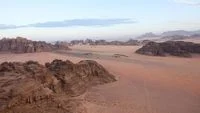
Wadi Rum in Jordan has officially been crowned the finest destination on the planet for experiencing a breathtaking sunset, outperforming 164 other global locations in a comprehensive study released in September 2026. Often romanticized as the Valley of the Moon, this expansive desert expanse captivated researchers with its dramatic crimson sands, towering monolithic sandstone formations, and an ethereal golden hour that transforms the arid landscape into an otherworldly canvas.
According to an analytical collaboration between the prominent travel company Kuoni and Jim Dale, a veteran meteorologist and founder of British Weather Services, Wadi Rum achieved a staggering score of 95.92 out of 100. This rigorous evaluation places the Jordanian marvel at the pinnacle of global twilight tourism, setting a new benchmark for travelers seeking the most pristine atmospheric conditions to witness day bleed into night.
Methodological Framework: How the World’s Best Sunsets Were Calculated
To determine the ultimate global locations for catching a sunset, the Kuoni and British Weather Services research team established a meticulous scoring rubric. The analytical model evaluated 165 destinations worldwide, filtering them through six critical environmental and meteorological indicators. Each metric was assigned a specific weight to reflect its impact on the visual quality of the golden hour.
Cloud cover formed the cornerstone of the evaluation, accounting for 35 percent of the total score, given that clear skies are vital for unobstructed solar illumination. Light pollution comprised 20 percent of the metric, ensuring that the transition from sunset to starlight remains pristine. Artificial lighting brightness accounted for 15 percent, while historical rainfall data held a matching 15 percent weight to minimize the likelihood of inclement weather disrupting the view. Wind speed contributed 8 percent to the equation, and the average duration of the sunset itself rounded out the remaining 7 percent.
Within this stringent framework, Wadi Rum emerged victorious, bolstered by its official status as a UNESCO World Heritage Site. Meteorological data highlighted that the desert boasts an exceptionally low average cloud cover of just 15.3 percent and a negligible annual rainfall of a mere 0.1 millimeters. These arid, stable atmospheric conditions create an optical purity that enhances the natural phenomenon.
Jim Dale, elaborating on the scientific mechanics behind the findings, noted that the richest and most saturated solar hues manifest precisely during the interval between official sunset and civil twilight. This narrow window occurs when the sun sits six degrees or less below the horizon, bending light through microscopic particles in the atmosphere to drench the landscape in deep ambers, fiery oranges, and bruised purples.
Cinematic Legacy and Stargazing Prolifics
Beyond its meteorological supremacy, Wadi Rum holds a prominent place in modern pop culture and cinematic history. The region gained international renown as a primary filming location for Denis Villeneuve’s epic science fiction adaptations of Dune. Its sweeping, wind-carved dunes and jagged rock pillars served as the visual stand-in for Planet Arrakis, the harsh, spice-rich desert world central to the narrative.
For travelers, the cinematic parallels are immediately apparent upon arrival. As the sun dips toward the horizon, the terrain mirrors the striking, desolate beauty projected on silver screens worldwide. Furthermore, Wadi Rum’s isolation shields it from the encroaching glare of urban development. The near-total absence of light pollution allows the destination to double as an elite stargazing sanctuary. Once the final sliver of the golden hour fades, the desert sky opens into a sprawling, high-definition panorama of the Milky Way, offering visitors a seamless transition from terrestrial twilight to celestial observation.
Global Rankings: The Top Five Destinations for the Golden Hour
While Wadi Rum claimed the crown, the Kuoni analysis mapped out a diverse array of runner-up destinations that cater to different geographical tastes and landscapes.
Securing the second position globally is Sossusvlei in Namibia, which achieved a remarkable score of 94.93. Located within the vast Namib-Naukluft National Park, Sossusvlei is characterized by striking white clay pans surrounded by some of the highest and most vibrant red sand dunes in the world. The study revealed that Sossusvlei boasts an average cloud cover of just 14.8 percent—the lowest among all top-tier contenders. Here, the golden hour stretches for slightly more than 27 minutes, during which the towering dunes refract the descending sunlight into piercing shades of apricot and crimson.
Staying within the borders of southwestern Africa, Namibia claimed the third spot as well with Damaraland, scoring 91.83. Unlike the classic sand seas, Damaraland presents a semi-gurun, ruggedly mountainous terrain celebrated for its resilient wildlife population, which includes desert-adapted elephants, black rhinos, and zebras. Damaraland is also home to Twyfelfontein, another UNESCO World Heritage Site renowned for its concentration of ancient rock engravings. Interestingly, meteorologists noted that while Damaraland experiences a slightly higher average cloud cover of 20.6 percent, these localized clouds frequently catch the oblique rays of the setting sun, creating dramatic, multi-textured cloudscapes that amplify the aesthetic depth of the twilight.
The Atacama Desert in Chile secured the fourth position with a score of 91.23. Famed for being one of the driest non-polar deserts on Earth, Atacama’s extreme aridity and high altitude produce exceptionally transparent skies. The region’s vast salt flats and volcanic backdrops provide a stark, contemplative setting for observing the slow, color-shifting gradients of the evening sky.
Rounding out the top five is Wahiba Sands in Oman, which achieved an impressive score of 89.89. Representing the Middle East alongside Wadi Rum, Wahiba Sands features towering, undulating sand dunes that shift in hue from honey-gold to deep bronze as day turns to night, offering travelers a classic, culturally rich desert sunset experience.
Economic and Tourism Implications
The publication of the Kuoni and British Weather Services study arrives at a time when experiential and niche tourism are experiencing unprecedented growth. Modern travelers increasingly prioritize journey-shaping moments over traditional sightseeing, with natural phenomena like sunsets, solar eclipses, and aurora borealis viewings driving significant travel itineraries.
For the Hashemite Kingdom of Jordan, Wadi Rum’s top-tier ranking provides a potent marketing catalyst. Tourism officials anticipate that the accolade will further stimulate international interest in the region, driving sustainable economic growth for local Bedouin communities who operate eco-lodges, jeep tours, and camel excursions within the protected reserve.
However, industry analysts emphasize the importance of managed growth. Desert ecosystems are notoriously fragile, and increased foot traffic requires strict adherence to environmental protections. Preserving the very qualities that earned Wadi Rum its top spot—namely, pristine dark skies, minimal disruption to natural landscapes, and unpolluted air—will be paramount for Jordanian tourism authorities in the years following the study’s release.
As travelers continue to scour the globe for authenticity, solitude, and visual grandeur, destinations like Wadi Rum, Sossusvlei, and the Atacama Desert stand as timeless reminders of the earth’s raw, unmodified beauty, captured most purely in the fleeting, golden minutes of twilight.