The architecture of modern business relies heavily on the integrity of its financial data. Beyond the mundane act of logging income and expenses, financial reporting serves as the backbone of strategic decision-making, regulatory compliance, and fiscal health. As the complexity of global and local financial standards evolves, the demand for highly skilled accounting technicians who can navigate these intricacies has never been higher. To address this gap in the professional market, the second batch of the Accounting Technician for Financial Report Compilation occupation program is opening its doors, offering a structured pathway for aspiring accountants to bridge the divide between theoretical knowledge and practical application.
The Critical Importance of Financial Literacy in Business
In an era defined by data-driven management, the ability to manage financial records is a fundamental competency. An accounting technician does not merely act as a data entry clerk; they are the primary architects of a company’s financial statements. This process involves a rigorous sequence of identifying, analyzing, and recording financial transactions, which, when executed correctly, culminate in transparent and accurate reports.
According to recent labor market reports, businesses that maintain impeccable financial records are 30% more likely to secure external funding and maintain operational longevity. The process of financial reporting involves several critical steps: classifying transactions, maintaining chronological journals, ledger posting, and the final synthesis of financial statements. For many small-to-medium enterprises (SMEs) in Indonesia, the lack of standardized financial reporting is often the primary reason for failure within the first three years of operation. By professionalizing the accounting function, businesses can better navigate tax obligations, audit requirements, and investor expectations.
Bridging the Knowledge Gap: The Role of Training Programs
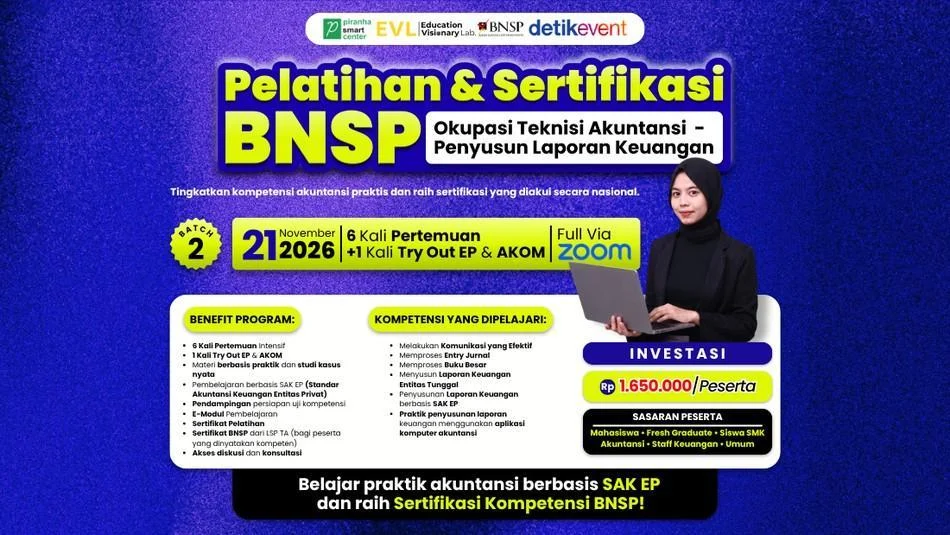
The upcoming Accounting Technician for Financial Report Compilation Batch 2 program is designed to transform novices into industry-ready professionals. The curriculum is meticulously crafted to cover the fundamental pillars of accounting, including the implementation of the Indonesian Financial Accounting Standards for Private Entities (SAK EP) and the transition from the previous Indonesian Financial Accounting Standards for Entities Without Public Accountability (SAK ETAP).
The inclusion of these standards is not arbitrary. As the regulatory landscape shifts, professionals must remain agile. The program emphasizes the practical application of these standards, ensuring that participants understand not just the "how," but the "why" behind every entry. This conceptual depth is complemented by the integration of modern technology. Participants will gain hands-on experience with Accurate Online, a leading cloud-based accounting software that has become a staple in the Indonesian business ecosystem. By mastering such tools, students move beyond pen-and-paper accounting and enter the realm of digital financial management, which is essential for remote work environments and automated reporting.
A Chronological Roadmap to Competency
The training program follows a phased approach to ensure that knowledge is retained and applied effectively. The structure is built as follows:
- Phase I: Foundational Theory. During the initial weeks, participants delve into the conceptual framework of accounting. This includes the identification of transaction types and the classification of assets, liabilities, and equity.
- Phase II: Technical Application. This phase introduces software integration. Using Accurate Online, participants learn how to migrate manual data into digital formats, perform bank reconciliations, and generate trial balances.
- Phase III: Regulatory Compliance. Here, the focus shifts to SAK EP and SAK ETAP. Participants learn how to format financial statements—such as the Statement of Financial Position, Statement of Profit or Loss, and Statement of Cash Flows—to meet legal and professional standards.
- Phase IV: Assessment Preparation. The final leg of the journey is dedicated to simulations. Through try-outs and expert-led consultations, participants identify their weaknesses and refine their speed and accuracy in preparation for the official certification exam.
Industry Implications and the BNSP Certification
A significant highlight of this program is its alignment with the National Professional Certification Agency (BNSP). In Indonesia, a BNSP-accredited certificate serves as a gold standard for technical competence. It provides prospective employers with a verifiable guarantee that the candidate possesses the required skills to handle sensitive financial tasks without direct supervision.
Industry analysts suggest that professionals holding recognized certifications enjoy a competitive advantage in salary negotiations and career progression. As automation threatens to replace low-skill data entry roles, the role of an "Accounting Technician" is evolving into that of a "Financial Analyst assistant." Employers are no longer looking for people who can just count; they are looking for professionals who can interpret the story behind the numbers. This program aims to cultivate that analytical mindset.
Perspectives on Financial Professionalism
While the program provides the technical tools, the ultimate goal is to instill a culture of integrity. "Accuracy in financial reporting is not just about avoiding errors; it is about transparency," says a representative close to the development of the training curriculum. "When an accounting technician understands the flow of data from a simple receipt to a balance sheet, they become a vital control point for the company’s internal governance."
Furthermore, the program’s emphasis on consultation and mentoring reflects a broader shift in adult education. Traditional learning models are often too passive. By incorporating "lembar kerja praktik" (practical worksheets) and personalized feedback loops, the organizers have ensured that the learning curve is supported by real-time correction, significantly reducing the likelihood of recurring errors in the field.
Broader Economic Impacts
The ripple effects of standardized financial reporting are felt throughout the economy. When businesses operate with high-quality financial statements, the overall quality of the business environment improves. Investors gain confidence, creditors provide better terms, and the government can collect taxes more efficiently.
For the individual, completing this certification program is a strategic investment in human capital. As the gig economy continues to expand, many accountants are choosing to work as independent consultants for multiple SMEs. Having a certified skill set allows these freelancers to command higher fees and provide a wider range of services, including audit preparation and tax planning.
Looking Ahead: Enrollment and Participation
For those looking to secure a place in the current labor market, the Accounting Technician for Financial Report Compilation Batch 2 represents a timely opportunity. The training is not merely a course; it is an entry point into a professional community that values precision, ethics, and technological literacy.
As businesses continue to navigate the post-pandemic economic landscape, the need for robust financial record-keeping will only intensify. Those who prepare today by acquiring recognized credentials will be the ones leading the financial departments of tomorrow. Interested candidates are encouraged to review the full syllabus, understand the assessment criteria, and register via official channels at detikevent.com.
In conclusion, the intersection of technological mastery and regulatory knowledge is the sweet spot for the modern accounting professional. Whether you are a fresh graduate looking to gain your first foothold in the corporate world or a professional seeking to validate your experience with a formal certificate, the structured approach offered by this program provides the necessary framework to succeed in the rigorous field of financial reporting. The path to professional excellence is paved with constant learning, and this batch offers the exact environment required to master the essential craft of accounting.