The catastrophic crash of a private jet in Palm Beach County, Florida, has sent shockwaves through the aviation community and left grief-stricken families searching for answers following a disaster that claimed nine lives. The tragedy, which unfolded on Sunday afternoon, November 1, 2026, involved a Learjet 60 traveling from Austin, Texas, bound for the Bahamas. What began as a routine cross-country flight quickly escalated into an unprecedented airborne crisis marked by severe weather phenomena, frantic mayday calls, and a harrowing final descent that witnesses described as resembling a falling ballistic missile.
As federal investigators comb through the charred wreckage and analyze recovered flight data recorders, emerging details have cast a spotlight on the final moments of the flight. Chief among these harrowing disclosures is the voice of the young co-pilot, 20-year-old Nathalia Gadelha Filgueiras, whose life and promising aviation career were tragically cut short alongside the other occupants on board. The incident has not only prompted rigorous investigations by federal transportation safety boards but has also reignited vital conversations regarding aviation safety protocols during severe atmospheric icing conditions and the immense pressures faced by commercial flight crews.
Chronology of a Disaster: From Routine Flight to Fatal Plunge
Flight operations for the Learjet 60 appeared standard as it departed from Austin, Texas, carrying a total of nine individuals toward its international destination in the Bahamas. However, as the aircraft approached airspace governed by the Miami Air Route Traffic Control Center over the skies of Florida, atmospheric conditions deteriorated rapidly. Meteorological data and subsequent air traffic control communications revealed that the jet encountered extreme sub-zero temperatures, dropping to an outside ambient temperature of minus 47 degrees Celsius.
Minutes before the catastrophic loss of control, the flight crew initiated contact with air traffic control to report mounting environmental hazards. According to transcripts obtained from aviation monitoring networks, the pilot initially communicated that the aircraft was dealing with manageable levels of structural icing and moderate turbulence. The turbulence caused the aircraft to buffet and oscillate by approximately 700 feet.
The situation escalated exponentially within a matter of seconds. The pilot requested clearance from air traffic controllers to alter the aircraft’s altitude to escape the adverse weather band. Before the maneuver could be effectively executed, the physical dynamics of the aircraft deteriorated catastrophically. The accumulation of ice severely disrupted the aerodynamics of the wings and control surfaces, triggering an uncommanded and violent descent.
Transcripts captured the rising panic in the cockpit as the aircraft began plunging at an initial rate of 8,000 feet per minute. Moments later, the pilot’s voice transmitted the urgent distress signal: "Mayday, mayday, we are experiencing a descent of 10,000 feet per minute." The situation worsened further into an overspeed condition as the aircraft entered a near-vertical dive. The final transmission from the cockpit indicated a catastrophic plunge exceeding 20,000 feet per minute before communication was abruptly severed, concluding with the grim realization: "We are going down into the ground."
The Crash Site and Immediate Emergency Response
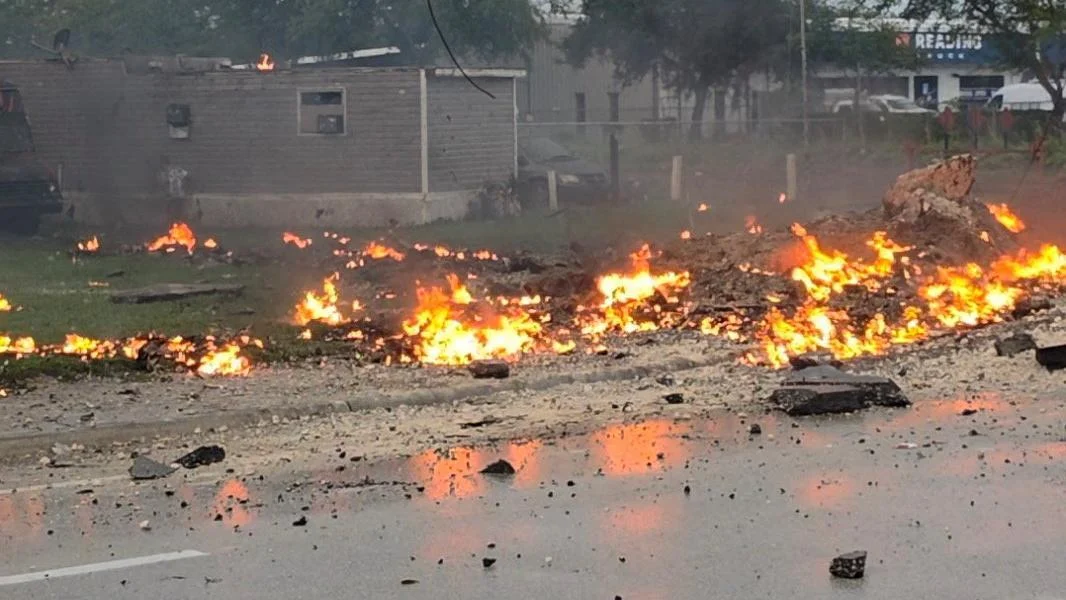
Ground witnesses described the impact as utterly devastating. Security cameras and mobile phone footage captured the Learjet 60 as it descended steeply from the overcast skies, impacting an open area near a public roadway in Palm Beach County, Florida. The collision generated a massive explosion, sending towering plumes of thick black smoke into the atmosphere and scattering burning debris across the asphalt and surrounding vegetation.
The force of the impact created a substantial crater in the ground, emphasizing the tremendous velocity at which the aircraft struck the earth. Remarkably, despite the proximity of the crash site to residential neighborhoods and bustling vehicular traffic, no injuries or fatalities were reported on the ground. First responders, including local fire rescue units and hazardous materials teams, rushed to the scene to extinguish the intense fires fueled by aviation jet fuel.
Florida Governor Ron DeSantis visited the crash site alongside local emergency officials to assess the damage firsthand. Addressing reporters at the scene, Governor DeSantis characterized the incident as an extraordinarily severe aviation disaster. He noted that the trajectory and velocity of the aircraft resembled a missile strike, leaving a deep crater in its wake and underscoring the miraculous fortune that no civilian structures in the immediate vicinity were directly struck.
A Portrait of the Crew: Remembering Co-Pilot Nathalia Gadelha Filgueiras
Amid the debris and the technical investigations, the human cost of the tragedy has come into sharp focus through the heartbreaking accounts of grieving families. The co-pilot of the ill-fated Learjet 60 has been officially identified as Nathalia Gadelha Filgueiras. At just 20 years old, Filgueiras represented a rising generation of aviation professionals, having achieved the remarkable milestone of earning her pilot’s license while still a high school student.
Speaking from her home in Palm Beach County, the young co-pilot’s mother, Camila, shared agonizing memories of her daughter. She revealed that Filgueiras, who would have celebrated her twenty-first birthday in January, had been working professionally as a commercial pilot for nine months. Despite her deep apprehension regarding the inherent risks of the aviation industry, Camila expressed immense pride in her daughter’s dedication to her lifelong passion.
"I wanted her to fulfill her dream, but I knew that dream was ultimately what would take her away from me," Camila stated through tears. "I knew aviation would take her from me; I was always aware of it. But I am so proud of her, and I know she was living her dream."
Adding to the poignant timeline of the flight’s final moments, Camila’s husband, Thiago Corteleti, disclosed that Filgueiras maintained communication with her loved ones almost until the end. Exactly ten minutes before the fatal crash, Filgueiras sent a final text message to her partner, Justin, succinctly describing the unfolding peril inside the cockpit: "There is turbulence, there is ice."
Family members confirmed that despite her young age, Filgueiras had accumulated an impressive 1,300 hours of flight experience, reflecting a level of maturity, training, and commitment that earned her a respected place in the cockpit of a complex twin-engine jet.
Regulatory Investigations and Safety Implications
In the wake of the disaster, federal transportation and aviation authorities, including the National Transportation Safety Board (NTSB) and the Federal Aviation Administration (FAA), launched a comprehensive investigation to determine the precise sequence of mechanical, environmental, and human factors that led to the crash.
Primary areas of focus for investigators include the efficacy of the aircraft’s anti-icing systems, the meteorological accuracy of forecasts regarding high-altitude freezing precipitation, and the performance characteristics of the Learjet 60 under severe overspeed descent conditions. Aviation safety experts note that high-altitude structural icing remains one of the most insidious hazards in aviation, capable of altering airflow dynamics over aircraft wings within minutes and leading to sudden aerodynamic stalls or uncontrollable loss of pitch authority.
Furthermore, the incident has renewed industry-wide discussions regarding pilot training standards for recognizing and recovering from unusual attitudes induced by extreme weather phenomena. While modern commercial aircraft are equipped with sophisticated avionics and environmental control systems, sudden localized micro-climates and rapid ice accumulation can overwhelm both human reflexes and automated recovery systems, particularly when compounded by structural turbulence.
Broader Impact on the Private Aviation Sector
The tragic loss of the Learjet 60 and its nine occupants reverberates far beyond the local community of Palm Beach County, serving as a sobering reminder of the unforgiving nature of flight operations. As the NTSB continues its meticulous recovery of engine components, avionics data, and cockpit voice recordings, the findings are expected to yield critical safety recommendations for the broader private and commercial aviation sectors.
For the families of the victims, particularly the relatives of young aviators like Nathalia Gadelha Filgueiras, the focus now shifts toward honoring the memories of those lost while demanding transparency and rigorous safety enhancements to prevent similar tragedies in the future. As aviation authorities pore over every second of the flight’s final transmission, the chilling echo of the cockpit’s mayday call remains a haunting testament to the ultimate price paid in the relentless pursuit of the skies.