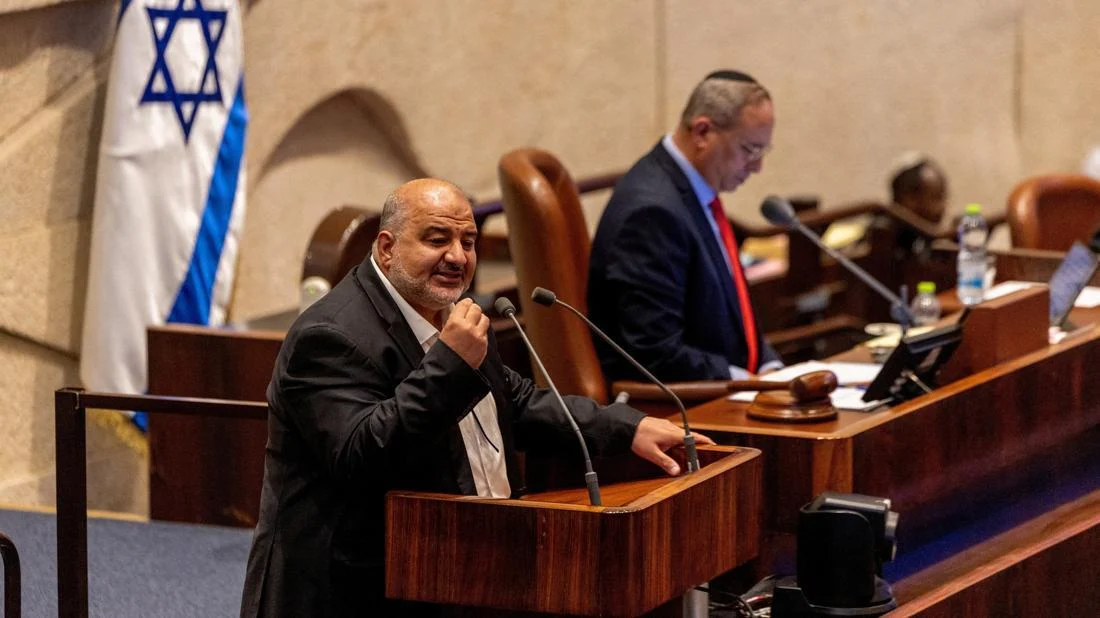
Tel Aviv — In a pivotal political development that could dramatically reshape the landscape of the Israeli parliament, Mansour Abbas, leader of the Arab-Israeli United Arab List—widely known as Ra’am—has formally signaled his ambition to forge a coalition with the nation’s political opposition. Speaking to Israel’s Channel 12, Abbas articulated a clear strategic objective: to unseat long-serving Prime Minister Benjamin Netanyahu by engineering a blocking majority within the Knesset, the Israeli parliament.
The political maneuvering comes in the wake of preliminary election results that have revealed a deeply fractured legislative body. As Israel navigates yet another electoral cycle defined by intense polarization, the role of Arab-Israeli parties has transitioned from the political margins to the absolute center of gravity. With neither major political bloc securing a decisive mandate to govern independently, the arithmetic of the Knesset places unprecedented power in the hands of leaders like Abbas, whose parliamentary faction could ultimately decide who occupies the prime minister’s office.
The Parliamentary Arithmetic and Preliminary Election Results
The core of Abbas’s strategy relies on achieving the magic number of 61 seats, the threshold required to form a governing majority in the 120-seat Knesset. According to preliminary data released by the Israeli Central Election Commission, the political map remains stubbornly deadlocked, reflecting a nation politically split down the middle.
With approximately 41.9 percent of the total ballots processed and tallied, the initial projections highlight the precarious position of incumbent Prime Minister Benjamin Netanyahu. The coalition of right-wing and religious parties loyal to Netanyahu has secured a provisional 57 seats. While this places the incumbent bloc ahead of its immediate rivals, it falls four crucial seats short of the 61-seat threshold needed to form a stable government.
Conversely, the disparate factions making up the anti-Netanyahu opposition bloc have captured 47 seats in the early counts. Standing firmly between these two traditional camps are the Arab-Israeli parties, including Ra’am, which have collectively garnered a formidable 16 seats. It is this bloc of 16 seats that Abbas believes can serve as the ultimate kingmaker, bridging the gap for the opposition and pushing them across the majority line.
"I hope that we can change this government and that the number of seats collected reaches 61 seats, namely from the opposition block together with Ra’am," Abbas stated during his interview with Channel 12. Emphasizing the leverage held by his party, he added, "With the number of seats that we have at this moment, no government can be formed."
Background Context: The Evolution of Arab-Israeli Political Engagement
To fully understand the weight of Mansour Abbas’s current strategy, one must examine the profound evolution of Arab-Israeli political participation over recent years. Historically, Arab political parties in Israel operated largely as perpetual opposition figures, choosing to remain outside the Zionist consensus and refusing to participate directly in government coalitions. Many Arab citizens and politicians viewed the state through a lens of systemic alienation, prioritizing advocacy for minority civil rights, land planning issues, and the resolution of the Israeli-Palestinian conflict from the sidelines of the Knesset.
However, under Abbas’s pragmatic leadership, Ra’am charted a radically different course ahead of previous election cycles. Breaking decades of political taboo, Abbas argued that tangible improvements for the Arab-Israeli minority—such as combating rampant crime in Arab towns, improving infrastructure, and securing state funding—could only be achieved by directly engaging with executive power rather than maintaining permanent opposition status.
This pragmatism culminated when Ra’am historically joined the "change government" coalition led by Naftali Bennett and Yair Lapid in 2021. Although that coalition eventually fractured, it permanently altered the Israeli political playbook. It proved that Arab parties could act as legitimate partners in governance. Abbas’s current bid to join an anti-Netanyahu coalition is a continuation of this strategic pragmatism, leveraging community mobilization to assert direct influence over national leadership.
Voter Turnout and Grassroots Frustration
Abbas attributed the robust performance of Arab parties in the current election to a surge in civic participation driven by a mixture of urgency and aspiration. For years, voter apathy plagued Arab-Israeli communities, fueled by frustration over discriminatory policies, socioeconomic neglect, and legislative measures such as the controversial Nation-State Law.
However, the political climate has shifted. Abbas noted that the high turnout among Arab voters reflects a transformation of widespread despair and frustration into a galvanized political hope. By casting their ballots in substantial numbers, Arab citizens have weaponized the democratic process to safeguard their collective interests and actively participate in determining the nation’s executive leadership.
The 16 seats secured by the Arab factions represent a powerful mandate from a constituency demanding representation, security, and equal citizenship. For Abbas, this electoral mobilization is not merely a symbolic victory; it is the raw political capital required to negotiate terms with mainstream Jewish-Israeli opposition parties that have historically kept their distance.
Navigating Political Resistance from the Opposition
Despite the mathematical necessity of an alliance with Ra’am, forming a unified front against Netanyahu remains fraught with logistical and ideological hurdles. Prominent figures within the anti-Netanyahu opposition—including former Prime Minister Naftali Bennett and former Defense Minister Avigdor Lieberman—have historically maintained hardline stances regarding political cooperation with Arab parties. Their voter bases, drawn largely from center-right and nationalist demographics, have often balked at the prospect of relying on Arab lawmakers to form a government.
When questioned about this resistance during his Channel 12 appearance, Abbas adopted a measured and diplomatic tone. He suggested that ideological friction and initial public rejections from opposition leaders should be set aside until the final, certified election results are officially announced. Abbas indicated that mature political negotiations must supersede campaign rhetoric once the full scope of the parliamentary math becomes undeniable.
"We will discuss these matters after the elections," Abbas remarked, implying that the raw necessity of ousting Netanyahu will ultimately compel opposition leaders to overcome their hesitations and engage in pragmatic coalition-building.
Fact-Based Analysis of Implications
The unfolding political drama carries profound implications for the domestic stability and diplomatic trajectory of Israel.
- Domestic Governance and Legislative Paralysis: If Netanyahu fails to secure 61 seats and the opposition proves incapable of bridging ideological divides to partner with Arab factions, Israel risks plunging deeper into a protracted constitutional and political crisis. This could potentially trigger an unprecedented fifth or sixth consecutive election cycle within a compressed timeframe, eroding public trust in democratic institutions.
- The Normalization of Arab Integration: Should Abbas successfully negotiate a coalition partnership with the opposition, it would further normalize the role of Arab-Israeli parties as indispensable actors in national governance. This precedent would permanently alter coalition politics in Israel, making the total exclusion of Arab parties from future governments increasingly difficult to sustain.
- Policy Shifts and Minority Welfare: A government reliant on Ra’am’s support would likely be pressured to deliver significant socioeconomic investments to the Arab-Israeli sector, particularly concerning law enforcement in Arab towns, housing developments, and budget allocations. However, it would also face intense internal ideological pressure regarding the broader Israeli-Palestinian conflict, as a coalition containing both left-of-center Zionists and Arab nationalists would inherently navigate volatile diplomatic terrain.
As the Central Election Commission continues the meticulous process of counting remaining ballots, all eyes remain fixed on Tel Aviv and Jerusalem. The final tally will not merely determine the allocation of parliamentary seats; it will test the limits of political pragmatism in a deeply divided democracy and decide whether Mansour Abbas can successfully broker the historic alliance that finally brings an end to the Netanyahu era.