The landscape of global transportation infrastructure is undergoing a historic transformation, with railway development standing out as one of the most capital-intensive and strategically vital sectors for modern nation-states. Building and maintaining an advanced rail network requires staggering financial commitments, creating a widening chasm between the world’s leading spenders and the rest of the international community. Comprehensive comparative data compiled by the International Transport Forum (ITF), an intergovernmental organization operating under the auspices of the Organisation for Economic Co-operation and Development (OECD), provides a revealing window into these massive capital outlays. Through periodic surveys of gross infrastructure investment—which encompasses new construction, network expansions, major reconstructions, renewals, and large-scale repairs—the ITF data highlights a singular global titan that outspends its peers by astronomical margins.
At the heart of this global disparity is the People’s Republic of China, a nation that has systematically prioritized rail as the backbone of its economic connectivity, urbanization, and industrial policy. While traditional economic powers allocate substantial sums to maintain aging transit systems, China’s financial mobilization for rail infrastructure represents a scale of state-directed investment previously unseen in modern history. According to comparative ITF metrics evaluated in recent peer-reviewed transport studies, China’s financial footprint dwarfs that of any other industrialized nation, fundamentally reshaping international benchmarks for mass transit and high-speed rail engineering.
The Global Financial Hierarchy of Railway Investment
When examining cross-border investments in railway infrastructure, the quantitative gap between the top-tier spenders and the rest of the world is immense. Data analyzed from international transport reviews outlines a distinct hierarchy among major global economies. Based on comprehensive gross investment metrics, the top five economies leading the charge in absolute financial allocation for rail networks comprise China, Japan, the United Kingdom, France, and Germany.
In the baseline comparative datasets evaluated by transport economists, China leads the global cohort with an overwhelming financial commitment. To contextualize the scale, China’s expenditure in a single calendar year frequently surpasses the combined totals of multiple developed Western nations. For instance, while nations such as Japan, the UK, France, and Germany maintain robust and technologically advanced rail networks, their collective annual investments pale in comparison to the single-handed capital deployment executed by Beijing. Other major economies, including India, Italy, and the United States, frequently utilize differing budgetary accounting frameworks and methodologies. Consequently, their national expenditures are often evaluated independently using localized national updates rather than standardized OECD-ITF metrics, yet they reinforce the reality that rail modernization is a multi-billion-dollar global priority.
China’s Unprecedented Capital Allocation and Network Expansion
The sheer volume of capital directed by Beijing toward its railway sector serves as a cornerstone of its broader macroeconomic strategy. In the foundational comparative studies provided by the ITF, China’s investment in railway infrastructure reached an astonishing €92.5 billion in 2021. To understand the magnitude of this figure, it is helpful to look at the combined spending of four major developed nations during the same period: Japan recorded approximately €17.0 billion, the United Kingdom allocated €13.3 billion, France spent €11.5 billion, and Germany accounted for €10.1 billion. Combined, these four advanced economies spent roughly €51.9 billion—barely more than half of China’s single-year outlay.
This level of expenditure is not an isolated anomaly but part of a sustained, multi-decade infrastructural campaign. Historical ITF records indicate that in 2018, China accounted for an extraordinary 52 percent of the total combined rail infrastructure investment across 42 surveyed nations. Furthermore, structural economic analyses demonstrate the immense priority placed on rail within China’s domestic budget; ITF calculations from 2020 revealed that the rail sector alone captured 15 percent of total combined infrastructure spending allocated toward both roads and railways nationwide.
Official domestic data released by the China State Railway Group illustrates an even more aggressive trajectory of capital deployment in subsequent years. In 2025, the state-owned enterprise reported fixed-asset investments in railways reaching a historic milestone of 901.5 billion yuan, translating to approximately USD 128.9 billion. This represented a substantial 6 percent year-on-year increase, setting an all-time record for annual railway capital injection.
Chronology of Modernization: The 2021–2025 Five-Year Leap
The financial commitments executed by Beijing materialized into massive physical network expansions, particularly during the 14th Five-Year Plan period covering 2021 through 2025. This era marked a transformative phase in the operational capacity and geographical reach of China’s domestic transport grid.
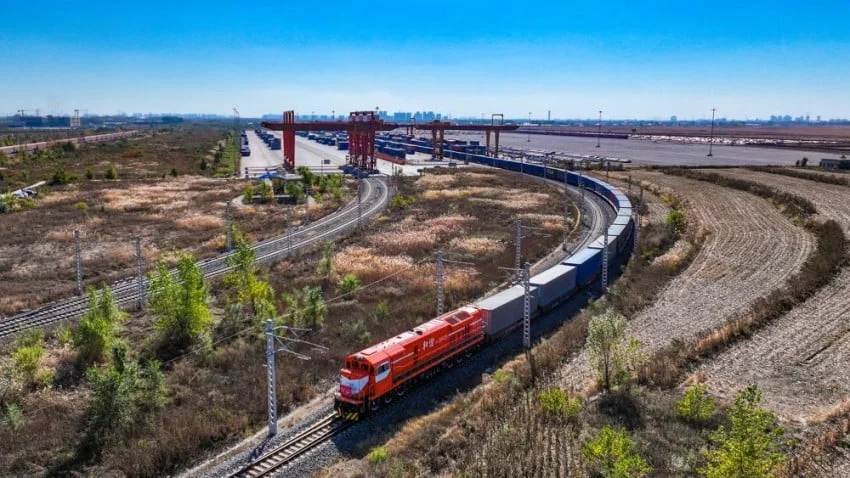
During this critical five-year window, the total operational length of China’s railway network expanded dramatically from 146,300 kilometers at the start of 2021 to an expansive 165,000 kilometers by the close of 2025. More notably, the expansion of high-speed rail (HSR)—the crown jewel of modern Chinese industrial engineering—accelerated at an unprecedented pace. The total length of operational high-speed rail lines surged from 37,900 kilometers to an unprecedented 50,400 kilometers over the same five-year span. This solidified China’s status as the undisputed operator of the world’s largest and most technologically integrated high-speed rail network, connecting remote interior provinces with major coastal mega-regions in a matter of hours.
The fruits of these multi-billion-dollar investments were delivered annually. In the single year of 2025 alone, newly operational railway lines totaled 3,109 kilometers, of which an overwhelming 2,862 kilometers were dedicated high-speed corridors. As the network reached high levels of national saturation and interconnected maturity, subsequent financial adjustments began to take shape. Entering the fiscal landscape of 2026, the meteoric pace of spending exhibited signs of stabilization. Financial reports from the first three quarters of 2026 recorded total railway investments standing at 601.2 billion yuan (approximately USD 89 billion), marking a more measured year-on-year increase of 1.3 percent as the focus shifted from rapid network construction to system optimization, technological upgrades, and financial sustainability.
Comparative Global Perspectives: How Western and Asian Economies Differ
The stark contrast between China’s railway investment strategy and those of Western economies highlights fundamentally different philosophies regarding public infrastructure, state intervention, and economic stimulus. In Western Europe, nations like Germany, France, and the United Kingdom often face complex regulatory hurdles, dense historical land ownership patterns, lengthy environmental review processes, and constrained public fiscal budgets. Consequently, European investments frequently focus on the decarbonization, modernization, and maintenance of existing Victorian-era or mid-20th-century networks rather than greenfield rapid expansion. Projects such as the UK’s High Speed 2 (HS2) initiative have faced severe budgetary overruns, political friction, and significant scaling back, underscoring the difficulties democratic market economies encounter when executing mega-scale rail projects.
Conversely, Japan maintains a highly efficient, privately and publicly integrated high-speed rail ecosystem centered around the legendary Shinkansen network. Although Japan’s annual investments—hovering around €17 billion—are vastly smaller than China’s in absolute financial terms, Japanese railway engineering remains a global pioneer in punctuality, safety, and technological innovation. Japan’s spending is primarily directed toward network renewal, seismic retrofitting, and the continuous development of next-generation magnetic levitation (maglev) lines, such as the ongoing Chuo Shinkansen project.
Meanwhile, the United States presents a contrasting paradigm where passenger rail has historically taken a back seat to automotive and aviation infrastructure. While the bipartisan Infrastructure Investment and Jobs Act injected historic funding into Amtrak and intercity passenger rail corridors, total U.S. investment figures remain distributed across complex federal, state, and private jurisdictions, lacking the unified centralized momentum seen in East Asian development models.
Socioeconomic Implications and Strategic Outcomes
The broader implications of China’s massive capital injection into rail infrastructure extend far beyond simple passenger convenience. Economists and transport analysts point out that heavy state investment in high-speed rail serves as a powerful macroeconomic stabilizer, driving domestic demand for steel, cement, advanced electronics, and heavy machinery while generating millions of direct and indirect engineering and construction jobs.
Furthermore, the expansion of high-speed rail has catalyzed regional economic integration on a monumental scale. By linking secondary and tertiary inland cities directly to economic powerhouses like Beijing, Shanghai, Shenzhen, and Guangzhou, the rail network has facilitated the redistribution of capital, talent, and industrial manufacturing. Commuter patterns have shifted profoundly, allowing for the emergence of integrated mega-city clusters where business travel times are reduced from days or hours to mere minutes.
Environmental considerations also play a pivotal role. As global carbon reduction targets become increasingly urgent, the modal shift from carbon-intensive domestic aviation and highway freight to electrified rail transport has positioned China’s railway system as a critical instrument in its national carbon neutrality roadmap. Electric multiple unit (EMU) high-speed trains powered by an increasingly diversified national grid offer an energy-efficient alternative for mass mobility over vast continental distances.
Future Outlook for Global Rail Development
As global economic headwinds test the fiscal capacities of nations worldwide, the trajectory of international railway investment is poised for critical evaluation. While China moves into a mature phase of network consolidation—exemplified by the moderation of its year-on-year investment growth to a sustainable 1.3 percent in late 2026—its foundational infrastructure remains decades ahead of most global competitors.
For other major economies, the challenge lies in balancing fiscal conservatism with the undeniable long-term economic and environmental benefits of modern rail connectivity. Whether through state-led mega-projects or public-private partnerships, the global standard set by China’s unprecedented multi-billion-euro capital deployment ensures that high-speed rail will remain a defining metric of national modernization throughout the twenty-first century.