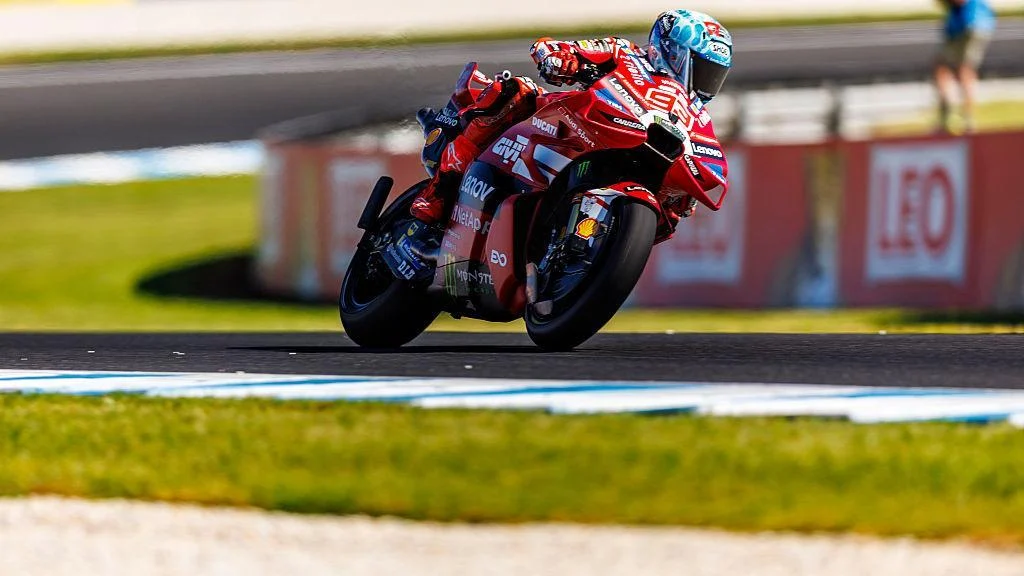
The 2026 MotoGP World Championship season has delivered yet another masterclass in tactical and raw racing prowess as Marco Bezzecchi seized the pole position for the Qatar Grand Prix at the Lusail International Circuit. The Italian rider, widely recognized as one of the standout proteges of Valentino Rossi’s VR46 Riders Academy, showcased blistering pace under the floodlights. Bezzecchi not only topped the time sheets but also shattered the previous circuit benchmark, leaving a competitive field of premier class veterans and rising stars in his wake. In a gripping qualifying session characterized by early drama, intense tactical adjustments, and razor-thin margins, Bezzecchi managed to outpace seasoned multi-world champion Marc Marquez, securing a vital psychological and strategic advantage ahead of the weekend’s races.
The high-stakes qualifying hour set the stage for an explosive weekend of motorcycle racing. As the premier class gathered in the Qatari desert, teams and riders faced the unique challenges posed by the Lusail International Circuit, a venue famous for its flowing layout, abrasive asphalt, and the distinct atmospheric shifts brought on by racing under artificial illumination at night. With the 2026 season reaching a critical juncture, every thousandth of a second in qualifying carried immense weight, dictating grid placement for both the Saturday afternoon sprint race and Sunday’s Grand Prix main event.
Chronology of the Qualifying Session
The battle for pole position was immediate and unforgiving, offering virtually no margin for error. Drama struck the very fabric of the session before it could properly build momentum. Brad Binder, representing the factory-backed KTM outfit, suffered a high-speed crash at one of the circuit’s notoriously tricky corners. The South African rider’s machinery sustained significant damage, ruling him out of the remainder of the session and forcing the Red Bull KTM squad into a frantic damage-control mindset for the rest of the weekend.
Once the marshals cleared the track and official timing got underway, Marc Marquez wasted no time asserting his competitive intent. The Spanish veteran immediately found a rhythm, hustling his machine around the Lusail asphalt to post a formidable benchmark of 1 minute 50.361 seconds. This early flyer instantly catapulted Marquez to the top of the timing monitors, demonstrating the racecraft and speed that have made him a perennial championship threat. Rookie sensation Pedro Acosta, continuing to turn heads in his premier class campaign, slotted himself provisionally into second place, applying immediate pressure on the rest of the grid.
However, Marco Bezzecchi’s response was clinical. Exploiting the maximum performance window of his Aprilia machinery, the Italian rider strung together a flawless sequence of sectors. Bezzecchi shattered Marquez’s provisional marker by clocking an astonishing lap of 1 minute 50.065 seconds, a performance that instantly etched his name into the record books as the new lap record holder for the MotoGP Qatar Grand Prix.
As the frantic 15-minute session ticked past its halfway mark, riders retreated to their respective team garages. In the tightly contested modern era of MotoGP, these pit lane respites are vital windows for crew chiefs and telemetry engineers to analyze tire degradation, adjust electronic mapping, and coordinate track positioning to secure clean air for a final time attack.
With just three minutes remaining on the clock, the tension inside the pit lane reached a boiling point as the entire field poured back onto the circuit. Bezzecchi still held the provisional pole, flanked by Marquez, while Raul Fernandez, Fabio Di Giannantonio, and Pedro Acosta occupied the remaining spots inside the top five.
Refusing to rest on his laurels, Bezzecchi delivered one final, flawless push lap in the dying moments of the session. He squeezed every ounce of performance from his motorcycle to drop the benchmark even further, stopping the clock at 1 minute 50.028 seconds. This exceptional lap completely extinguished any lingering hopes his rivals had of snatching the premier grid slot. While Bezzecchi soared, reigning contenders like Jorge Martin found themselves struggling for grip and balance, ultimately watching their positions slide down the order as the checkered flag fell.
Starting Grid and Comprehensive Results
When the dust settled and the final time sheets were officially locked in, the top tier of the grid showcased a compelling mix of established excellence and rising Italian-Spanish rivalry. Marco Bezzecchi reigned supreme at the top, flanked by Marc Marquez in second and Fabio Di Giannantonio rounding out the front row in third.
The complete qualifying results for the top twelve positions at the Lusail International Circuit highlight the fierce competitiveness of the 2026 grid:
- Marco Bezzecchi (Aprilia Racing) – 1:50.028
- Marc Marquez (Factory Ducati / Gresini) – +0.333
- Fabio Di Giannantonio (VR46 Racing Team) – +0.412
- Raul Fernandez (Trackhouse Racing) – +0.495
- Francesco Bagnaia (Ducati Lenovo Team) – +0.551
- Ai Ogura (Trackhouse Racing / Independent) – +0.620
- Johann Zarco (LCR Honda) – +0.685
- Pedro Acosta (Red Bull KTM Factory Racing) – +0.712
- Fermin Aldeguer (Gresini Racing) – +0.790
- Enea Bastianini (Red Bull KTM Tech3) – +0.810
- Jorge Martin (Aprilia Racing) – +0.945
- Brad Binder (Red Bull KTM Factory Racing) – No Time Recorded (Crash in Q1)
Background Context of the 2026 Qatar Grand Prix
The Lusail International Circuit has long held a prestigious place on the FIM Grand Prix World Championship calendar. Located on the outskirts of Doha, the circuit underwent significant infrastructure modernization in recent years to accommodate both Formula 1 and premier two-wheel racing under optimal conditions. Known for its 5.38-kilometer layout featuring 16 challenging turns and a massive 1.068-kilometer main straight, Lusail places a premium on high-speed stability, precise cornering agility, and immaculate tire conservation.
The 2026 season has introduced new technical regulations and aerodynamic packages, which have compressed the competitive field tighter than ever before. Manufacturer development battles between European heavyweights Ducati, Aprilia, and KTM, alongside traditional Japanese giants, have made every qualifying session a high-stakes chess match. Track temperatures, humidity levels, and the infamous desert dust that periodically coats the racing line present unique engineering hurdles that teams must constantly adapt to.
Strategic Implications and Team Reactions
Securing pole position at Lusail is widely regarded by crew chiefs and riders as one of the most critical achievements of a race weekend. Due to the abrasive nature of the desert tarmac and the heavy reliance on aerodynamic downwash, overtaking in dirty air during a race can severely compromise rear tire life and engine cooling. By locking down the premier grid slot, Marco Bezzecchi has effectively insulated himself from the chaotic midfield jostling that invariably occurs through Turns 1 and 2 during race starts.
Speaking in the post-qualifying media debrief, team representatives and paddock analysts emphasized the monumental significance of Bezzecchi’s performance. Aprilia’s engineering division expressed immense satisfaction with how the motorcycle’s chassis responded to the cooler evening track conditions, noting that continuous telemetry optimization over free practice sessions paid immediate dividends during the time attacks.
Meanwhile, Marc Marquez remained pragmatic yet visibly motivated after securing a front-row start. The multiple world champion acknowledged Bezzecchi’s extraordinary pace, noting that maintaining race rhythm and managing rear tire degradation over the longer distance of Sunday’s Grand Prix will ultimately dictate the race winner. Marquez’s ability to extract maximum performance from his machine despite lingering traffic issues underscores his championship pedigree.
Conversely, the struggles faced by riders such as Jorge Martin and Brad Binder highlight the razor-thin margins of error in modern MotoGP. Martin, who finished down in eleventh position, faces a monumental challenge during the Saturday afternoon sprint race to claw his way into the points-paying positions. Working through a congested midfield requires both aggressive overtaking maneuvers and calculated risk management, raising the stakes for the early laps of the race.
Broader Impact on the 2026 Championship Battle
As the paddock prepares for the lights to go out on the sprint race and the subsequent Grand Prix, the psychological impact of Bezzecchi’s pole position cannot be overstated. With the championship standings remaining fiercely contested, earning vital points in the Saturday sprint while denying direct rivals prime grid placement could reshape the trajectory of the season.
Marco Bezzecchi enters the race weekend not only as a record-breaker but as the definitive target for the rest of the premier class grid. Whether he can convert his blistering single-lap speed into race-winning dominance under the intense pressure of a full-distance Grand Prix remains one of the most anticipated narratives of the 2026 MotoGP season. Fans and racing pundits alike will be watching closely as the red lights prepare to fade at Lusail, signaling the start of what promises to be a legendary battle in the Qatari desert.