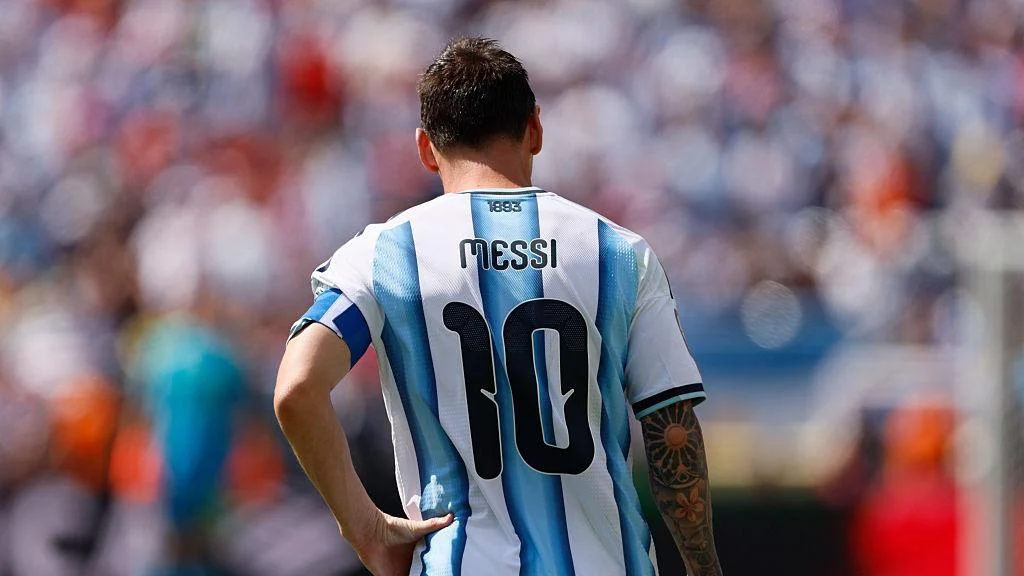
Buenos Aires — The sacred number 10 jersey of the Argentina national football team currently rests in a state of unprecedented limbo. Following the definitive international retirement of Lionel Messi in early October 2026, the Albiceleste have entered a new era, leaving head coach Lionel Scaloni grappling with one of the most significant and delicate decisions in modern football administration: to whom should the most famous jersey in the sport be permanently entrusted?
This high-stakes dilemma materialized on a brisk Saturday morning in November 2026, as the reigning world champions stepped onto the pitch to face their fierce South American rivals, Uruguay. Notably, the iconic number 10 was conspicuously absent from the field. In a tribute to the magnitude of Messi’s legacy and the vacuum left by his departure, the coaching staff opted to leave the jersey vacant for this specific fixture, a gesture that immediately captured the attention of global sports media and ignited intense speculation among fans and analysts alike.
The Weight of the Legacy: Understanding the Cultural Significance of Argentina’s Number 10
To fully comprehend the gravity of Scaloni’s current predicament, one must examine the historical weight carried by the number 10 shirt within Argentine football culture. Far beyond a mere numerical identifier on a player’s back, the number 10 represents the spiritual heartbeat of the Albiceleste. Historically worn by the architects of Argentina’s greatest triumphs, the jersey has been sanctified by legendary figures who defined eras of world football.
Diego Armando Maradona immortalized the number during the 1986 FIFA World Cup in Mexico, single-handedly carrying the nation to glory with performances that remain etched in football folklore. Decades later, Lionel Messi assumed the mantle, transforming the jersey into a symbol of unparalleled consistency, record-breaking goalscoring, and aesthetic brilliance. Under Messi’s stewardship, the number 10 guided Argentina to victory in the 2021 Copa América, the 2022 Finalissima, and the historic 2022 FIFA World Cup in
Qatar, cementing his status as arguably the greatest player in the history of the sport.
When Messi announced his retirement from international competition in October 2026 at the age of 39, the footballing world paused. The transition from the Messi era was always destined to be tumultuous, but the logistical and psychological challenge of reassigning his shirt number emerged as an immediate hurdle for the Argentine Football Association (AFA) and the technical staff.
The FIFA Regulatory Framework Versus Friendly Match Flexibility
The decision to leave the number 10 vacant against Uruguay was made possible strictly by the nature of the fixture. Because the match served as an international friendly, tournament regulations permitted the coaching staff to omit the number entirely from the matchday squad list. In friendly encounters, governing bodies often allow teams flexibility with squad numbering, acknowledging logistical experiments and symbolic gestures.
However, this temporary vacuum cannot be sustained indefinitely. According to the stringent regulations enforced by FIFA and continental confederations such as CONMEBOL, official competitive fixtures—including FIFA World Cup Qualifiers and major tournaments—mandate a strict sequential numbering system. FIFA mandates that a registered matchday squad must wear consecutive numbers ranging from 1 through 23 (or up to 26 in modern expanded tournament formats). Consequently, the Argentine national team cannot permanently "retire" the number 10 in official competitions, a practice generally discouraged by football’s governing bodies to preserve the standard integrity of matchday rosters.
Lionel Scaloni’s Strategic Dilemma and the Desire for Permanence
Speaking to the media ahead of the high-profile clash against Uruguay, Albiceleste head coach Lionel Scaloni addressed the media regarding the vacant jersey, offering candid insight into the internal deliberations of the coaching staff. Scaloni emphasized that while the number was withheld for the friendly fixture, a permanent solution must eventually be found to comply with regulatory standards.
"In this match, we will not be giving it to anyone," Scaloni stated during his pre-match press conference, as reported by World Soccer Talk. "We have not thought about who we will give that number to when it becomes mandatory."
Scaloni underscored his desire to avoid a revolving door of temporary wearers, a scenario that could heap undue psychological pressure on developing players or dilute the symbolic value of the shirt. The coaching staff’s primary objective is to identify a successor whose maturity, technical quality, and psychological resilience align with the historical gravity of the garment.
"We hope that the day we do it, it will be forever, and we do not keep changing it," Scaloni explained. "The idea is to give it to a player who can sustain it."
The Candidates: Evaluating the Frontrunners for the Iconic Shirt
As the AFA and Scaloni’s technical team evaluate potential successors, reports from prominent sports outlets, including ESPN Argentina and insider networks like AlbicelesteTalk, have indicated that the coaching staff has narrowed its focus to two primary candidates representing the bridge to Argentina’s future: Nico Paz and Lautaro Martínez.
Nico Paz: The Rising Maestro
Nico Paz represents the youthful exuberance and technical ingenuity that the Argentine faithful adore. Emerging through the famed youth ranks of Real Madrid and subsequently making waves in European club competition, Paz has consistently showcased the vision, passing range, and composure under pressure that characterize a traditional playmaker. Handing the number 10 to Paz would signal a bold, forward-looking strategy by Scaloni—signaling that the national team is fully investing in a new generation of creative talent capable of dictating matches on the international stage.
However, entrusting such a heavy burden to a young player still establishing his definitive senior status carries inherent risks. The mental fortitude required to withstand the inevitable comparisons to Lionel Messi cannot be underestimated, and the coaching staff must weigh whether Paz is psychologically prepared for the intense scrutiny that accompanies the shirt.
Lautaro Martínez: The Established Leader
Conversely, Lautaro Martínez offers a vastly different profile. As a seasoned veteran, Inter Milan talisman, and a cornerstone of Argentina’s attacking line during their recent tournament triumphs, Martínez commands absolute respect within the dressing room. Having already worn various numbers for the national team—predominantly the number 22—Martínez possesses the maturity, leadership qualities, and proven track record at the elite level that could insulate him from the psychological pressures of the jersey.
While Martínez traditionally operates as an out-and-out central striker rather than a classic number 10 playmaker, modern football tactics have increasingly blurred traditional positional boundaries. Giving the shirt to Martínez would represent a reward for longevity, consistency, and exceptional service to the Albiceleste, providing a stable bridge into the post-Messi era without thrusting an inexperienced prospect into the spotlight.
Broader Implications for the Albiceleste and Global Football
The resolution of Argentina’s number 10 dilemma holds far-reaching implications that extend well beyond squad logistics. Culturally, how the Albiceleste manage the transition away from Messi will set a precedent for how modern football treats its living legends. In an era where commercial branding, player legacy, and national identity intersect more powerfully than ever, the preservation of the number 10’s prestige is paramount for the AFA.
Furthermore, the psychological impact on the eventual chosen player cannot be overstated. History is littered with examples of prodigious talents weighed down by the expectations of historic shirt numbers at both club and international levels. Scaloni’s deliberate caution reflects an acute awareness of this psychological trap. By taking time to deliberate, assess candidate maturity, and consult with senior squad members, the technical staff aims to protect the future of the national team while honoring its storied past.
Conclusion: A New Chapter for World Football’s Most Famous Jersey
As Argentina navigates its first matches of the post-Messi era, the vacant number 10 shirt remains a powerful metaphor for transition. It serves as a daily reminder of the extraordinary heights achieved under Lionel Messi, while simultaneously challenging a new generation of players to rise to the occasion.
Whether Lionel Scaloni ultimately selects the youthful dynamism of Nico Paz or the seasoned leadership of Lautaro Martínez, the decision will mark a defining milestone in contemporary Argentine football history. As official competitive fixtures loom on the horizon and FIFA regulations demand compliance, the world watches eagerly to see who will be entrusted with the most coveted legacy in the global game.